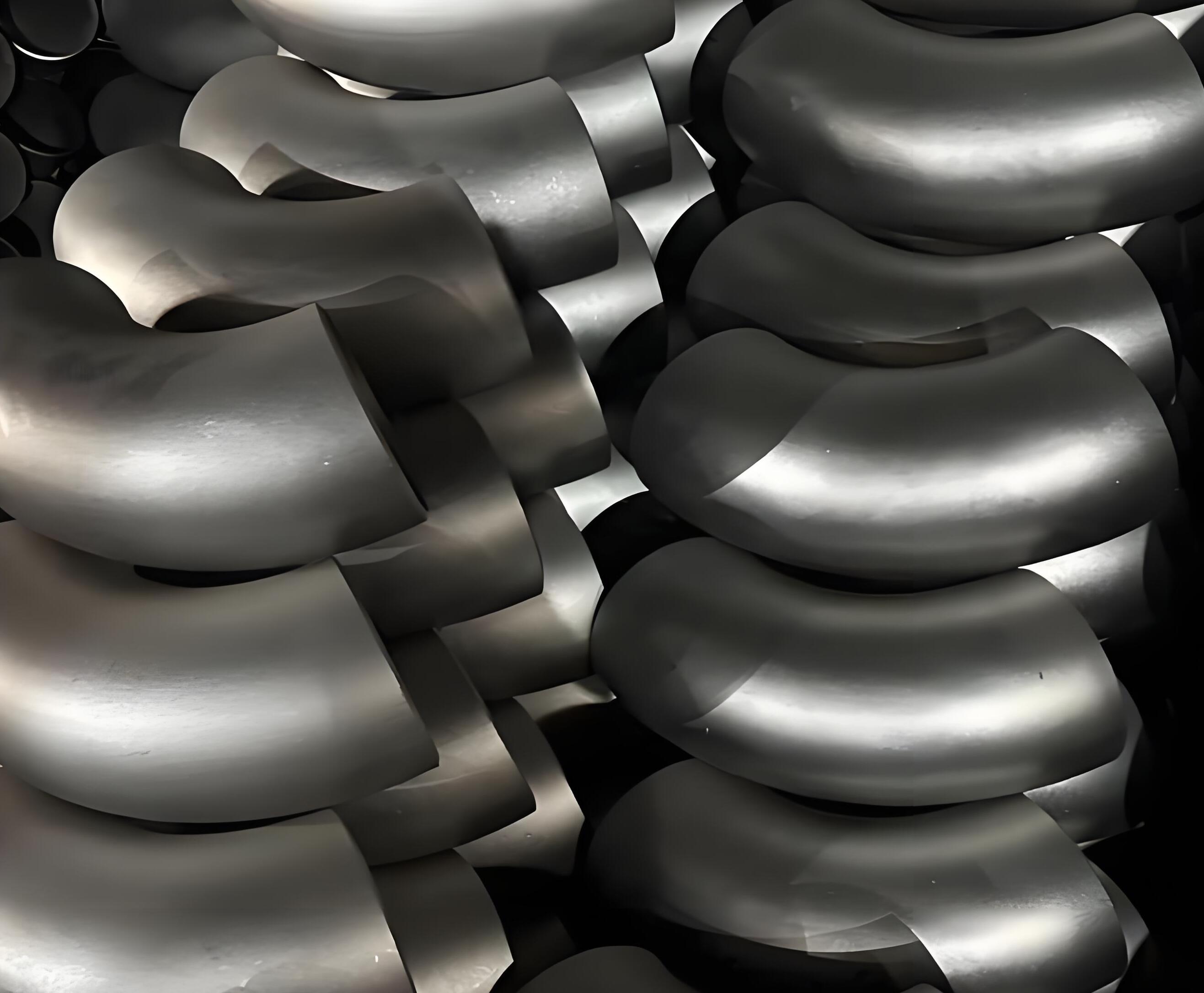
Why is the fluid resistance of a 45° elbow usually less than that of a 90° elbow?
Source of resistance from the change in flow direction
When fluid flows in a pipe, the essence of resistance originates fromthe change in flow direction. The elbow forces the fluid to deviate from a straight path; the more drastic the direction change, the more severe the vortices, secondary flows, and boundary layer separation generated inside the fluid, and the greater the energy loss.
A 90° elbow causes the fluid to complete a 90° turn over a short distance, equivalent to giving the fluid a "sharp turn";whereas a 45° elbow only requires the fluid to deflect by 45°, making the turn gentler, giving the fluid more distance to gradually adjust its velocity distribution, resulting in smaller vortex regions and thus significantly lower resistance.
Specifically in terms of values, although it cannot be generalized (the resistance coefficient is affected by multiple factors such as the elbow's curvature radius, pipe diameter, wall thickness, medium flow velocity, and Reynolds number), in engineering experience,The resistance of a single 45° elbow is typically about 40%–60% of that of a 90° elbow of the same size.That is, when two 45° elbows are combined to achieve a 90° turn, the total resistance is often still lower than that of a single 90° elbow—this is one reason why many pipeline designs prefer a "double 45°" over a 90° elbow.
Energy-saving potential of 45° elbows in pumping systems and long-distance pipelines
The impact of resistance differences on pumping energy consumption is amplified in long-distance pipelines and high-flow systems. The energy consumption of a pump is proportional to the total pressure drop in the pipeline, which is composed of frictional resistance along the pipe and local resistance (elbows, valves, tees, etc.). In piping systems with a large number of elbows, local resistance can account for 20%–40% of the total, making the choice of elbow type a significant factor in energy consumption.
Scenarios where 45° elbows are preferred:
- Long-distance transmission pipelines with many elbows, where cumulative pressure drop is considerable.
- In pumping systems, pressure drop directly affects pump head selection and operating electricity costs.
- For process pipelines sensitive to pressure loss, such as systems that need to maintain a stable outlet pressure.
- When pipelines need to route around equipment or building structures, use 45° elbows to achieve a smooth transition.
Scenarios where 45° elbows are not necessarily required:
- When the pipeline is very short and the number of elbows is small (e.g., near equipment inlet/outlet), the resistance difference has minimal impact on total pressure drop.
- When space is extremely limited and 45° elbows cannot meet the piping angle requirements.
- When 90° elbows with a large radius (LR, long radius) are used, their resistance is already significantly lower than that of short-radius 90° elbows; in this case, whether to switch to 45° requires comprehensive judgment.
It should be noted that the above are general engineering guidelines. Actual pressure drop calculation requires hydraulic calculation combining specific pipe diameter, medium, flow rate, and elbow curvature radius. If you have a pipeline layout diagram or pumping parameters on hand, you can provide the pipe diameter, medium, flow rate, and number of elbows to the Guojie team. We will help you confirm whether the energy-saving effect of the 45° elbow solution in your system is worth adjusting the piping layout.
In which scenarios should 45° elbows be prioritized?In which scenarios are they not recommended?
Petrochemical, plant piping networks, and buried pipelines: typical application scenarios for 45° elbows
The core value of a 45° elbow lies in its 'gentle turning'. Unlike a 90° elbow, which causes a sharp change in the direction of the medium flow, it changes direction at a smaller angle, thereby reducing local resistance, vortex flow, and erosion. In the following scenarios, this characteristic directly translates into operational benefits:
- Petrochemical process pipelines: The media are often high-temperature, high-pressure, or corrosive, with high flow velocities.45° elbows can reduce local resistance caused by abrupt flow direction changes, lower pumping energy consumption, and reduce erosion wear on the back of the elbow caused by the media.For continuously operating units, this difference can accumulate into a significant energy consumption gap.
- Plant pipeline network renovation and new construction: When pipelines need to bypass equipment foundations, building columns, or existing pipe racks, combining two 45° elbows can achieve a smoother "S"-shaped detour than a single 90° elbow, meeting avoidance requirements without causing excessive local pressure drop.Especially in old pipeline renovation, the original pipe space is often limited, and 45° elbows are easier to complete turns within existing support spacing.
- Buried pipelines: Buried pipelines are constrained by the depth of cover and the width of the excavation. A 45° elbow allows the direction to be adjusted within a shorter pushing distance, and because the bending radius is gentler, the pipe experiences more uniform stress after backfilling, reducing stress concentration at the elbow.
- : Connections at the inlet and outlet of equipment units: The inlet and outlet of pumps, compressors, and other equipment typically have strict allowable thrust limits.: The reaction force generated by a 45° elbow is smaller than that of a 90° elbow, resulting in less additional stress on the equipment connections, which helps protect the operational stability of the unit.
: Criteria for prioritizing the selection of a 45° elbow: The pipeline needs to change direction, but the turning angle does not need to reach 90°;: Or, although the total turn is close to 90°, it can be completed in two segments using two 45° elbows to reduce single-point resistance. : At the same time, the higher the pressure rating of the pipeline and the faster the medium flow rate, the more worthwhile it is to prioritize the 45° solution.
When space is extremely limited or a 90° sharp turn is required: it is not recommended to force the use of a 45° elbow.
A 45° elbow is not a universal solution. In the following situations, forcing its use will instead increase cost and construction difficulty:
- Insufficient space length: The straight pipe section required for a 45° elbow to complete the turn is longer than that for a 90° elbow.If the pipeline has only a short straight distance before and after the turning point, forcing a 45° elbow will lead to the need for additional short pipes or adjustment of support positions, which is not worth the cost.
- Must make a 90° sharp turn: When the process requires the pipeline to complete a right-angle turn in a compact space (such as in equipment-dense areas or crossing between pipe rack levels), a single 90° elbow or a short-radius 90° elbow is a more direct choice.At this point, using two 45° elbows in combination, although the resistance is smaller, takes up more space and adds two more weld joints, increasing the risk of leakage and construction time.
- Overhead pipelines with limited support spacing: If the support spacing on the pipe rack is already fixed, the longer developed length brought by 45° elbows may cause the unsupported sections on both sides of the elbows to exceed the allowable span, requiring additional supports, which actually increases costs.
Key trade-off: The advantage of 45° elbows is "energy saving," but the cost is "space occupation." When space is ample and energy consumption is a concern, choose 45°;When space is tight and construction schedule is a priority, directly choosing 90° elbows is more practical. If the space is somewhere in between, you can provide the pipeline routing diagram, pipe diameter, and pressure rating to the Guojie team to confirm whether two 45° elbows can replace a single 90° elbow, and whether the supports need to be adjusted.
How to choose between long-radius and short-radius 45° elbows?How should materials and standards match the working conditions?
LR long radius vs. SR short radius: a trade-off between space and resistance
A 45° elbow inherently has less fluid resistance than a 90° elbow, but the difference between LR and SR still affects piping design and energy consumption.
LR long radius (R=1.5D) is the conventional first choice. Its larger bending radius makes the change in medium flow direction gentler, resulting in a lower local resistance coefficient and less erosion on the pipe. In applications sensitive to pressure loss, such as pump outlets and compressor piping, LR is the more prudent option.
Guojie 45° elbows default to full bore coverage from DN15 to DN1200, with a complete range of LR specifications, requiring no additional confirmation under normal operating conditions.
SR short radius (R=1.0D) Use only when space is constrained—for example, in dense pipe rack areas, equipment mezzanines, or retrofit projects where an LR elbow truly cannot fit. The trade-offs are increased resistance and more pronounced thinning of the outer wall of the elbow. If the medium flows at high velocity or contains solid particles, the risk of localized erosion on SR elbows increases significantly.
The decision logic is simple: First, check whether space allows for LR; if it does, choose LR.Only when space is a hard constraint should you settle for SR as a fallback. For SR under high-pressure conditions, it is recommended to conduct a design review to confirm that the wall thickness and stress of the elbow meet the requirements—this step should not be skipped.
Carbon steel, stainless steel, alloy steel, and execution standards: select materials based on the medium and project requirements
Material selection depends on the medium characteristics and project execution standards; it is not about choosing the most expensive option.
| Material | Applicable environment | Typical scenarios |
|---|---|---|
| Carbon steel | Normal to medium temperature, non-corrosive media | Water, steam, compressed air, general oil products |
| Stainless steel (304/316, etc.) | Corrosive media, high hygiene requirements | Chemical media, seawater desalination, food and pharmaceutical pipelines |
| Alloy steel (such as 15CrMo, P11/P22, etc.) | High temperature and high pressure, creep conditions | Power plant steam pipelines, refinery heater pipelines |
In terms of execution standardsGuojie can simultaneously execute multiple standard systems, including the national standard (GB/T), American standard (ASME B16.9), and European standard (EN 10253). The selection basis is mainly the specification requirements of the project location: domestic petrochemical projects usually follow the GB/T series, while export or foreign-invested projects follow ASME or EN. For elbows of the same specification, different standards have differences in end bevel form, dimensional tolerances, and inspection requirements. The project execution standard must be clarified before placing an order.
Regarding material certificates and testing: Guojie can provide MTR material reports (including heat number, chemical composition, and mechanical properties) as needed, and can also perform non-destructive testing (such as UT, MT, PT) according to project requirements. It should be noted that non-destructive testing is not a default item for all orders; it depends on the requirements of the project technical specification and the service conditions of the pipe fittings—high-temperature, high-pressure, or highly toxic media pipelines usually require it, while general plumbing lines do not need to add this cost. When placing an order, clarify the inspection level and proportion, and the team will match the quotation and delivery plan accordingly.
Next confirmation actions: Organize three pieces of information: ① whether the pipeline space allows LR;② medium temperature, pressure, and corrosiveness;③ project execution standard (national standard / American standard / European standard) and whether MTR and non-destructive testing are required. Provide these three items to the Guojie team to confirm the specific material, wall thickness (SCH level), and inspection plan.
45° elbow vs 90° elbow: final selection conclusion and judgment boundaries
The selection conclusion can be condensed into one sentence:Under normal working conditions, when space permits and pressure drop needs to be controlled, prioritize 45° long-radius (LR) elbows;Only when space is extremely limited or the pipeline must make a 90° sharp turn, choose a 90° elbow.
This is not a preference based on whim, but is determined by the characteristics of the fluid. Each time the medium passes through a 90° turn, the flow direction is completely reversed, and turbulence and local resistance increase significantly;A 45° turn only changes the direction by half, and the flow field disturbance is much smaller. In long-distance transportation or pressure-sensitive systems, this difference can accumulate into a measurable energy consumption difference.
When to choose a 45° elbow and when to choose a 90° elbow
Scenarios where a 45° LR elbow is preferred:
- The pipeline needs to detour around equipment or building components, but the turning angle is not large, and a 45° elbow can complete the transition.
- The conveyed medium is sensitive to pressure drop—for example, long-distance transportation, post-pump pipelines, and gravity flow pipelines.
- When the medium contains solid particles or is prone to sedimentation, a gentle turn can reduce dead-corner accumulation.
- Under high-temperature and high-pressure conditions, it is desirable to reduce local stress concentration (the impact of a 45° elbow on the pipe wall is less than that of a 90° elbow).
Cases for selecting a 45° SR (short radius) elbow:
- The turn angle is indeed 45°, but the installation space is insufficient to accommodate the bend radius of an LR elbow.
- At this point, sacrificing some resistance for a compact layout is a reasonable trade-off.
Key reasons for selecting a 90° elbow:
- The pipeline indeed requires a 90° turn, and it cannot be replaced by two 45° elbows with a straight pipe section.
- Space is extremely limited, and even a 45° SR elbow with a transition section cannot fit.
Special attention is required:Do not substitute a 90° elbow for a 45° elbow just to save a fitting.If the pipeline only requires a 45° turn, using a 90° elbow means additional resistance and an unnecessary flow field discontinuity point, which may later lead to increased pump power consumption or local erosion issues.
4 Key Pieces of Information to Confirm Before Selection
Before inquiring or placing an order with the Guojie team, first collect the following four items; missing any one may affect the matching solution:
- Space dimensions: The length, width, and height limits of the installation location, as well as the available straight pipe lengths at both ends of the elbow.This directly determines whether to choose LR or SR.
- Design pressure and temperature: Working pressure and temperature determine the wall thickness schedule (SCH) and material selection.Under high-pressure conditions, the wall thickness and bending radius of the elbow need design review; you cannot only consider the pipe diameter.
- Medium characteristics: Is it gas, liquid, or two-phase flow?Is it corrosive, containing particles, or prone to crystallization?This affects the material (carbon steel/stainless steel/alloy steel) and whether a smoother turn is needed to avoid erosion or deposition.
- Applicable standards: Does the project require Chinese national standards, American standards, or European standards?Different standards have differences in the bending radius, wall thickness tolerance, and testing requirements for elbows.Guojie can execute multiple standards, but you need to clarify the project location or the owner's requirements.
How to get selection support when information is incomplete
If you only know that you need "a 45° elbow" but cannot specify the pressure, medium, or installation space, the most effective approach is:Send the existing drawings or on-site photos to the Guojie team, and explain the pipeline purpose and approximate working conditions. The team can then confirm the LR/SR selection, material matching, and standard execution plan based on the pipe diameter, wall thickness, connection method, and installation position you provide.
It should be noted that if you only have the pipe diameter but no pressure data, the team cannot directly determine the wall thickness grade—this is not a product capability issue, but because selection must rely on working condition parameters. Only by filling the gap can an accurate matching solution be provided.
Frequently Asked Questions
Q1: Is a 45° elbow always more energy-efficient than a 90° elbow? Yes, under the same pipe diameter, flow rate, and material conditions, the local resistance coefficient of a 45° elbow is significantly lower than that of a 90° elbow. However, note that if the pipeline actually requires a 90° turn, replacing it with two 45° elbows and a straight pipe section may not necessarily result in lower total resistance—the length of the straight pipe section and the spacing between the two elbows affect flow field recovery.
Specific operating conditions need to be calculated.
Q2: Besides dimensions, what other differences are there between LR and SR 45° elbows? The bending radius of an LR (long radius) elbow is approximately 1.5 times the pipe diameter, while that of an SR (short radius) elbow is approximately 1 time. The LR has a smoother flow path with less resistance, and is also more friendly to medium erosion and stress concentration;The SR is more compact, but has higher pressure drop and greater local disturbance.
When space permits, prioritize LR.
Q3: What pipe diameters can Guojie's 45-degree elbows cover? Conventionally, it covers DN15 to DN1200 full bore, with multiple SCH wall thickness options available. But for your specific project, you need to confirm whether the combination of pipe diameter, wall thickness, and material is within the standard production range—report these three items to the team for confirmation.
Q4: What additional requirements are there for selecting 45-degree elbows under high temperature and high pressure conditions? It is necessary to confirm whether the wall thickness rating meets the design pressure, and whether the material is applicable at the operating temperature. Under high-pressure conditions, the wall thickness matching between elbows and straight pipes, as well as the welding groove design, need to be reviewed.
Guojie can perform non-destructive testing and provide MTR material reports, but only if you provide the design pressure and temperature parameters.
Q5: What should be noted when selecting products for export projects? It is necessary to clarify the execution standards (American/European) and packaging requirements. Guojie can implement welding groove protection according to export standards, but you need to inform us in advance of the destination and transportation method so that we can match the standard version and packaging plan.
Learn more
If you are selecting elbows for a pipeline project, you are welcome to provide parameters such as pipe diameter, pressure, medium, space dimensions, and project standards to the Guojie team. We will match you with the most suitable 45° elbow solution and assist in confirming LR/SR, material, and testing requirements.
Related products:45° Elbow