Introduction
In engineering fields such as petrochemical, coal chemical, gas transmission, and power heating, the media inside pipelines supporting reciprocating compressors, plunger pumps, and diaphragm pumps are subject to periodic pressure pulsation.Unlike conventional steady-state pressure pipelines, pulsating-media pipelines bear continuous cyclic alternating loads; the periodic rise and fall of pressure superimposed on fluid excitation amplifies the stress concentration effects at elbows, tees, branch connections, welds, and other locations.Pipe fittings that pass static pressure containment qualification will initiate microcracks and continue to propagate under long-term pulsating cyclic loading, ultimately leading to leakage and fracture accidents; this type of failure is typical fatigue damage and is not subject to conventional static strength selection logic.
In engineering practice, many procurement projects use only design pressure and temperature as the basis for pipe fitting selection, ignoring the fatigue effects caused by pulsating loads, and select ordinary standard pipe fittings, resulting in vibration-induced cracking shortly after being put into operation.According to industrial pipeline accident statistics, in more than half of the failure cases of inlet and outlet pipelines of reciprocating equipment, the root cause is that pipe fitting selection did not consider fatigue resistance requirements, improper structural form, insufficient material toughness, or excessive local thinning.Therefore, an independent fatigue-resistant selection system must be established for pipe fittings in pulsating-media pipelines, and the special requirements for severe cyclic operating conditions must be implemented throughout all stages of design, procurement, manufacturing, and inspection.This article systematically elaborates the fatigue-resistant selection determination logic, material standards, structural selection, procurement control, and acceptance specifications for pipe fittings in pulsating-media pipelines.
1. Fatigue Failure Mechanisms and Operating Condition Classification of Pulsating Medium Pipelines
The essence of pressure pulsation is the periodic reciprocating change of fluid pressure, which forms a cyclic alternating load.With each load cycle, the local stress of the pipe fitting completes one rise and fall.When the peak stress exceeds the fatigue limit of the material, after a certain number of cycles, microcracks initiate at the stress concentration locations.The inner side of elbows, the intersections of tees, the fusion lines of welds, and the opening areas of branch pipes are stress concentration sensitive zones and are also the preferential initiation locations for fatigue cracks.The higher the pulsation frequency and the larger the pressure fluctuation amplitude, the faster the accumulation of fatigue damage.
Current pressure piping codes classify pipelines into general operating conditions and severe cyclic operating conditions; pipe fittings under severe cyclic operating conditions must comply with more stringent fatigue design and material selection standards.GB/T 20801 and ASME B31.3 define severe cyclic conditions as piping systems in which, within the design life cycle, the number of pressure cycles and displacement cycles reaches a certain threshold and the alternating stress range exceeds the allowable limit.The inlet and outlet pipelines of reciprocating compressors and plunger pumps mostly belong to severe cyclic service conditions and must not be treated as ordinary steady-state piping during procurement.
During the operating parameter identification stage, procurement personnel must collect four core parameters: pressure fluctuation amplitude, pulsation frequency, total number of cycles, and medium temperature.Pressure fluctuation amplitude is the primary parameter for fatigue-based selection; even if the average pressure is not high, a large peak-to-valley pressure differential will still generate significant alternating stress.Operating condition classification is the basis for subsequent material, fitting structure, and inspection proportion; the technical agreement must clearly state "pulsating medium, severe cyclic service conditions" as the basis for the supplier's manufacturing and inspection, so as to prevent the supplier from producing and supplying according to conventional steady-state fittings.
II. Fatigue-Resistant Material Selection Standards for Pulsating Pipeline Fittings
Core principle of fatigue-resistant material selection: select metal materials with excellent plasticity and impact toughness, low notch sensitivity, and slow fatigue crack growth rate.Rimmed steel and ordinary cast iron are not permitted for pulsating-load pipeline fittings; such materials contain many internal defects and are highly prone to rapid cracking under alternating loads.
For carbon steel materials, killed steel shall be preferred, such as A105, 20# killed steel, and P265GH; the materials must be accompanied by room-temperature or low-temperature impact test reports to ensure good toughness.Austenitic stainless steels 304 and 316L exhibit excellent fatigue resistance under alternating loads and are suitable for medium- and low-temperature pulsating media pipelines, but their susceptibility to intergranular corrosion must be controlled and the solution heat treatment condition must be ensured.For high-temperature service conditions, chromium-molybdenum alloy steel is selected; in addition to strength indicators, the material fatigue curve (S-N curve) must be checked to evaluate the allowable number of cycles within the design life.
During the material acceptance stage, procurement needs to verify heat number traceability, chemical composition, mechanical properties, and impact toughness reports.Pipe fittings for fatigue service conditions are not permitted to use leftover material pieced together or repair welding materials.For pipelines with a high number of cycles and media containing corrosive components such as hydrogen sulfide, the coupled effect of corrosion fatigue must also be considered; the material must not only meet mechanical fatigue requirements but also be compatible with the corrosive characteristics of the medium, because corrosion accelerates crack propagation and greatly reduces fatigue life.
III. Selection criteria for pipe fitting structural types to reduce stress concentration
The stress concentration factor directly determines fatigue life; the primary objective in selecting pipe fittings for pulsating service conditions is to reduce local stress concentration.
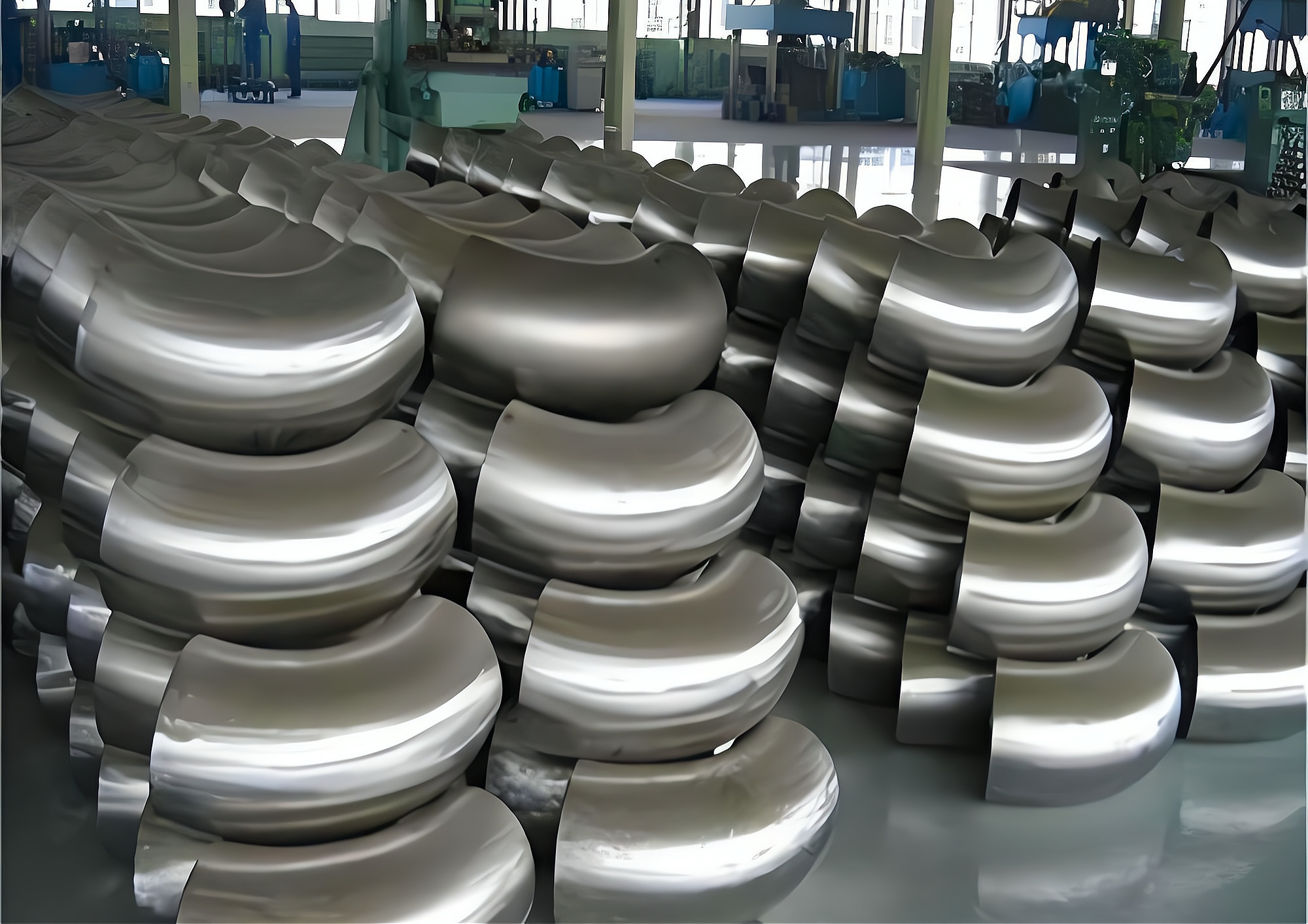
1. Elbows: Long-radius elbows (R=1.5D) shall be preferred; short-radius elbows and miter elbows are prohibited on pipelines with severe cyclic pulsation.SH/T3059 explicitly specifies that for pipelines subjected to pressure pulsation and alternating mechanical vibration loads, miter elbows should not be used, as miter welds exhibit obvious abrupt stress changes and extremely high fatigue risk.The wall thickness reduction of elbows after forming must be strictly controlled; excessive forming reduction will weaken the cross-section and amplify alternating stress.
2. Tees: Forged integral tees shall be preferred, and opening reinforcement and welded branch outlets shall be avoided as far as possible.Welded branch structures have corner stress concentration and are highly prone to cracking under high-frequency pulsating loads.If branch connections must be used, integral forgings shall be adopted, with fillet transitions and smooth transitions at corner locations to reduce the notch effect.
3. Reducers: Concentric or eccentric forged butt-welded reducers shall be selected, with a gentle transition slope in the conical section; step-type abrupt structures are not permitted, as stress peaks will occur at abrupt cross-section changes.
4. Flanges: For severe cyclic service, welding neck flanges are recommended, and slip-on flat welding flanges shall be avoided.Slip-on flanges exhibit obvious stress concentration at the root weld and are prone to weld cracking and gasket leakage under alternating loads.The machining roughness of the sealing surface must be strictly controlled, and the bolt load must account for the risk of relaxation under pulsation.
All pipe fitting corners and groove positions should transition smoothly to reduce original defects such as sharp corners, notches, and scratches.Original surface defects will directly serve as crack initiation points under alternating loads, significantly shortening fatigue life.
IV. Wall Thickness Verification and Fatigue Strength Calculation Requirements
Conventional pipe wall thickness is calculated only based on static internal pressure. For pipe fittings in pulsating pipelines, in addition to meeting static pressure requirements, the influence of alternating stress must also be superimposed, and fatigue strength verification must be performed.In the procurement technical agreement, the supplier should be required to carry out fatigue stress analysis in accordance with GB/T19624 or the ASME B31.3 fatigue assessment method, verify the stress range, and ensure that the safety factor is met under the design number of cycles.
The design wall thickness of pipe fittings should include a fatigue margin. On the basis of the wall thickness calculated for static strength, the corrosion allowance and additional fatigue wall thickness should be appropriately increased according to the pulsation amplitude.Procurement must not simply be based on the minimum wall thickness for steady-state pipelines.At the same time, it is necessary to distinguish between the wall thickness of the fitting body and the thinning caused by forming. After forming, elbows and tees will experience local wall thickness thinning. Procurement specifications need to clearly define the minimum measured wall thickness limit, and one must not only look at the nominal wall thickness.
At the piping system level, in addition to selecting the fitting body, supporting pulsation suppression measures are also required, such as pulsation dampers and properly arranged supports and hangers, to avoid piping resonance.Piping resonance will amplify alternating stress. Even if the fitting itself meets fatigue standards, it will still fail rapidly under resonance conditions.During the procurement stage, it is necessary to coordinate with the design party, confirm the piping system dynamic analysis report, and verify that the natural frequency avoids the pulsation excitation frequency to prevent resonance.
V. Control of Welding Process, Non-Destructive Testing, and Factory Acceptance
Welds are weak locations for fatigue in pulsating piping, and weld defects and weld toe notches are high-incidence points for fatigue cracks.For fitting welding under severe cyclic operating conditions, qualified WPS/PQR must be used, and post-weld heat treatment must be performed according to specifications to eliminate welding residual stress.Residual stress superimposed on alternating load will significantly accelerate crack propagation.Grinding the weld toe to a smooth contour to reduce stress concentration is a key process measure for improving weld fatigue life.
The proportion of non-destructive testing needs to be increased.For conventional steady-state pipeline welds, local RT/UT sampling inspection can be adopted; for pipe fittings under severe pulsating cyclic conditions, butt welds should undergo 100% non-destructive testing (RT or UT), while surface MT/PT testing should be added to detect surface microcracks.Under alternating pressure, small surface cracks will rapidly propagate inward.In the procurement technical agreement, the non-destructive testing execution standards, acceptance levels, and inspection timing must be clearly specified.
The factory documentation delivery list should include: material quality certificates, impact test reports, heat treatment records, stress analysis reports, fatigue assessment calculation sheets, a full set of non-destructive testing reports, and dimensional inspection records.The review of documentation for pipe fittings under fatigue conditions cannot be simplified; for owner-supervised projects, the purchaser should arrange factory supervision, focusing on verifying forming thinning, weld toe grinding, and heat treatment execution.
VI. Common Selection Misconceptions and Risk Prevention in Procurement
First major misconception: directly reusing the procurement list for steady-state pipeline fittings, only increasing the pressure rating while ignoring fatigue conditions.Increasing the pound class or PN rating can only improve static pressure-bearing capacity; it cannot improve stress concentration or solve the problem of fatigue cracking.
Second misconception: mixing short-radius elbows, miter elbows, and plate-type flat welding flanges, purely pursuing lower procurement costs while ignoring the risk of alternating loads.Short-term pressure testing passes, but failure occurs after long-term pulsating cycles.
Third misconception: not requiring a fatigue calculation report, not performing dynamic analysis, and only verifying the material report.Without fatigue assessment, the service life of fittings under cyclic loading cannot be verified.
Fourth misconception: non-destructive testing is conducted as sampling inspection for ordinary pipelines rather than full inspection, so tiny surface cracks that are missed become hidden hazards for fatigue failure.
Prevention and control strategy: at the pre-project technical disclosure stage, clearly define pulsating conditions and severe cyclic service determination, and write them into the technical agreement as the basis for supplier bidding and manufacturing;In the bid evaluation and supplier admission stages, verify the supplier's manufacturing track record for pulsating fatigue pipe fittings;Set quality penalty clauses in the contract and clarify fatigue-related acceptance terms;Add appearance, wall thickness, and surface flaw detection sampling inspections to the incoming re-inspection.
VII. Conclusion
The failure mechanism of pipe fittings in pulsating medium pipelines differs from that of conventional static pressure pipelines; the coupling of alternating stress and stress concentration makes fatigue cracks likely to occur.Fatigue-resistant selection is a complete system that requires multi-dimensional control from working condition determination, material toughness selection, optimization of pipe fitting structural forms, wall thickness fatigue verification, welding quality control, and full-scale non-destructive testing.The core approach to selection is to reduce stress concentration, control material defects, eliminate welding residual stress, and reserve fatigue safety margins.
Pipeline procurement work must not focus only on nominal pressure and nominal diameter; it is necessary to identify pressure pulsation and severe cyclic working conditions and to solidify fatigue requirements into the technical agreement.When procuring piping for chemical and oil & gas reciprocating equipment, priority should be given to long-radius elbows, forged tees, and weld-neck flanges, accompanied by complete fatigue analysis and 100% non-destructive testing, so as to avoid fatigue fracture accidents from the procurement source and ensure the long-term safe and stable operation of pulsating medium pipelines.
References
[1] GB/T 20801.3-2020, Pressure Piping Code — Industrial Piping — Part 3: Design and Calculation [S].
[2] GB/T 32270-2015, Pressure Piping Code — Power Piping [S].
[3] GB/T 19624-2019, Safety Assessment of In-Service Pressure Vessels Containing Defects [S].
[4] SH/T 3059-2012, Specification for Selection of Design Materials for Petrochemical Piping [S].
[5] ASME B31.3-2022, Process Piping [S].
[6] TSG D0001-2009, Safety Technical Supervision Regulations for Pressure Piping — Industrial Piping [S].