Introduction
Industrial water circulation systems include open circulating cooling water, closed circulating water, and HVAC hot and cold circulating water, and are an important part of the utility engineering of factories, power stations, and building mechanical and electrical projects.Water circulation pipeline fittings undertake the task of continuous circulation and transportation of media. The media contain dissolved oxygen, chloride ions, and suspended sediment. Under the effects of flow velocity disturbance and start-stop water hammer, the inner walls of fittings are highly prone to erosion corrosion and scaling deposition;buried pipelines also face external soil corrosion.Compared with high-temperature process pipelines, the operating pressure and temperature of water circulation pipelines are usually lower, but the problems of medium corrosion and erosion are highly concealed. In many projects, after several years of operation, failures such as pitting perforation, weld seam leakage, and anti-corrosion coating detachment gradually appear, causing system shutdown and equipment damage.
A review of a large number of quality accidents in circulating water engineering projects shows that the vast majority of leakage problems are not design defects, but rather omissions in control during the procurement stage: ordinary plates are selected and rolled into fittings to replace finished stamped/forged fittings, resulting in many welds that become weak points for corrosion;the chloride ion content of the medium is ignored, and carbon steel fittings are not provided with effective internal anti-corrosion protection;fittings of dissimilar materials are mixed, forming galvanic corrosion;Wall thickness is selected simply based on nominal pressure, without considering the thinning allowance for erosion;The anti-corrosion coating thickness is insufficient, the rust removal grade does not meet the standard, and the coating is damaged during transportation;The flange gasket is not adapted to the circulating water medium, resulting in aging and leakage;The procurement technical agreement is simplistic and lacks constraints on anti-corrosion, flow velocity erosion, and material compatibility;Incoming inspection only checks the appearance, without verifying the coating holiday detection report or material warranty documentation.
Circulating water pipeline fittings include elbows, tees, reducers, caps, flanges, blind flanges, branch outlets, and matching gaskets and fasteners. The entire set of pressure-bearing components must be uniformly included in procurement control; do not focus only on straight pipe material and randomly select ordinary fittings for pipe fittings, flanges, and seals.A typical misconception commonly exists in current industry procurement: confusing the corrosion grades of open circulating water and closed circulating water. Open systems have high dissolved oxygen, and the corrosion risk is far higher than that of closed systems;The anti-corrosion standards for overhead pipelines and buried pipelines are conflated;The selection boundaries for plastic, ductile iron, carbon steel, and stainless steel pipe fittings are blurred;Only the pressure-bearing strength of the fitting body is emphasized, while the effects of internal anti-corrosion and internal wall roughness on scaling and erosion are ignored;During bulk procurement, the sampling ratio for non-destructive testing is reduced, leading to missed detection of weld defects;When fittings from different manufacturers are purchased as a set, flange sealing face tolerances and coating systems are not unified, leaving hidden leakage risks after assembly.
The procurement of water circulation pipe fittings falls within the scope of utility pressure piping procurement, and the five major elements of pressure-bearing strength, resistance to medium corrosion, resistance to sediment erosion, anti-corrosion integrity, and sealing compatibility must be managed in a coordinated manner.Procurement must not focus only on nominal pressure and dimensional specifications; medium water quality parameters, material corrosion resistance, anti-corrosion and rust removal grade, coating thickness, erosion allowance, hydrostatic testing, and weld non-destructive sampling inspection must be made mandatory acceptance clauses, and a full-chain control system must be established covering supplier qualification access, locked technical agreements, manufacturing process supervision, finished product inspection, documentation traceability, and re-inspection upon arrival.This article systematically elaborates the general procurement standards for water circulation pipeline fittings across dimensions including the corrosion-erosion failure mechanisms of water circulation fittings, operating condition classification, domestic and international water circulation pipeline standard systems, material access, fitting structure selection, anti-corrosion systems, non-destructive testing, pressure testing, factory documentation, procurement misconceptions and risk prevention and control, and full-lifecycle economic evaluation, providing a complete technical basis for material procurement, supplier auditing, factory supervision, and incoming acceptance of circulating cooling water engineering projects in the chemical, power plant, HVAC, and manufacturing industries.
I. Failure Mechanisms of Water Circulation Pipelines and Pre-Procurement Operating Condition Classification and Identification
1.1 Failure Mechanisms of Water Circulation Pipe Fittings
The failure of pipe fittings in water circulation systems is mainly divided into four categories: erosion corrosion, electrochemical corrosion, under-deposit corrosion caused by scaling, and water hammer impact.In open circulating cooling water systems, the water body is in contact with the atmosphere and has a high dissolved oxygen content, so carbon steel materials are highly prone to oxidative corrosion;Chloride ions and suspended sediment in the water form turbulent erosion in areas with abrupt flow velocity changes such as elbows, tees, and reducers, damaging the passivation film on the metal surface and causing rapid local wall thickness reduction, which is erosion.After scale deposits on the pipe wall, an oxygen-deficient environment forms beneath the scale layer, inducing under-deposit pitting corrosion, which over time develops into perforation and leakage.System startup and shutdown and rapid valve opening and closing generate water hammer impact, producing alternating loads at stress concentration locations in pipe fittings, causing weld seam cracking and loosening of flange seals.
Direct connection of dissimilar metals causes galvanic corrosion. For example, when carbon steel pipe fittings are directly connected to stainless steel pipe fittings or copper alloy pipe fittings, the potential difference accelerates corrosion of the carbon steel. This is a very common hidden failure point in circulating water systems.Failure of the flange sealing system is also frequent. With long-term immersion in circulating water media, ordinary rubber gaskets age and swell, and bolts corrode from long-term immersion, causing preload to decay and resulting in dripping and leakage at flange joints.
1.2 Collection of operating condition parameters and classification of water circulation pipelines
Before procurement is initiated, process operating condition parameters must be fully collected as the prerequisite for material selection, anti-corrosion scheme determination, and wall thickness allowance determination. If the operating condition parameters are incomplete, procurement work shall not be carried out.The collected parameters include: open circulating water/closed circulating water, medium temperature, and design pressure;Water quality indicators: chloride ion content, pH value, and suspended solids content;Installation method: aboveground/underground;Sediment content in the medium, and whether frequent start-stop water hammer occurs;Nominal pipe diameter and medium flow velocity; Project execution standards.
According to the classification of corrosion risk levels, open circulating cooling water has the highest corrosion risk;The closed hot and cold circulating water system has low dissolved oxygen, so its corrosion risk is relatively low;In addition to internal corrosion caused by the medium, buried pipelines are also subject to external soil corrosion.The higher the pressure, the greater the flow velocity, and the higher the chloride ion content, the higher the risk of corrosion and erosion of pipe fittings, and the corresponding material, anti-corrosion, and inspection levels need to be upgraded;Low-flow closed HVAC circulating water has a relatively low risk, but material matching must still be done properly, and standards must not be lowered arbitrarily.
In the working condition determination stage, the entire water circulation pipeline system uniformly applies the baseline standard.Domestic industrial circulating water projects are based on GB50873 "Code for Design of Water Supply and Drainage Piping in Chemical Industry," the GB/T20801 pressure piping code, and the GB/T12459 standard for steel butt-welded pipe fittings;For overseas circulating water export projects, when the customer specifies international standards, ASME B31.9 Building Services Piping and ISO2531 ductile iron pipeline specifications are applied; there are differences in materials, coatings, and pressure values among different standards, and they cannot be directly substituted as equivalent.
II. Review of Domestic and International Standards Systems for Water Circulation Pipeline Fittings
2.1 Current Core Domestic Standards
GB50873-2013 "Code for Design of Water Supply and Drainage Pipelines in Chemical Industry", the core national standard for industrial circulating water systems, specifies material selection for circulating water pipelines, fitting selection, joint types, internal and external anti-corrosion, and protection requirements for buried pipelines, and distinguishes applicable scenarios for carbon steel, ductile iron, and plastic pipelines.
GB/T20801 "Pressure Piping Code - Industrial Piping", the basic code for pressure-bearing circulating water pipelines, covering complete-set acceptance requirements for fittings, flanges, and fasteners of GC-class pressure piping.
GB/T12459-2025 "Steel Butt-Welding Pipe Fittings - Types and Parameters", standards for dimensions, tolerances, and forming processes of steel butt-welding elbows, tees, reducers, and caps, applicable to carbon steel and stainless steel steel fittings for water circulation.
GB/T13401-2025 "Steel Butt-Welding Pipe Fittings - Technical Specification", specifications for manufacturing, inspection, and acceptance of steel plate butt-welding pipe fittings, applicable to large-diameter circulating water fittings.
SY/T0413 Technical Standard for Polyethylene Anti-Corrosion Coating of Buried Steel Pipelines, the basis for construction and testing of 3PE external anti-corrosion coating on buried circulating water pipelines.
GB/T23257 Polyethylene Anti-Corrosion Coating for Buried Steel Pipelines, the standard for acceptance and holiday detection of anti-corrosion coatings on buried pipelines.
GB50235 "Code for Construction of Industrial Metallic Piping Engineering", the supporting code for pipeline hydrostatic testing and installation acceptance.
NB/T47013 Non-destructive Testing of Pressure Equipment, the standard for UT, MT, and PT testing and acceptance of welds on steel pipe fittings.
GB/T17219 Standard for Sanitary Safety Evaluation of Drinking Water Distribution Equipment and Protective Materials, used for controlling the sanitary indicators of lining materials in purified water circulation pipelines.
2.2 Mainstream Foreign Water Circulation Pipeline Standards
ASME B31.9, Building Services Piping Code, the basis for the design and procurement of fittings and flanges for overseas HVAC and cooling water circulation systems.
ISO2531, Standard for Ductile Iron Pipes and Fittings, applicable to the procurement and acceptance of ductile iron fittings for large-diameter municipal and industrial circulating water.
ASTM A234, Standard Specification for Carbon Steel Butt-Welding Pipe Fittings, the raw material specification for carbon steel circulating water fittings in foreign trade.
2.3 Basic Principles of Standard Adaptation
The entire water circulation piping system must adopt a unified baseline standard: straight pipes, elbows, tees, reducers, flanges, gaskets, and fasteners must all simultaneously comply with the same set of utility piping standards. It is prohibited for pipe fittings to follow the circulating water anti-corrosion standard while gaskets and bolts use ordinary fittings without anti-corrosion treatment.For GC-class pressure-bearing circulating water piping, all pipe fittings, flanges, and sealing elements must simultaneously satisfy GB50873 + GB/T20801; it is not acceptable to control only the fitting body while ignoring the matching sealing elements.For cross-standard equivalent substitution, a technical difference comparison document must be issued and may only be implemented after approval by the design party and the owner.
Red lines for water circulation pipe fitting procurement: material must be compatible with the chloride ion and dissolved oxygen levels of the water quality;Pipe fittings in open systems must be equipped with reliable internal anti-corrosion protection;The external anti-corrosion coating of buried pipe fittings must be complete and pass spark testing;Connections between dissimilar metals require isolation treatment;Wall thickness must reserve an allowance for erosion thinning, and selection must not rely solely on nominal pressure.
III. Material Selection and Admission Specifications for Water Circulation Pipe Fittings
For the material selection of water circulation pipe fittings, the core evaluation indicators are resistance to electrochemical corrosion, resistance to sediment erosion, and suitability for the medium's pH and chloride ion content, while also taking project cost into account.The applicable working condition boundaries of different materials are clear and must not be mixed arbitrarily.
3.1 Material Selection Rules for the Body of Metal Pipe Fittings
For closed-loop room-temperature circulating water with low chloride ion content and stable water quality: choose Q235B and 20# carbon steel stamped butt-welded pipe fittings, which offer high cost-effectiveness;The inner wall of the pipe fittings shall be provided with an anti-corrosion coating selected according to water quality.
For open industrial circulating cooling water containing suspended solids and a certain amount of chloride ions: carbon steel pipe fittings shall be provided with complete internal anti-corrosion protection;For circulating water with relatively high chloride ion content and strong corrosiveness, choose 304 stainless steel pipe fittings;For high-chloride seawater circulating cooling systems, duplex stainless steel or copper-nickel alloy pipe fittings are selected.
Large-diameter buried circulating water main pipes: ductile iron pipe fittings may be selected, with flexible socket joints, settlement resistance, and stable anti-corrosion performance, suitable for municipal and plant-wide large circulating water pipe networks.
HVAC small-diameter cold and hot circulating water, low-pressure conditions: galvanized carbon steel pipe fittings may be selected, with threaded or clamp connections; pay attention to protecting the galvanized layer, and welded locations require secondary galvanizing.
Key points for material procurement review:
1. For steel pipe fittings, seamless stamped and formed finished pipe fittings are preferred;For large diameters above DN600, butt-welded pipe fittings made from qualified steel plates may be used, and the welds must undergo non-destructive testing;It is strictly prohibited to use simple on-site rolled non-standard pipe fittings as pressure-bearing circulating water pipe fittings.
2. The supplier shall provide MTC material certificates, heat numbers, chemical composition, and mechanical property reports;Pitting resistance equivalent and intergranular corrosion test data for stainless steel pipe fittings are available upon request.
3. For butt joints of dissimilar materials, isolation measures must be specified in the technical agreement, and insulating flanges shall be added to block the galvanic corrosion path;Direct welding connection between carbon steel and stainless steel that is immersed in circulating water for a long time is prohibited.
4. Upon arrival, sampling for spectral re-inspection may be conducted to verify the material grade, preventing the substitution of inferior materials for superior ones.
3.2 Procurement Specifications for Sealing Gaskets and Fasteners
Gaskets for circulating water systems need to be resistant to water immersion and aging.For normal-temperature open circulating water, rubber gaskets or EPDM ethylene propylene diene monomer gaskets may be selected;For high-temperature circulating water, non-metallic composite gaskets or spiral wound metal gaskets shall be selected;Ordinary rubber gaskets that are not water-resistant are not recommended, as they will swell and fail after long-term immersion.
Carbon steel flanges shall be paired with carbon steel bolts, and stainless steel flanges with stainless steel fasteners;Bolts in buried or humid environments require hot-dip galvanizing for corrosion protection.Fasteners shall be included in the overall procurement scope; ordinary bolts without corrosion protection must not be purchased separately, to prevent bolts from rusting and seizing so that they cannot be removed during later maintenance.
IV. Procurement Rules for Structural Selection of Water Circulation Pipe Fittings
For the structural selection of water circulation pipe fittings, the focus is on reducing local flow velocity disturbances, minimizing sediment erosion, optimizing smooth flow passage transitions, and lowering the risk of scaling and erosion.
1. Elbows: Long-radius R=1.5D butt-welded elbows are preferred;For pipelines where the circulating water medium contains large amounts of sediment, short-radius elbows are not recommended, as the inner and outer arcs of elbows are areas with a high incidence of erosion and corrosion.Procurement agreement specifies the minimum wall thickness of elbows, with allowance reserved for erosion thinning.
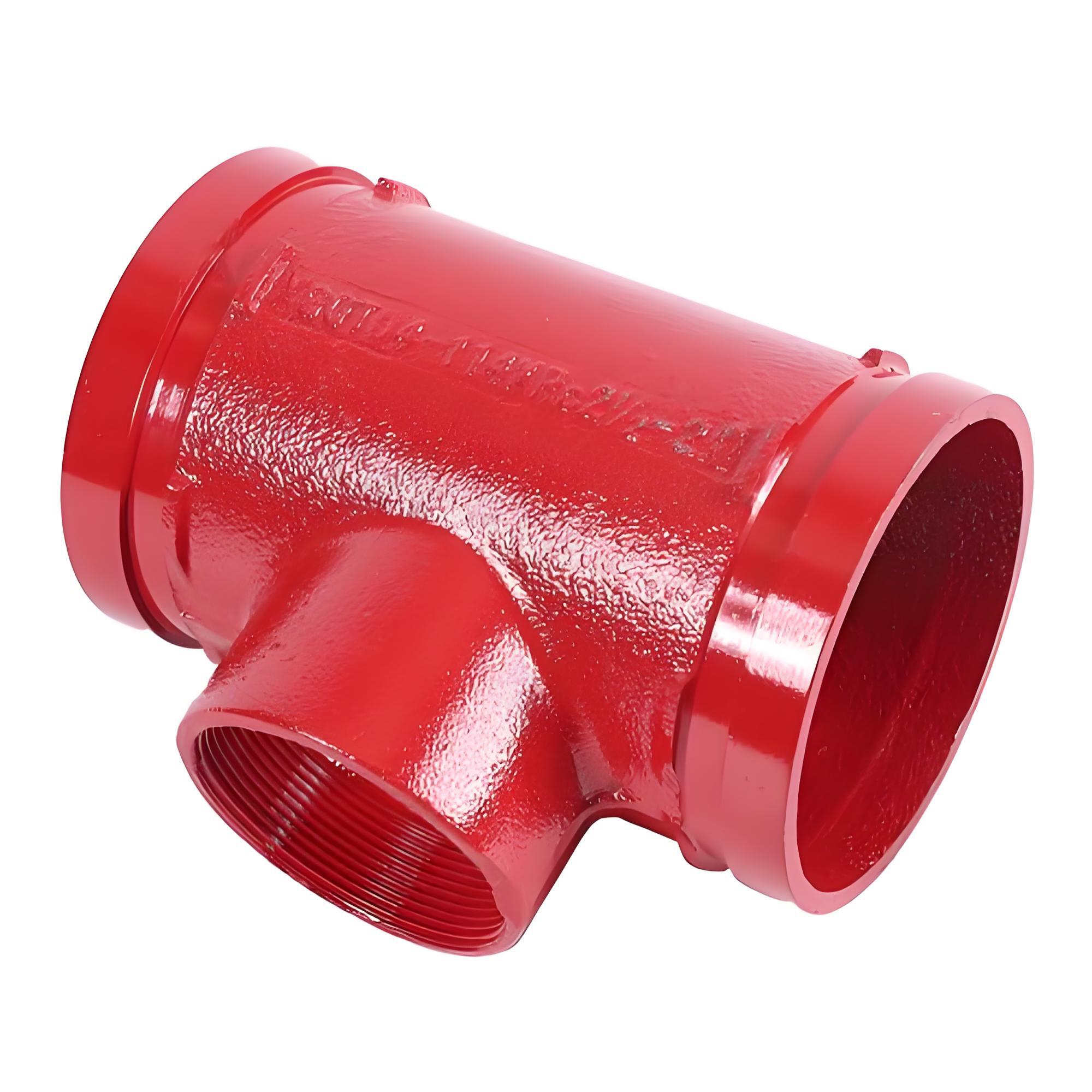
2. Tees: Prefer finished forged/stamped tees, with smooth transitions between branch and main pipe;Avoid field-fabricated branch connections by drilling holes, as sharp corners at the openings create vortex erosion.
3. Reducers: Concentric or eccentric forged/stamped reducers, with gentle transitions and no abrupt steps, to reduce vortices.
4. Flange selection: For low-pressure circulating water PN≤1.6MPa, plate-type slip-on flanges and hubbed slip-on flanges may be used;For higher pressure and important buried pipelines, hubbed weld-neck flanges shall be used;Flange sealing faces shall preferably be raised-face RF, which meets sealing requirements under normal circulating water conditions.
5. Pipe caps: Elliptical head pipe caps, avoiding flat-bottom structures, as flat bottoms tend to accumulate sediment and cause under-deposit corrosion.
The nominal inner diameters of the entire set of pipe fittings should be kept as consistent as possible; steps or misalignment in the inner diameter will create eddies and accelerate localized erosion.It is recommended to purchase the entire water circulation piping system as a complete packaged set, with unified materials and anti-corrosion systems for fittings, flanges, gaskets, and fasteners;Purchasing separately from multiple suppliers easily leads to mismatched flange tolerances and inconsistent anti-corrosion coating systems, resulting in leakage after assembly.
V. Procurement Technical Requirements for Anti-Corrosion Systems, Non-Destructive Testing, and Hydrostatic Testing
Anti-corrosion is a core control point in the procurement of water circulation pipe fittings, divided into internal wall anti-corrosion and external wall anti-corrosion.For carbon steel above-ground circulating water pipe fittings, epoxy coatings or IPN8710 anti-corrosion coatings are selected according to water quality;For buried carbon steel pipe fittings, the external wall adopts a 3PE anti-corrosion layer, with sandblasting to Sa2.5 grade, anchor profile depth meeting specifications, and after coating completion, spark testing is carried out to detect pinhole defects in the coating.For ductile iron pipe fittings, the internal wall uses a cement mortar lining to inhibit scaling and corrosion.Plastic pipe fittings require no additional anti-corrosion treatment, but the raw materials and anti-aging indicators need to be verified.
Non-destructive testing: MT/PT sampling inspection is performed on the finished steel stamped pipe fitting bodies as required;For butt welds of large-diameter pipe fittings made from steel plates, UT/RT non-destructive testing is carried out according to the proportion specified in the technical agreement to detect welding cracks, porosity, and slag inclusions;For GC-class pressure piping, the sampling inspection proportion is increased, and 100% testing is performed on welds of important main lines.
Hydrostatic strength test: the test pressure is determined in accordance with the specifications of GB50235 and GB/T20801;The hydrostatic test is completed before anti-corrosion construction; the test medium is clean, and after the test is completed, the water is drained and blown dry;Internal and external anti-corrosion is carried out only after the pressure test passes, to prevent residual test water from remaining beneath the coating and causing the coating to blister and peel off.For large-diameter buried pipelines, an air tightness test is added when necessary to verify the sealing performance of flange joints.
Factory delivery documentation list: material warranty certificates, heat/batch number traceability sheets; Inspection records for fitting dimensions and wall thickness; Weld seam non-destructive testing reports; Hydrostatic pressure test records; Anti-corrosion coating inspection reports, spark leak detection records; Product certificate of conformity; pipe fitting drawings; Material certificates for gaskets and fasteners.
Incoming inspection process: prioritize the review of the complete set of technical documents;Visual inspection of surface defects on pipe fittings, and the anti-corrosion coating must be intact without damage;Verify wall thickness and check the thinning amount of elbows;For buried pipe fittings, on-site spark testing may be conducted on a sampling basis;Use an endoscope to spot-check the quality of internal anti-corrosion;Stainless steel pipe fittings shall undergo spectral re-inspection as needed.If documents are missing, the coating is damaged, the wall thickness is insufficient, or flaw detection fails, the entire batch shall be rejected and must not be put into the circulating water project.For important plant circulating water main pipe projects, factory supervision during manufacturing shall be arranged, with focus on verifying derusting, coating application, hydrostatic testing, and weld seam flaw detection.
VI. Pipe Fitting Identification, Packaging, Storage and Transportation Control
After pipe fitting inspection, pressure testing, and anti-corrosion completion, both ends of the pipe fittings shall be sealed with plastic end caps to protect the bevels and keep the interior of the pipe clean;Flange sealing surfaces shall be wrapped with protective film to prevent impact and scratches.The outer packaging shall be marked with [Pipe Fittings for Water Circulation], indicating material, pressure rating, and medium type, with permanently clear markings;Anti-corrosion pipe fittings shall be protected during transportation; friction and impact against the coating by hard objects are prohibited. Once the coating is damaged, on-site repair and re-inspection by spark testing must be carried out;
The supplier and the receiving party shall set up storage areas for pipe fittings, with carbon steel and stainless steel pipe fittings stored separately to prevent material mixing and galvanic contact;Buried anti-corrosion pipe fittings stored in the open air shall be covered to avoid UV aging of the coating.During lifting and handling, the bevels, sealing surfaces, and anti-corrosion layer shall be protected; dragging and friction against the outer wall of pipe fittings are prohibited.The procurement technical agreement stipulates that large-area coating damage or impact damage to sealing surfaces caused by transportation shall be deemed product nonconformity, and the receiving party may reject the goods.
VII. Core Special Clauses of the Technical Agreement for Water Circulation Pipe Fittings Procurement
The technical agreement for the water circulation pipeline and pipe fittings procurement contract shall establish a separate special chapter on anti-corrosion and medium compatibility, which must not be merged into the general technical clauses.Core clauses: open/closed circulating water, design pressure, temperature, and water quality parameters;Installation method: overhead/buried;Applicable standards: GB50873, GB/T20801, GB/T12459;Pipe fitting material and forming method; Wall thickness erosion allowance; Internal and external anti-corrosion system, rust removal grade, coating thickness, and electrical spark leak detection indicators; Flange type and sealing face; Anti-corrosion requirements for gasket and fastener materials; Non-destructive testing items and sampling inspection ratio; Hydrostatic test parameters; Pipe fitting marking and packaging protection; List of complete factory documentation; Factory pre-shipment supervision; Material substitution approval; Quality responsibility for corrosion leakage; Safety breach clauses.
Contractual agreement: The supplier shall not arbitrarily lower the material grade, simplify the anti-corrosion process, or reduce the proportion of non-destructive testing;If corrosion perforation or medium leakage of pipe fittings is caused by material mismatch or anti-corrosion failure, the supplier shall bear the rework and production shutdown losses.Bid evaluation must not only compare prices; it should focus on reviewing the supplier's manufacturing track record for circulating water pipe fittings, anti-corrosion construction capability, and non-destructive testing qualifications.Low-priced products often simplify rust removal, reduce coating thickness, and use non-standard rolled pipe fittings, resulting in corrosion leakage shortly after being put into operation.The complete set of water circulation pressure-bearing pipe fittings shall be purchased as a unified package, with pipe fittings, flanges, gaskets, and fasteners supplied as a complete set to ensure the integrity and matching of the pressure-bearing, anti-corrosion, and sealing system.
VIII. Typical Misconceptions and Risk Prevention in Water Circulation Pipe Fitting Procurement
Misconception 1: Using the same material for open circulation water and closed circulation water, ignoring the high dissolved oxygen in open water bodies; carbon steel without internal anti-corrosion protection develops pitting perforation after 1-2 years of operation.
Misconception 2: Selecting wall thickness only based on nominal pressure without reserving allowance for silt erosion thinning; the wall thickness at elbows and tees decreases year by year, leading to premature failure.
Misconception 3: Directly connecting carbon steel pipe fittings to stainless steel pipe fittings without insulating isolation, causing galvanic corrosion and rapid perforation of the carbon steel.
Misconception 4: Insufficient rust removal grade before anti-corrosion application, resulting in poor coating adhesion; the coating peels and falls off after operation, losing its protective function.
Misconception 5: Using simple on-site rolled parts for large-diameter pipe fittings, with many welds and no flaw detection; corrosion preferentially causes leakage at welds.
Misconception 6: Incorrect gasket selection; ordinary rubber ages after long-term immersion in circulating water, causing continuous dripping at flange connections.
Misconception 7: The technical agreement is described too simply and lacks quantitative indicators such as water quality, anti-corrosion, and erosion allowance, leaving no basis for judgment in corrosion quality disputes.
Misconception 8: Purchasing pipe fittings, flanges, and anti-corrosion separately; the tolerances and coating systems of matching parts from different manufacturers are inconsistent, resulting in leakage after assembly.
Risk prevention and control measures: In the early stage of the project, distinguish between open and closed circulating water, test the chloride ion content of the water quality, and determine the material and anti-corrosion scheme;The technical agreement locks down the material, minimum wall thickness, rust removal grade, coating indicators, and non-destructive sampling inspection ratio;For high-sediment pipelines, use long-radius elbows to increase erosion allowance;Install insulating flanges between dissimilar metals;After anti-corrosion is completed, perform spark leak detection;Protect the anti-corrosion layer throughout transportation; Factory supervision during manufacturing; Review incoming documentation + physical re-inspection;After the pipeline installation is completed, a system water pressure test shall be carried out before commissioning.
IX. Full Life Cycle Safety and Economic Evaluation of Water Circulation Pipe Fittings Procurement
For the procurement and selection of water circulation pipe fittings, it is not enough to compare only the initial purchase unit price; evaluation must be based on the full life cycle.For open high-corrosion circulating water systems, selecting stainless steel pipe fittings or carbon steel with complete anti-corrosion coating results in higher procurement costs, but provides strong erosion resistance and corrosion resistance, greatly reducing the risk of perforation leakage and shutdown maintenance;For low-corrosion closed HVAC circulation branch lines, qualified galvanized carbon steel pipe fittings can be selected, with lower procurement costs, but regular inspections of corrosion conditions are required.
For closed HVAC circulating water branch lines, the risk is relatively low, and galvanized carbon steel pipe fittings can be selected;For main open cooling water lines in chemical plants and power plants, priority should be given to finished stamped carbon steel pipe fittings with complete internal and external anti-corrosion protection; under high chloride ion conditions, upgrade to stainless steel material.The core logic of selection is not to compress procurement costs, but to match the corrosion safety boundary corresponding to water quality and flow velocity. Once a circulating water pipe fitting leaks due to perforation, the losses from shutdown maintenance and equipment damage far exceed the price difference in pipe fitting procurement.The procurement cost assessment includes raw materials for pipe fittings, forming and processing, non-destructive testing, hydrostatic testing, anti-corrosion construction, packaging and protection, factory supervision, subsequent pipeline inspection and maintenance, and leakage accident risk costs.
X. Conclusion
The procurement of water circulation pipeline fittings differs from that of high-temperature process pipelines. The core contradiction is not high-temperature creep, but medium erosion, electrochemical corrosion, and under-deposit corrosion. Five major elements—material matching, anti-corrosion system, wall thickness erosion allowance, dissimilar metal isolation, and sealing accessories—must be considered in a coordinated manner. The goal is to suppress corrosion perforation and interface leakage, and to ensure the long-term stable operation of the circulating water system.Domestic industrial circulating water and HVAC cooling water projects are based on GB50873, GB/T20801, and GB/T12459 standards;Overseas circulating water projects may implement ASME B31.9 and ISO2531 standards.
Distinguish between open and closed circulating water, and between overhead and buried installation scenarios. Highly corrosive open circulating systems should be given priority for complete anti-corrosion support;For steel pressure-bearing pipe fittings, finished stamped and formed components should be preferred, and simple rolled components should be used with caution;Dissimilar metal connections should be provided with insulating isolation to block galvanic corrosion;After the anti-corrosion construction is completed, spark leak detection shall be carried out;Welds shall be subject to sampling non-destructive testing in accordance with specifications, and hydrostatic testing shall verify pressure-bearing capacity;Elbows and tees shall be provided with reserved erosion-thinning allowances.The procurement technical agreement shall separately set special clauses for anti-corrosion media, locking in material, coating, wall thickness allowance, and inspection indicators, and implementing supplier admission, factory supervision, and incoming re-inspection.
For water circulation systems in power plants, chemical plants, manufacturing, and HVAC engineering, the general procurement standards for water circulation pipeline fittings shall be strictly implemented, so as to avoid hidden dangers such as erosion corrosion, anti-corrosion failure, and flange leakage from the procurement source, prevent pipeline perforation and leakage, and ensure the safe and stable operation of industrial circulating water pipelines.
References
[1] GB 50873-2013, Code for design of water supply and drainage piping in chemical industry [S].
[2] GB/T 20801, Pressure piping code—Industrial piping [S].
[3] GB/T 12459-2025, Steel Butt-Welding Pipe Fittings Types and Parameters [S].
[4] GB/T 13401-2025, Steel Butt-Welding Pipe Fittings Technical Specification [S].
[5] SY/T 0413, Technical Standard for Polyethylene Anti-Corrosion Coating of Buried Steel Pipelines [S].
[6] GB/T 23257, Polyethylene Anti-Corrosion Coating for Buried Steel Pipelines [S].
[7] GB 50235, Code for Construction of Industrial Metallic Piping [S].
[8] NB/T 47013, Nondestructive Testing of Pressure Equipment [S].
[9] GB/T 17219, Standard for Hygienic Safety Evaluation of Drinking Water Transmission and Distribution Equipment and Protective Materials [S].
[10] ASME B31.9, Building Services Piping Code [S].
[11] ISO 2531, Ductile iron pipes and fittings for water applications [S].
[12] ASTM A234, Standard Specification for Piping Fittings of Wrought Carbon Steel [S].