I. Introduction
In high-end international engineering projects such as global oil and gas, refining and petrochemical, power plants, offshore engineering, nuclear power, and new energy green hydrogen, small-diameter high-pressure pipelines such as instrument tubing, sampling lines, high-pressure branch connections, and safety valve connections in piping systems have extremely stringent technical requirements for fitting tightness, fatigue resistance, and corrosion resistance.Forged fittings, unlike seamless pushed fittings and steel plate rolled and welded fittings, are formed by integral forging of forged blanks, with material grains flowing continuously along the direction of force, dense internal structure, and no base material weld seams, providing a higher safety margin under high pressure, alternating loads, and corrosive media conditions, making them the preferred product for small-diameter pressure-bearing fittings in the international high-end engineering field.
Forged fittings implement the core international standard ASME B16.11, covering socket weld and threaded forged fittings, with pressure classes including Class 2000, Class 3000, Class 6000, and Class 9000, and size range NPS 1/8 to NPS 4.Materials include A105 carbon steel, A182-F304/F316L stainless steel, A182-F11/F22 alloy, A350 LF2 low-temperature carbon steel, duplex stainless steel, etc., suitable for various complex working conditions such as high temperature, low temperature, acidic, and high pressure.In high-end EPC project tenders in the Middle East, North America, Europe, and Southeast Asia, technical specifications for high-pressure process small pipes, instrument impulse lines, and wellhead pipelines often directly specify the use of ASME B16.11 forged fittings.
After years of technological iteration, the domestic forged fittings industry has developed increasingly mature supporting systems for forging, heat treatment, non-destructive testing, and physical and chemical testing, and domestically produced forged fittings are exported in large quantities to overseas high-end engineering projects.However, there is a common cognitive bias on the foreign trade procurement side: some procurement personnel confuse the applicable boundaries of forged fittings, seamless fittings, and welded fittings, and mistakenly use forged fittings for large-diameter main pipelines;Or ignoring the special inspection of forgings, forging grades, and international certification requirements, resulting in rejection by overseas supervision, rejection by the owner, and incurring high demurrage and claim losses.
The foreign trade value of forged pipe fittings is not only reflected in the strength advantages of the product itself, but also in the compliance for bidding on international high-end projects, the recognition of third-party supervision, the traceability of special equipment documentation, and the adaptability to access certifications of multiple countries.Starting from the manufacturing process and material characteristics of forged pipe fittings, this article categorizes and analyzes various high-end foreign trade application scenarios, clarifies the logic of selection according to working conditions, sorts out the key points of foreign trade procurement, technical agreements, factory inspection, and export compliance control, summarizes selection misconceptions, and provides a complete reference for supply chain selection and foreign trade performance of overseas high-end pressure pipeline projects.
II. Manufacturing Process and Basic Technical Characteristics of Forged Pipe Fittings
Forged pipe fittings use steel ingots/forged round billets, which are formed by high-temperature forging and die forging, and then machined to obtain pipe fittings such as socket weld elbows, tees, couplings, male and female threaded connectors, branch outlets, and caps.During the forging process, external force compacts the internal pores of the metal, breaks the as-cast structure, refines the grains and arranges them directionally along the direction of force, so that the material density is much higher than that of castings, and the fatigue resistance, stress corrosion resistance, and lamellar tearing resistance are significantly improved.The finished pipe fitting body has no base material weld seam; installation weld joints are only produced during on-site installation. There is no hidden danger of weld seam defects in the pipe fitting body, which is the core advantage of forged pipe fittings under high-pressure and high-risk working conditions.
The ASME B16.11 standard provides complete regulations on the dimensions, tolerances, pressure-temperature ratings, marking, materials, and inspection of forged pipe fittings. The higher the pound class, the greater the wall thickness of the pipe fitting and the stronger the pressure-bearing capacity. Class9000 is the highest pressure class, specifically used for extreme high-pressure working conditions.Forged products need to be produced in accordance with ASTM forging standards. Forgings are divided into different forging levels; high-end projects often require Grade III and Grade IV forgings, requiring piece-by-piece UT ultrasonic testing, MT magnetic particle testing, and PT penetrant testing to detect internal inclusions, cracks, shrinkage cavities, and other defects. TSG31 Industrial Piping Safety Technical Regulations also impose mandatory requirements for non-destructive testing of forged pipe fittings.
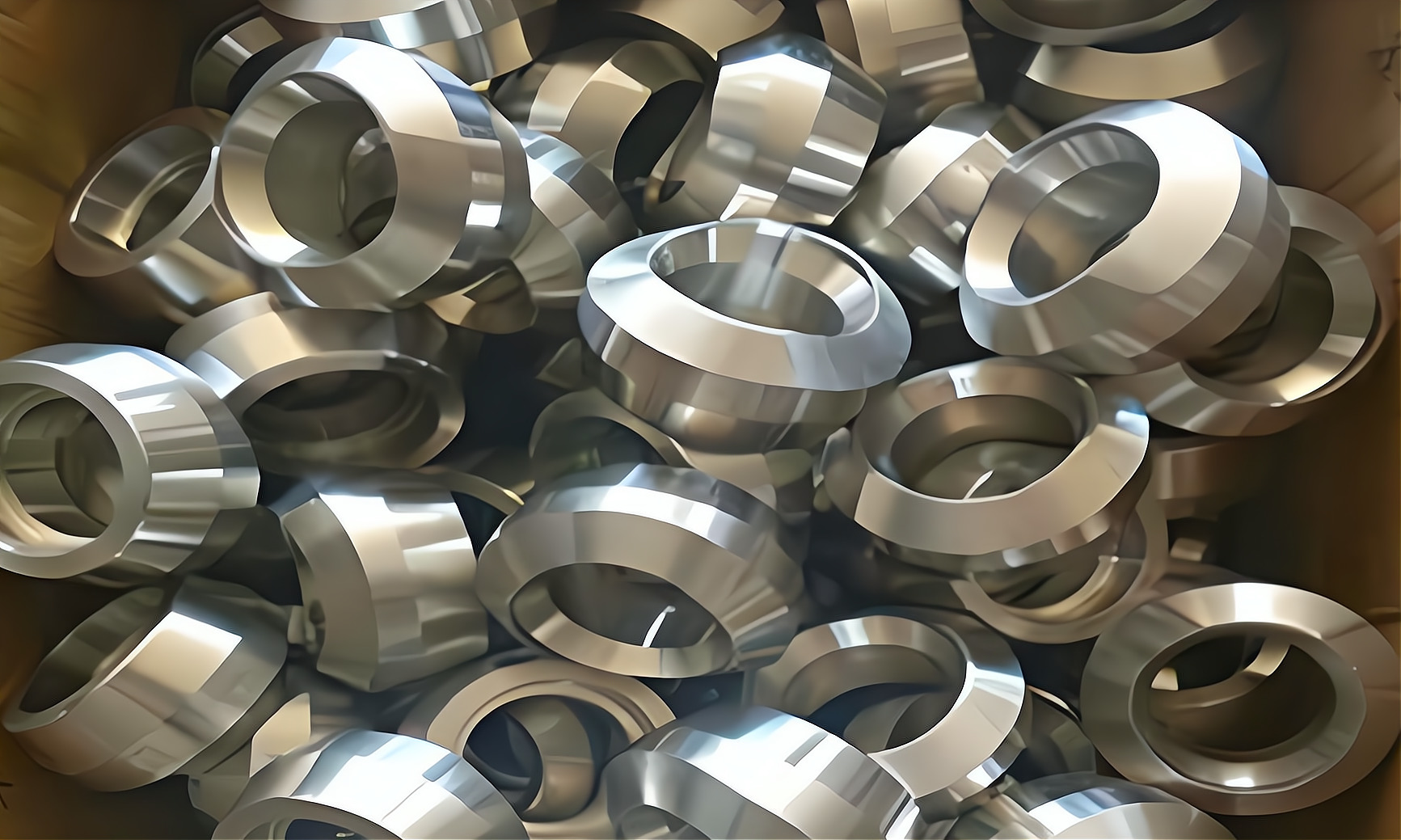
In terms of material systems, A105 is the most commonly used carbon steel forging, suitable for medium-to-high temperature and high-pressure service conditions;A182 series stainless steel forgings are used for corrosion-resistant service conditions;Low-temperature forgings such as A350 LF2 are used for LNG and low-temperature process pipelines;F11, F22, and F91 alloy forgings are used for high-temperature steam small-bore piping in power plants;Duplex stainless steel forgings are used for seawater and chloride-ion corrosion offshore engineering service conditions.The branch outlet fittings matched with forged pipe fittings are special forgings for branch reinforcement in piping. They achieve local thickening and reinforcement at the opening position on the main pipe, avoiding stress concentration at the tee opening. They are widely used for branch connections in overseas petrochemical and offshore high-pressure pipelines, and are characteristic forged components for high-end projects.
The limitation of forged pipe fittings lies in their relatively small applicable diameter. The standard coverage upper limit is NPS4 (DN100), and they are generally only used for small-diameter branch pipes and instrument piping. They cannot replace seamless pipe fittings for large-diameter main pipes.Procurement and selection must clearly define: forged fittings are positioned for small-diameter high-pressure branches, instrumentation, and sampling lines, while large-diameter main lines still use ASME B16.9 seamless butt-welded fittings; the application boundaries of these two product types must not be confused.
III. Core technical advantages of forged fittings in foreign trade, suited to high-end overseas projects
3.1 Integral forging forming, no base-material weld seams, sufficient safety redundancy under high-pressure conditions
Forged fittings are machined from integrally forged blanks; the fitting body has no welded joints and no weld heat-affected zone, eliminating the risk of inherent defects such as weld porosity, slag inclusion, and lack of penetration.Under high pressure, alternating cyclic pressure, acidic media, and hydrogen embrittlement conditions, weld locations are high-incidence failure points. Forged fittings fundamentally avoid the risk of base-material weld failure and are highly suitable for lines such as instrument impulse lines, safety valve connections, and wellhead high-pressure small-bore piping where any leakage could cause a major safety accident.Overseas owners and third-party inspection agencies generally give priority acceptance to forged fittings for high-pressure small-bore piping.
3.2 Dense and uniform metal grains, excellent fatigue resistance and stress corrosion resistance
Forging densifies the metal structure, makes grains continuous, stabilizes mechanical properties, and provides better alternating fatigue resistance than seamless fittings machined from rolled pipe.Offshore platforms and wellhead pipelines are subjected to long-term pressure fluctuations and wave-induced vibration loads, resulting in a prominent fatigue risk;Sour oil and gas service conditions carry the risk of wet hydrogen sulfide stress corrosion cracking; forgings have a uniform microstructure and stronger resistance to corrosion cracking, meeting the requirements of the NACE MR0175 sour service specification.
3.3 The international standards system is mature, providing strong compliance for high-end EPC project bidding
ASME B16.11 is a globally accepted authoritative standard; in the P&ID drawings and technical specifications of high-end overseas EPC projects in Europe, America, the Middle East, and Southeast Asia, ASME B16.11 forged fittings are directly specified for small-diameter high-pressure process pipelines. Selecting compliant forged fittings at the bidding stage satisfies the mandatory technical clauses of the tender documents and avoids the risk of technical bid disqualification. Supported by ASTM forging material certificates, forging UT/MT/PT non-destructive testing reports, and heat treatment records, the documentation system meets the requirements for international engineering archiving and special equipment filing.
3.4 The full-chain traceability system for forgings is well established, meeting the supervision and audit requirements of high-end projects
Overseas petrochemical, offshore engineering, and nuclear power supporting projects have stringent material traceability requirements; the raw material forged round billets for forged fittings have a single melt heat number, and finished forgings are stamped with the heat number, material, standard, and pressure class, while MTC material certificates, forging inspection reports, and heat treatment reports can be traced back to the steel mill's melting records.For reinforced forgings such as branch outlets, the forging grade and sampling test records are complete. When the resident third-party supervision reviews the documentation, the traceability chain is clear, and the one-time pass rate for documentation is high.
3.5 Compatible with export certification systems of multiple countries, meeting market access requirements of different countries
For exports to the EU market, forged pipe fittings can obtain PED Pressure Equipment Directive CE certification and DoP Declaration of Performance;For projects in Saudi Arabia in the Middle East, SABER product registration and PVoC pre-shipment verification can be completed;US standard projects meet the ASME material system;For offshore marine engineering and shipbuilding projects, product certification from classification societies such as DNV and ABS can be provided.The certification documentation system for forging products is clear, with no need for a large number of additional welding procedure WPS/PQR documents. Compared with welded pipe fittings, the certification preparation workload is smaller.
3.6 Specialized forgings such as branch outlets solve the problem of stress reinforcement for pipeline branches
Conventional tees experience stress concentration at the branch opening on high-pressure main lines, whereas forged branch outlets are integrally forged with locally thickened reinforcement, reducing the stress level at the opening and improving the overall safety factor of the pipeline.Overseas hydrogenation and offshore platform high-pressure pipelines extensively use forged branch outlets to replace ordinary tees; they are a signature component of high-end process pipelines and also a high-value-added category in the export trade of domestically produced forged pipe fittings.
IV. Classification and Analysis of High-End Application Scenarios for Forged Pipe Fittings in Export Trade
4.1 Overseas Petrochemical and Hydrogenation Refining EPC Projects
Petrochemical hydrogenation units, catalytic cracking, and desulfurization sour oil and gas projects are the most core high-end scenarios for the export trade of forged pipe fittings.Instrument impulse lines, sampling lines, safety valve connections, small pipes for emergency shut-off valves, and high-pressure chemical injection lines within the units handle media including high-temperature oil and gas, wet hydrogen sulfide, and hydrogen, with high pressure and flammable, explosive media that carry a risk of stress corrosion; international project specifications mandate the use of ASME B16.11 forged pipe fittings.Common materials include A105, A182 stainless steel, and sulfide stress cracking resistant forgings; some hydrogenation projects use F22 alloy forgings.Branch outlets are widely used for branch connections on process main lines to achieve opening reinforcement.Middle East, Central Asia, and Southeast Asia overseas refining and petrochemical projects, which purchase large quantities of Class3000 and Class6000 forged socket weld fittings, requiring NACE sour service resistance, full non-destructive testing of forgings, EN10204 3.2 material certificates, and third-party supervision with full-process witness.
4.2 Overseas oil and gas wellhead and production platform surface pipeline projects
Surface small-diameter high-pressure pipelines supporting oil and gas wellheads and Christmas trees, wellhead choke lines, and chemical injection lines, with large pressure fluctuations, media containing hydrogen sulfide and chloride ions, and harsh operating conditions.Wellhead pipeline specifications generally specify forged fittings, with Class6000 and Class9000 high-pressure-class forgings being more widely used.Projects require products to meet the NACE MR0175 sour service standard, with piece-by-piece MT and UT inspection and complete heat-number traceability.Such projects have high added value and impose strict requirements on supplier qualifications and comparable track records; they represent the high-end track for domestically produced forged fittings going overseas.
4.3 Overseas thermal power and supercritical power station high-temperature process small piping
Overseas coal-fired power stations, waste-to-energy plants, and concentrated solar power plants, including boiler body auxiliary instrument piping, high-temperature sampling lines, and safety valve impulse lines, under long-term high-temperature and high-pressure operating conditions with high-temperature creep risk.F11, F22, and F91 alloy forged pipe fittings are widely used in this scenario; the forgings have stable high-temperature mechanical properties and strong creep resistance.Power station projects generally require forgings of Grade III or above, with complete heat treatment records and full hardness testing reports, in compliance with the ASME B31.1 power piping code; overseas owners and third-party supervisors conduct strict reviews of forging metallography and heat treatment curves.
4.4 Offshore platforms and FPSO floating production unit offshore engineering projects
For offshore oil production platforms and FPSO offshore engineering projects, seawater chloride ion corrosion and alternating wave vibration loads make maintenance difficult and downtime maintenance costs extremely high.For small-diameter process pipelines carrying hazardous media, high-pressure firefighting pipelines, and instrument pipelines, the DNV and ABS classification society rules require the use of forged pipe fittings.Seawater contact pipelines use 316L and duplex stainless steel forgings to resist chloride ion pitting corrosion;Oil and gas medium pipelines use sour-service-resistant carbon steel forgings.In addition to inspection of the products themselves, offshore engineering projects also require classification society certificates; packaging must be suitable for long-distance sea transport, with proper anti-corrosion protection and clear marking of shipping marks and heat numbers.
4.5 LNG low-temperature chemical foreign-related engineering projects
For overseas liquefied natural gas, liquid ammonia, and low-temperature ethylene units, small-diameter instrument, sampling, and safety valve connections remain at extremely low temperatures for long periods, and the materials must ensure low-temperature impact toughness.Low-temperature forged pipe fittings such as A350 LF2 are the mainstream products for this scenario, requiring piece-by-piece low-temperature Charpy impact testing, controlling internal defects in forgings, and preventing low-temperature brittle cracking.Under low-temperature working conditions, the weld impact toughness of welded pipe fittings is prone to fluctuation, and small seamless pipe fittings also carry the risk of uneven grain structure; international LNG projects give priority to forged pipe fittings for instrument piping.
4.6 Overseas green hydrogen and high-pressure hydrogen storage and transportation engineering projects
Hydrogen media are highly prone to hydrogen embrittlement, and hydrogen-induced cracking is likely to occur at internal defects and stress concentration locations in materials, placing extremely high requirements on the tightness of pipe fittings.For high-pressure small pipes at overseas hydrogen production, hydrogen storage, and hydrogen refueling stations, design specifications give priority to forged pipe fittings.Forgings are integrally dense with few internal defects and lower hydrogen embrittlement sensitivity. Projects under high-pressure hydrogen working conditions generally require piece-by-piece UT/MT inspection of forgings, strict control of internal inclusions and cracks in forgings, and the use of special hydrogen-resistant forgings as materials; at the same time, special requirements are imposed for the cleanliness and degreasing of the inner surfaces of pipe fittings.
4.7 Nuclear power supporting BOP auxiliary piping foreign-related projects
Nuclear power main piping generally does not use forged small pipes, but conventional island and BOP auxiliary system instrument, sampling, and safety valve small-diameter high-pressure pipelines extensively use forged pipe fittings.Nuclear power supporting projects implement a strict quality assurance system, with high forging grades and stringent full-set documentation control, requiring complete quality plans, supervision witness points, physical-chemical and non-destructive testing records; documentation archiving requirements are far higher than ordinary petrochemical projects, making it the highest-threshold scenario in foreign trade, with strict requirements on the supplier's quality assurance system and similar nuclear power supporting performance.
4.8 Fine chemicals and pharmaceutical high-purity process overseas projects
Overseas fine chemical and pharmaceutical high-purity installations, highly toxic and strongly corrosive medium pipelines, and high-purity medium transport instrument small pipes require pipe fittings with uniform structure, no internal defects, and smooth surfaces to avoid medium retention and contamination.Stainless steel forged socket weld pipe fittings are widely used, with strict control of S and P impurity content in materials; some projects require polishing and degreasing of the inner surface of pipe fittings, and the documentation system must meet the owner's audit requirements.
V. Scenarios where forged pipe fittings are not applicable (selection boundaries)
Forged pipe fittings have outstanding advantages, but they are characterized by size limitations and higher costs and cannot be selected without restriction; clear boundaries can control project costs and avoid over-design.
First, for large-diameter main pipelines of NPS4 and above, the scope of the ASME B16.11 standard does not cover them; large-diameter main lines should use ASME B16.9 seamless butt-welded fittings and must not use forged fittings.
Second, for large low-pressure ambient-temperature utility pipelines, such as ordinary circulating water and compressed air mains, where the pressure is low and there is no corrosion risk, welded fittings or ordinary seamless fittings should be used; forged fittings have a relatively high procurement cost and would cause investment waste.
Third, for large-diameter low-pressure branches that are not high-pressure instrument sampling lines, forged branch outlets are not mandatory; conventional tees may be used to reduce project material costs.
For foreign trade selection, it is essential to strictly follow the P&ID drawings, the owner's technical specifications, and the project execution standards. Where the drawings do not specify forged fittings, do not proactively upgrade the selection; during the bidding stage, carry out a technical and economic comparison.
VI. Key control points for foreign trade procurement, technical agreements, and export performance of forged fittings
6.1 Technical agreement locks down special technical clauses for forgings
The foreign trade technical agreement must clearly state that the product is an ASME B16.11 forged fitting, and specify the Class rating, material grade and ASTM forging standard, forging level (Level II/Level III/Level IV), forging sampling method, heat treatment requirements, non-destructive testing items (UT, MT, PT) and applicable standards, MTC certificate type EN10204 3.1 or 3.2, and heat number stamping identification requirements.Add special clauses for special service conditions: for sour service projects, add NACE MR0175;Add low-temperature impact tests for low-temperature projects;Add degreasing and cleanliness requirements for hydrogen service conditions;Add classification society certification requirements for offshore engineering projects.At the same time, clarify the delivery requirements for quality assurance documentation of forged round bars used as raw materials for forgings, prohibit the use of nonconforming forged blanks, clarify the approval process for material substitution, and require that any change in material or forging grade must obtain the owner's written approval.
6.2 Supplier qualification review focuses on verifying forging manufacturing capability
The supplier must hold a pressure piping component manufacturing license, and the licensed scope must cover the corresponding materials and forging grades of forged pipe fittings.For projects exported to the EU, verify the PED CE certificate;For offshore engineering projects, verify the DNV/ABS classification society certificate;For American standard projects, verify the ASME material system.Focus on auditing the supplier's forging equipment, heat treatment furnace temperature uniformity, physical and chemical laboratory, and qualifications of non-destructive testing personnel.For high-end projects, prioritize auditing performance in similar overseas hydrogenation, offshore engineering, and LNG projects. For high-value orders, on-site factory audits may be arranged to verify full-process control of forged billet warehousing, forging, heat treatment, and flaw detection.
6.3 Key Points for Supervision and Factory Inspection Control
For high-end foreign trade forged pipe fitting orders, third-party resident factory supervision is recommended, with supervision witnessing the acceptance of forged billet raw materials, forging forming, heat treatment, and non-destructive testing.Focus on rechecking the UT/MT/PT inspection reports and films of forgings, and verify the steel stamp heat number, material, and pressure class of forgings.Before finished products leave the factory, pre-review the complete set of English documents, including the forged round steel mill quality assurance certificate, forging MTC, heat treatment curves, non-destructive testing reports, and mechanical and impact test reports.Shipment may proceed only after the documents pass pre-review, preventing rejection by the owner at the destination port due to missing documents or contradictory data.
6.4 Heat Number Traceability Management
Forged pipe fittings must achieve reverse traceability of finished products back to the smelting furnace number of the forged round bar; forged blanks shall be stored in designated zones to prevent mixing of materials, and each finished product shall be stamped with the furnace number.Forging certificates, non-destructive testing reports, and heat treatment reports shall be bound one-to-one with the heat number, so that the complete document chain can be retrieved at any time during overseas owner audits and third-party supervision inspections.Special forgings such as branch outlets shall be numbered separately, and reinforcement calculation sheets shall be kept separately.
6.5 HS Classification and Customs Declaration Document Management
Forged pipe fittings are classified under HS 7307, iron and steel tube fittings. Customs declaration invoices and packing lists shall truthfully indicate Forged fittings, and the material, pressure class, governing standard, and heat number descriptions shall be consistent with the MTC certificate, without concealing the forging process.Foreign trade documents shall be described accurately to avoid customs inspection caused by classification errors.
6.6 Packaging, Anti-corrosion, and Sea Freight Protection
Key protection for forged pipe fitting socket holes and threaded sealing surfaces: apply anti-rust oil to threads and seal with protective caps to prevent impact damage and rust during ocean shipping. Mark shipping marks with order number, heat number, material, and pressure class. Use moisture-proof packaging for ocean freight to avoid failing destination port unpacking inspection.
VII. Typical Misconceptions in Foreign Trade Selection and Contract Fulfillment of Forged Pipe Fittings
Misconception 1: Confusing forged pipe fittings with seamless pipe fittings, believing that forged pipe fittings can replace large-diameter main line pipe fittings, and ignoring the size upper limit of ASME B16.11, resulting in bid rejection due to incorrect selection in bidding.
Misconception 2: Looking only at material certificates while ignoring forging grade. Ordinary Grade II forgings used in high-demand projects such as nuclear power and hydrogenation are not recognized by the owner and are directly rejected.
Misconception 3: Omitting UT ultrasonic testing of forgings and performing only surface MT/PT, so internal defects cannot be detected, leaving hidden safety hazards under high-pressure conditions.
Misconception 4: The technical agreement does not specify special requirements such as NACE, low-temperature impact, and degreasing. Only after the product leaves the factory is it found not to meet the working conditions, causing rework and delay losses.
Misconception 5: Simplified documentation, providing only finished forging certificates but lacking the smelting quality assurance certificate for forged round raw materials, breaking heat number traceability, so overseas supervision does not approve it.
Misconception 6: Equating cast pipe fittings with forged pipe fittings. Castings have many internal porosity defects and poor mechanical properties, and are strictly prohibited from replacing forgings in high-pressure high-end projects. Once supplied, they will trigger major claims.
VIII. Foreign Trade Market Opportunities for Forged Pipe Fittings and Corporate Business Strategies
Against the backdrop of the global energy transition, overseas high-end engineering projects such as oil and gas refining, offshore wind power supporting facilities, green hydrogen storage, LNG receiving terminals, and overseas power plants continue to release procurement demand for small-diameter high-pressure forged pipe fittings.International high-end projects continue to raise requirements for pipeline safety, material traceability, and product certification. Relying on a complete steel forging industry chain, domestically produced forged pipe fittings are competitive in product quality, delivery cycles, and overall cost, and the high-end foreign trade market has huge growth potential. At the same time, however, international customers have higher requirements for quality assurance systems, English technical documentation, and the ability to cooperate with third-party inspection.
Domestic pipeline and pipe fitting foreign trade enterprises should adopt differentiated market strategies, avoid the low-price involution track of ordinary low-pressure pipe fittings, and deeply cultivate high-end tracks such as petrochemical hydrogenation, offshore engineering platforms, hydrogen storage and transportation, and LNG.First, improve the international certification matrix, fully equip PED, classification society, and ASME-related qualifications, and continuously optimize bilingual Chinese-English forging document templates to adapt to overseas inspection and audit practices;Second, establish a pre-order operating condition review mechanism. Before accepting an order, verify drawings, media, pressure and temperature, and owner specifications, and confirm whether forged pipe fittings are required, as well as the forging grade and special tests, to eliminate selection errors;Third, strictly control supplier admission, screen qualified forging plants with stable forging, heat treatment, and non-destructive testing capabilities, and eliminate small workshops without proper forging inspection capabilities;Fourth, for high-value projects, arrange resident factory inspection and pre-review of ex-factory documentation to identify documentation and product defects in advance and reduce the risk of cross-border performance claims;Fifth, strengthen technical service capabilities by providing fitting selection consulting for overseas EPC general contractors, upgrading from pure product sales to pipeline system material technical solution services, and enhancing product added value.
IX. Conclusion
Forged fittings, with the core technical characteristics of integral forging forming, dense grain structure, no base metal weld seams, and fatigue and corrosion resistance, have become the preferred pressure-bearing components for small-diameter high-pressure instrumentation, sampling, safety valves, and branch pipelines in overseas high-end foreign-related EPC projects.Their typical high-end foreign trade application scenarios are concentrated in petrochemical hydrogenation, oil and gas wellheads, supercritical power stations, offshore platform FPSO, LNG cryogenic facilities, high-pressure hydrogen storage and transportation, nuclear power BOP supporting facilities, and high-purity fine chemical projects.The scope of application of forged fittings has clear diameter limitations; they are only used for NPS4 and below small-diameter high-pressure branch lines and cannot replace large-diameter mainline seamless fittings. Blind selection for low-pressure large pipelines will cause project investment waste.
In foreign trade procurement practice, selection must be strictly carried out according to design drawings and owner technical specifications, with all requirements such as forging grade, pressure class, non-destructive testing, special tests, and heat number traceability locked in the technical agreement. Supplier forging qualification review, production supervision, and pre-review of factory English documentation must be strengthened, the selection boundaries between forgings, castings, and seamless fittings must be distinguished, and performance risks such as substituting castings for forgings and downgraded delivery must be eliminated.
With the continued development of the global high-end energy engineering market, domestic forged fitting enterprises, relying on the advantages of a complete domestic forging industry chain, adhering to standard compliance, forging quality control, and complete documentation delivery, and deeply cultivating the overseas high-pressure high-end pipeline niche market, can continuously enhance the market position of domestic pressure-bearing forged fittings in the global high-end engineering supply chain and build a high-end foreign trade brand of Chinese forged fittings.
References
[1] ASME B16.11, Socket-Welding and Threaded Forged Fittings [S]. American Society of Mechanical Engineers.
[2] ASME B31.3, Process Piping Code [S]. American Society of Mechanical Engineers.
[3] ASME B31.1, Power Piping Code [S]. American Society of Mechanical Engineers.
[4] NACE MR0175, Materials Requirements for Hydrogen Sulfide Environments in Oil and Gas Production [S]. Association for Materials Protection and Performance.
[5] TSG 31-2025, Safety Technical Regulation for Industrial Piping [S]. Special Equipment Bureau of the State Administration for Market Regulation.
[6] GB/T 20801, Pressure Piping Code: Industrial Piping [S]. National Technical Committee for Standardization of Pressure Piping.
[7] ASTM A105/A105M, Standard Specification for Carbon Steel Forgings for High-Temperature Service [S]. American Society for Testing and Materials.
[8] ASTM A182/A182M, Standard Specification for Forged Austenitic Stainless Steel and Alloy Steel Pipe Fittings and Flanges for High-Temperature Service [S]. American Society for Testing and Materials.
[9] ASTM A350/A350M, Carbon steel forgings for low-temperature service [S]. American Society for Testing and Materials.
[10] PED 2014/68/EU, Pressure Equipment Directive of the European Union [S]. European Commission.
[11] GB/T 14926, Forged branch outlet fittings [S]. National Technical Committee for Standardization of Pipeline Accessories.
[12] DNV-OS-F101, Submarine pipeline systems [S]. Det Norske Veritas.
[13] Li Xuedao. Practical Guide to Foreign Trade Procurement and Quality Control of Pressure Piping Components [M]. Beijing: China Machine Press, 2023.
[14] China Customs Brokers Association. Practical Guide to Import and Export Compliance for Iron and Steel Products [M]. Beijing: China Customs Press, 2024.
[15] Lange Steel Research Center. Research Report on the International Export Market and Product Selection of High-Pressure Forged Pipe Fittings [R]. 2025.