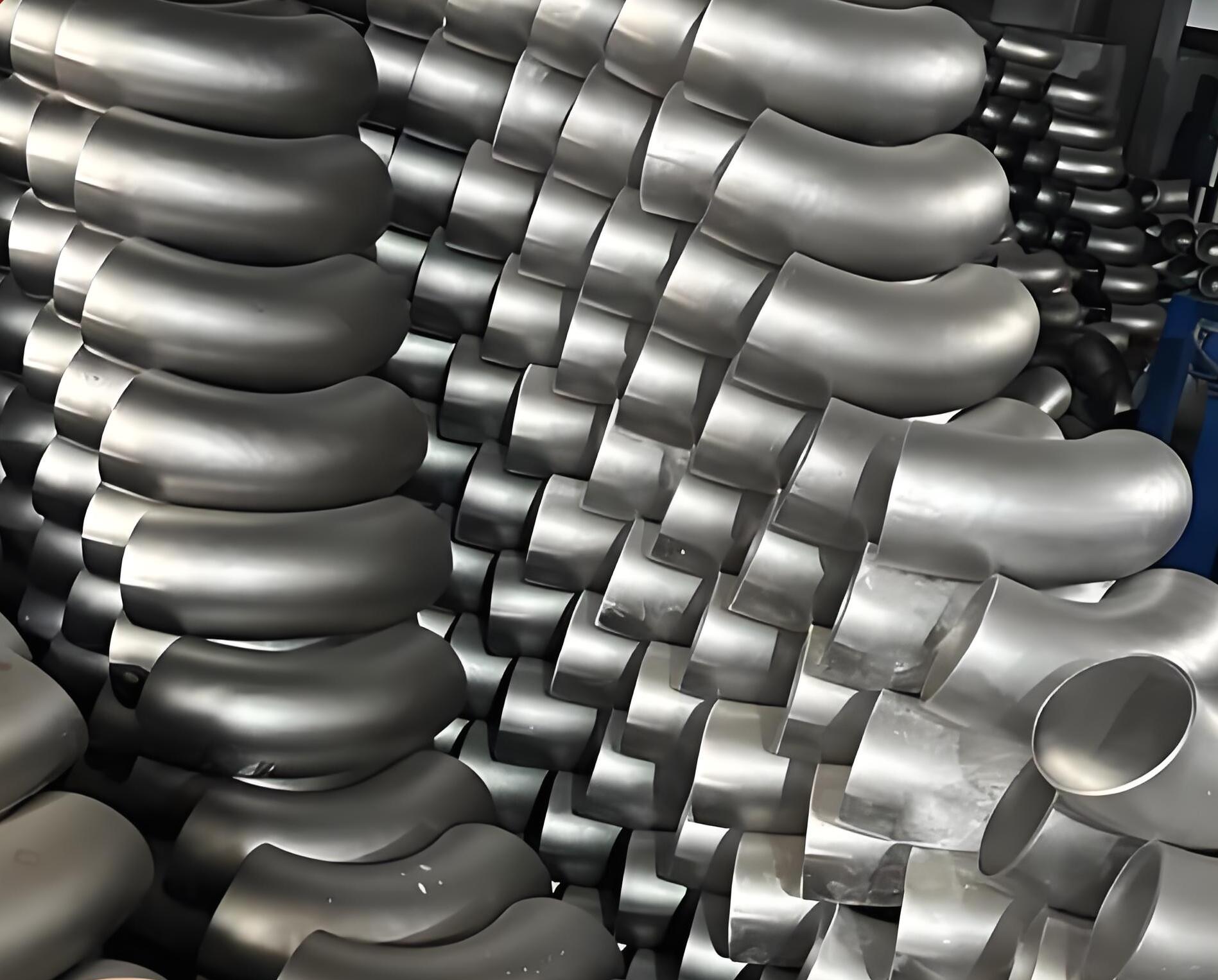
Long-radius vs. short-radius 90° elbows: the core difference lies only in the bend radius, R=1.5D versus R=1.0D
When purchasing a 90° elbow, one of the first parameters to determine is whether to choose a long-radius (LR) or short-radius (SR) type. This choice does not involve material quality or processing sophistication; it is purely a geometric difference in bend radius, but it directly affects the resistance, stress distribution, and installation space of your piping system.
How the bend radius is defined: geometric differences between LR and SR
The bend radius R refers to the curvature radius of the elbow's centerline, expressed as a multiple of the nominal diameter D:
- Long radius (LR): R = 1.5D.For example, for a DN100 elbow, the bend radius is 150 mm.
- Short Radius (SR): R = 1.0D.For the same DN100, the bending radius is only 100mm.
In terms of appearance, LR elbows are more "stretched" with a gentle bend;SR elbows are more "compact" with a sharp turn. Under the same nominal diameter, both have the same end face dimensions (connection size), and the difference lies only in the bending arc length and space occupied by the elbow body. The center-to-end distance of an LR elbow is approximately 1.5 times the DN, while that of an SR elbow is about 1.0 times the DN, meaning that in piping layout, SR can save about one-third of the space.
How does the bending radius affect fluid resistance and stress concentration?
The size of the bending radius directly determines how sharply the medium turns when flowing through the elbow, which in turn affects two key indicators:
Fluid resistance: When the medium turns inside the elbow, centrifugal force and eddy currents are generated. The sharper the turn, the greater the energy loss. SR elbows have a smaller curvature, causing a more abrupt change in the direction of the medium flow, and their local resistance coefficient is significantly higher than that of LR elbows. In pumping systems or long pipelines sensitive to pressure drop, this difference can accumulate into a considerable energy consumption gap.
Conversely, LR elbows provide a smoother transition, resulting in a more uniform velocity distribution of the medium and a smaller pressure drop.
Stress concentration: Elbows are weak points in piping systems, and during operation they withstand the combined effects of internal pressure, thermal expansion, and external loads. The smaller the bending radius, the more uneven the wall thickness stress distribution on the inner and outer sides of the elbow, and the higher the stress concentration factor. In pipelines under high-temperature and high-pressure conditions or with frequent thermal cycling, the fatigue life of SR elbows is typically lower than that of LR elbows.
This is also why pipeline design codes for harsh conditions such as petrochemical and power industries generally prioritize the use of LR elbows.
Practical Selection Judgment:
| Judgment Dimension | Prefer LR (1.5D) | Prefer SR (1.0D) |
|---|---|---|
| Space Constraints | There is ample installation space | Limited space in pipe galleries and equipment areas |
| Medium characteristics | High pressure, high temperature, viscous media | Low pressure, normal temperature, clean media |
| System requirements | Pressure drop sensitive, energy consumption needs to be controlled | Pressure drop impact is not significant |
| Stress environment | Frequent thermal cycling, vibration conditions | Static, low-stress pipelines |
| Cost considerations | Regular inventory, transparent pricing | Material savings, reduced pipeline length |
It should be noted that SR elbows are not a "low-end" product; they are a reasonable and necessary choice in space-constrained situations (such as equipment-dense areas and pipe rack interlayers). The key is whether your operating conditions allow for higher resistance and stress concentration. If you are unsure whether the current pipeline's pressure rating and temperature conditions are suitable for SR elbows, you can provide the specific operating parameters (medium, pressure, temperature, installation space dimensions) to the Guojie team, and we will help you confirm the matching solution according to GB/T12459 or ASME B16.9 standards.
When should you choose a long-radius elbow?Systems with ample space, high pressure and high temperature, or sensitivity to pressure drop should prioritize
The core trade-off between long-radius elbows (LR, bend radius R=1.5D) and short-radius elbows (SR, R=1.0D) lies inspace occupationandflow performance. The judgment criterion is not complicated: if the piping system is sensitive to pressure loss, or the medium temperature or pressure is high, long-radius elbows are usually the safer choice.
Advantageous scenarios for long-radius elbows: low resistance and high safety
Does a long-radius elbow have high resistance? No, quite the opposite. Compared to short-radius elbows, long-radius elbows have a gentler bending path, resulting in less turbulence when the medium changes direction and lower local resistance.
This means that under the same flow rate, the system pressure drop is smaller, and the energy consumption of pumps or compressors is lower.For long-distance pipelines sensitive to pressure drop, it can reduce the need for intermediate pressurization.
Under high pressure and high temperature conditions, the advantages of long-radius elbows are also prominent. The inner side of the elbow bears additional stress when the medium changes direction; the larger the bending radius, the lower the stress concentration factor. Therefore, in high-temperature and high-pressure steam pipelines and main pipelines of chemical plants, design codes typically require the use of long-radius elbows—this is a matter of safety margin, not preference.
Guojie long-radius elbows are available in carbon steel, stainless steel, and alloy steel, meeting the requirements of various working conditions such as high temperature, high pressure, and corrosion.
Where long-radius elbows are not suitable: compact layouts with extremely limited space
The most typical case is compact layouts with extremely limited space. For example, in areas with dense equipment nozzles, pump inlet and outlet pipelines, or when multiple layers of pipelines are laid side by side in a pipe rack, long-radius elbows require significantly more installation space, which may lead to overall pipeline expansion, adjustment of support positions, or even changes in equipment layout. In these scenarios, although short-radius elbows have slightly higher resistance, they can significantly reduce the occupied space.
How to confirm the next step? First, measure the minimum available installation space at the pipe turning point (the distance from the pipeline centerline to the adjacent obstacle), then compare it with the structural dimensions of the long-radius elbow (center-to-end distance = 1.5 × nominal diameter). If space is sufficient, prioritize long-radius elbows;If not, then evaluate whether the pressure drop increase from short-radius elbows is within the system's allowable range.
When in doubt, provide the pipe diameter, wall thickness rating, medium parameters, and on-site space dimensions to the Guojie team, and verify specific dimensions and matching solutions according to GB/T12459 or ASME B16.9 standards.
What occasions are suitable for short-radius elbows?Choose them when space is limited, but must evaluate resistance and stress risks.
The core value of short-radius elbows: saving space.
The core value of short-radius elbows (SR, bending radius R=1.0D) is only one: they occupy less space when changing the direction of the pipeline. When your pipeline layout area is crowded by equipment, structural beams, or other pipelines, and there is no room for long-radius elbows (LR, R=1.5D), short-radius elbows allow the pipeline to complete a 90° turn within a more compact range.
Typical applicable scenarios include:
- Dense pipe rows in pump stations and compressor rooms, where pipe spacing is strictly limited.
- At equipment nozzle connections, where space is occupied by valves, instruments, and supports.
- Retrofit projects where the existing pipe rack has no spare dimensions, forcing a reduction in bend radius.
- Buried pipelines crossing obstacles, where the distance before and after the bend point is insufficient.
In these scenarios, short-radius elbows are one of the key choices to "fit in," which is their irreplaceability.
The cost of short-radius elbows: increased resistance and stress concentration, use with caution in high-pressure applications.
Short-radius elbows save space, but the cost is real. You need to evaluate two risks simultaneously:
Increased resistance. The smaller the bending radius, the more drastic the change in the direction of the medium flow, and the greater the local resistance loss. For liquid media, this means increased pump head consumption;for gases or steam, the pressure drop is more pronounced.
If your pipeline itself has little pressure drop margin, or is for long-distance transportation, short-radius elbows may cause insufficient pressure at the end. When selecting, multiply the number of elbows by the resistance increment of each one and include it in the total pressure drop of the entire pipeline.
Stress concentration. The wall thickness of a short-radius elbow changes more drastically at the bend, and the abrupt curvature change makes the elbow a stress concentration point in the piping system. In conditions with significant thermal expansion and contraction (such as high-temperature steam, pipelines with frequent start-stop cycles) or in systems with vibration or water hammer, short-radius elbows are more prone to fatigue cracks at the outer bend.
Criteria for judging high-pressure situations: Short-radius elbows themselves have pressure ratings, but whether they can be used depends on your actual working conditions—medium pressure, temperature, pipe wall thickness schedule (SCH), and whether alternating loads are present. The thicker the SCH, the stronger the pressure-bearing capacity, but the stress concentration issue does not disappear. If your system has high pressure and large temperature fluctuations, or the pipeline has obvious vibration, it is recommended to prioritize long-radius elbows;If space is truly limited, you need to confirm with the pipe fitting supplier the applicable pressure range of the short-radius elbow under that material and wall thickness, and decide based on the results of pipeline stress analysis.
A one-sentence trade-off: If space is sufficient, choose the long radius;Only if space is insufficient, choose the short radius, and must simultaneously confirm that the pressure drop is acceptable and the stress risk is controllable. Do not prioritize the short radius elbow just because it is slightly cheaper or in ample stock—the space and cost saved may not be enough to compensate for subsequent energy consumption and maintenance expenses.
If you are evaluating a specific project, it is recommended to organize the medium pressure, temperature, and pipeline routing diagram, and confirm with the Guojie team the matching solution for the short radius elbow under your required material and wall thickness grade, before deciding whether to adopt it.
90° Elbow Selection Decision Tree: Judge in Four Steps Based on Space, Pressure, Resistance, and Budget
Selection does not require thorough research of every parameter; only four questions truly matter. Answer them in order, and the answer will naturally emerge.
Step 1: Is space limited?
This is the first hard condition to confirm. Measure the clear distance on the outside of the pipe bend—if the distance from the outside of the elbow to a wall, equipment, or another pipe is less than 1.5 times the pipe diameter, a short radius (SR, R=1.0D) is one of the key choices to consider;if space is ample, directly choose a long radius (LR, R=1.5D) without hesitation.
Judgment criteria:
- Obstacles on the outside of the bend, insufficient clear distance → short radius
- Buried pipelines, installation in trenches, compact space → short radius
- Above-ground pipelines, pipe racks, equipment area connections, normal space → long radius
Step 2: What are the medium pressure and allowable pressure drop?
Space determines whether it can be used, while pressure and resistance determine whether it should be used. Here is a key trade-off:Short-radius elbows have higher local resistance and greater pressure drop than long-radius elbows. For the same pipe diameter and flow rate, the resistance coefficient of a short-radius elbow is approximately 1.3 times that of a long-radius elbow.
If your system has a tight allowable pressure drop, or the medium is high-speed gas or steam, long-radius elbows are the safer choice.
The pressure rating itself does not directly determine whether to choose LR or SR; it is determined by the wall thickness schedule (SCH) and material. But note:Under high-pressure conditions, the outer wall thickness reduction of short-radius elbows is more pronounced.If a short radius must be used, it is recommended to increase the wall thickness rating by one level and confirm with the supplier the wall thickness verification result for this specification under this pressure.
Step 3: Resistance Sensitivity and Medium Characteristics
This step is an extension of Step 2, but it deserves separate consideration:
- Medium contains particles, prone to wear → choose long radius to reduce erosion
- Medium is viscous liquid or slurry → choose long radius to reduce clogging risk
- Pipeline is at pump discharge, sensitive to flow loss → choose long radius
- Just ordinary water, gas, or steam with sufficient pressure drop margin → either length is acceptable, decide based on space
Step 4: Budget and Supply Lead Time
Are long radius elbows more expensive than short radius ones? Not necessarily. With the same material and wall thickness, long radius elbows use slightly more material, so the price is usually 5%-15% higher;however, in space-constrained conditions, short radius elbows often require additional compensators or changes in pipeline routing, which may result in higher overall costs.
Additionally, short radius elbows are non-standard common parts, and the availability of some specifications in stock is lower than that of long radius elbows, potentially leading to longer delivery times. If the project schedule is tight, first confirm whether the specifications you need are in stock.
Final conclusion:
| Working conditions | Recommendation |
|---|---|
| Normal space, no special requirements | Long radius (LR) |
| Limited space, insufficient outer clearance | Short radius (SR), increase wall thickness rating if necessary |
| High pressure or high flow velocity media | Long radius, and verify wall thickness check |
| Media containing particles, prone to wear | Long radius |
| Tight schedule, need stock | Confirm inventory first, then decide LR/SR |
Cases where short radius is not recommended: When there is ample space but you choose a short radius to save a bit on material costs—the money saved may not be enough to offset the energy loss caused by pressure drop. Cases where long radius is not recommended: When space is truly insufficient, forcing a long radius will cause the pipe to hug the wall, leaving inadequate maintenance space.
Frequently Asked Questions
Q1: How to distinguish long radius and short radius elbows by appearance? Look at the curvature. Long radius elbows have a gentle curve and a longer curved section;short radius elbows have a sharp turn and are more compact overall.
The most accurate way is to measure the distance from the center of the elbow to the face: long radius is approximately 1.5 times the nominal diameter, short radius is approximately 1.0 times.
Q2: What parameters must be provided for selecting a 90° elbow? At least five items: nominal diameter DN, wall thickness schedule SCH, material grade, bend radius (LR or SR), and connection type (butt weld/socket weld/threaded/flanged). If used for high pressure or special media, design pressure and temperature must also be provided for wall thickness verification.
Q3: Can short radius elbows be used in high-pressure pipelines? It can be used, but it is necessary to confirm whether the wall thickness is sufficient. Short radius elbows have more obvious thinning on the outer side during the bending process, and under the same SCH grade, the pressure-bearing capacity is slightly lower than that of long radius elbows.
It is recommended to increase the wall thickness grade by one level when selecting short radius elbows under high-pressure conditions, and ask the supplier to provide wall thickness inspection data for that specification.
Q4: What standards and materials do Guojie's 90° elbows support? They support production according to national standards GB/T12459, GB/T13401, and American standard ASME B16.9, with materials covering carbon steel, stainless steel, and alloy steel. Non-standard specifications can be customized according to drawings. The delivery cycle depends on the specification. Confirm the specific production schedule with the sales team before placing an order.
Q5: How to confirm the quality of elbows is reliable when purchasing? Ask the supplier to provide material test reports (MTR) and confirm whether non-destructive testing is supported. Guojie can provide a full set of material reports and non-destructive testing services. For export orders, bevel protection and rust-proof, moisture-proof packaging are also available.
Learn more
The key to selection is to match the working condition parameters with the geometric characteristics of the elbow.If you are evaluating the selection of 90° elbows for a specific project, it is recommended to organize the medium, pressure, temperature, pipe diameter, and on-site space dimensions. The Guojie team can assist you in verifying dimensions and matching solutions according to GB/T12459 or ASME B16.9 standards.
Related products:90° elbow