Introduction
In petrochemical, coal chemical, thermal power generation, and oil and gas gathering and transportation projects, reciprocating compressors, plunger pumps, safety valve discharge lines, and gas-liquid two-phase flow pipelines are highly prone to persistent pipeline vibration.Vibration sources include fluid pressure pulsation, mechanical excitation from equipment, gas column resonance, water hammer impact, and various other factors.Conventional steady-state pipeline fittings are selected only based on static pressure and temperature and do not have the ability to withstand cyclic dynamic loads. Under sustained vibration, microcracks will gradually appear in the fitting body, welds, flange seals, and connecting bolts, bolts will loosen, and gaskets will fail, ultimately leading to medium leakage and, in severe cases, pipeline rupture, causing safety production accidents.
A large number of engineering accident cases show that the failure of vibrating pipelines is not simply due to insufficient static strength of the fittings, but rather because the fitting structure and the associated reinforcement and limiting components did not account for dynamic alternating loads.In many projects, the procurement stage directly applies ordinary pipeline procurement lists and only raises the nominal pressure rating, without simultaneously purchasing reinforced supports and damping limiting accessories, and without optimizing the fitting structure for vibration resistance, so vibration exceeding limits occurs shortly after commissioning.The treatment of vibrating pipelines includes two levels: first, vibration resistance optimization of the pressure-bearing fitting body; second, associated reinforcement and limiting components. Together they form the vibrating pipeline reinforcement system, and neither can be omitted.
The common problem in current industry procurement is that procurement personnel only focus on nominal diameter and pressure rating while ignoring dynamic parameters such as natural frequency, vibration displacement, and dynamic load amplitude;Reinforcement components and the pipe body are procured separately, and products from different manufacturers do not match;The technical agreement does not specify dynamic load tests or fatigue inspections;The supply documentation lacks modal analysis and vibration verification calculation reports;Ordinary plate-type flat welding flanges and short-radius elbows are selected, resulting in high stress concentration and an inability to adapt to continuous vibration conditions.Therefore, an independent procurement standard must be established for vibration pipe reinforcement fittings, embedding dynamic requirements into procurement technical documents, unifying the technical specifications for the fitting body, reinforcement supports, and limiting damping components, and reducing the risk of vibration pipe failure from the source of material procurement.This article systematically discusses vibration pipe operating condition determination, reinforcement fitting body selection, supporting reinforcement components, materials, inspection and testing, contract technical clauses, supervision and acceptance, procurement pitfalls, and other content.
I. Identification of Vibration Pipe Operating Conditions and Collection of Pre-Procurement Parameters
Before procurement work begins, the primary task is to complete the identification of vibration conditions and collect basic dynamic parameters; one must not directly proceed to compiling the material list.Procurement personnel need to work with the design and stress disciplines to confirm the sources of vibration excitation, distinguish steady-state continuous vibration from transient impact vibration, and determine whether the pipeline has a resonance risk.The core parameters that need to be collected include: pipeline medium, design pressure, design temperature, pipe diameter and wall thickness, excitation frequency, vibration displacement limit, dynamic load amplitude, number of cycles, medium corrosiveness, pipeline thermal expansion, and installation space constraints.
According to the GB/T32270 pressure piping and power piping code, piping subjected to excitation from reciprocating equipment is classified as dynamically loaded piping; support hangers and reinforcement materials must not use rimmed steel or ordinary cast iron, as such materials have poor toughness and are prone to brittle fracture under vibration.Modal analysis and harmonic response analysis need to be carried out using piping stress software such as CAESAR II to calculate the natural frequency of the pipeline, ensuring that the pipeline natural frequency avoids the equipment excitation frequency and preventing resonance from amplifying the vibration amplitude.If the natural frequency falls within the excitation frequency range, replacing pipe fittings alone cannot solve the problem; rigid reinforcement supports and damping limit devices must be provided to change the stiffness of the piping system and move it out of the resonance range.
Operating condition classification is the basis for procurement selection.For low-amplitude vibration pipelines, only the fitting structure needs to be optimized, along with conventional reinforced pipe clamps;For medium- and high-amplitude continuous vibration pipelines, the inspection level of the fitting body, welds, and flanges must all be raised, and rigid limit supports must be added;For pipelines with severe vibration and transient impact, in addition to forged pipe fittings, dedicated reinforcement components such as damping shock absorbers, anti-sway braces, and limit stops need to be procured.All vibration-related parameters and modal analysis conclusions must be attached as appendices to the procurement technical agreement and serve as the basis for the supplier's design and manufacturing; material requisitioning must not rely solely on drawing dimensions.
II. Procurement Requirements for Vibration-Resistant Selection of Pressure-Bearing Pipe Fitting Bodies
Under vibration conditions, elbows, tees, reducers, and flanges are high-incidence locations of stress concentration. The selection principle for pipe fitting bodies is to reduce stress concentration, improve structural integrity, reduce the number of welds, and enhance fatigue resistance.
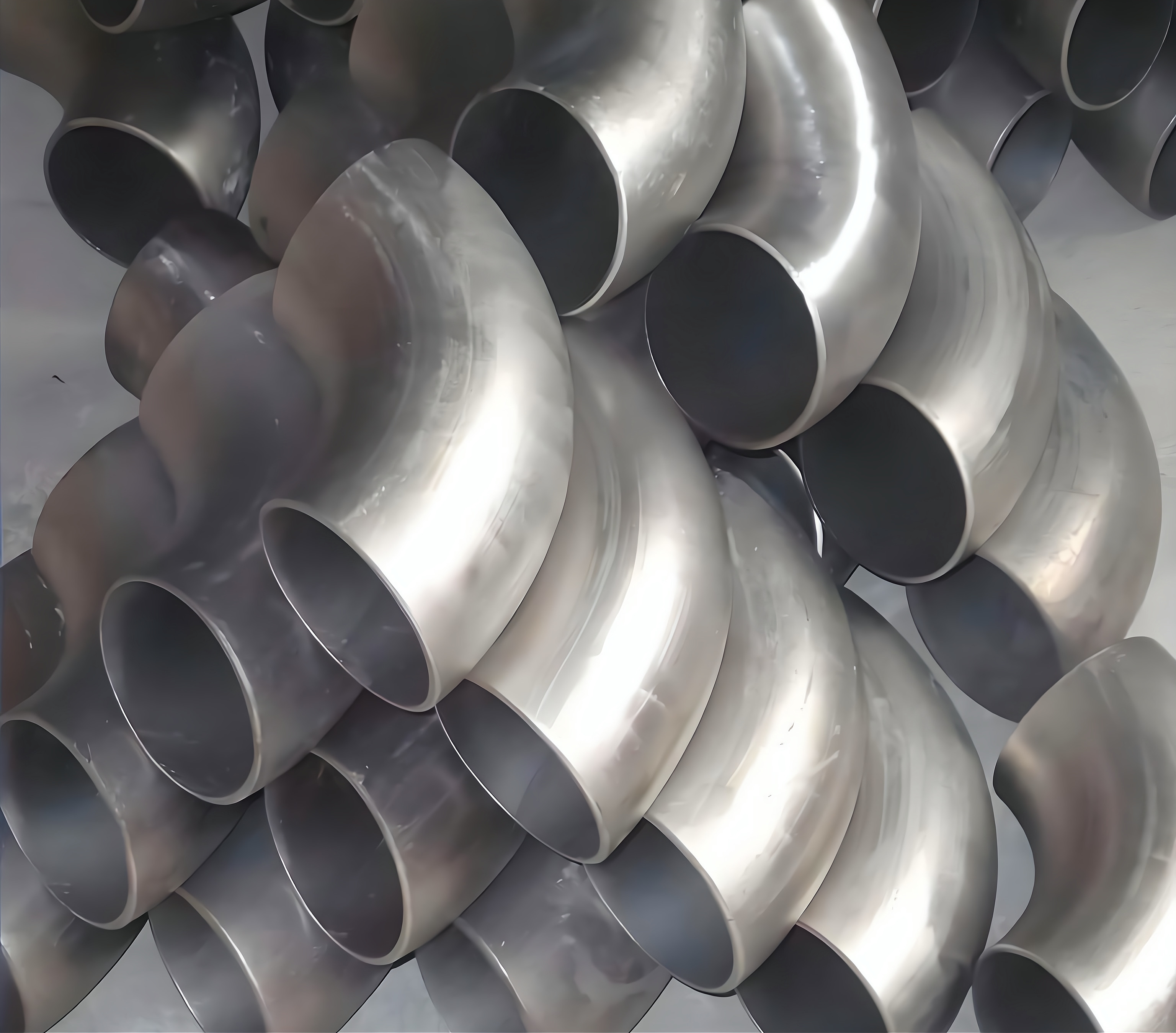
Elbow procurement: Short-radius elbows and mitered elbows are strictly prohibited for vibrating pipelines.Priority shall be given to procuring long-radius R=1.5D butt-welded elbows.Mitered elbows have multiple splice welds, and stress concentration at the weld roots is significant, making them highly prone to cracking under alternating vibration loads.The wall thickness reduction of elbows after forming shall be strictly controlled. The technical agreement shall specify the minimum measured wall thickness limit; excessive forming reduction will weaken the cross-section and amplify vibration stress.Original defects such as scratches and pits are not allowed on the inner and outer surfaces of elbows; surface defects will propagate into fatigue cracks under sustained vibration.
Tee and branch connection: For pipelines with severe vibration, integrally forged tees shall be preferred, and welded branch pipes with opening reinforcement shall be avoided.There is an obvious notch effect at the corner of the welded branch connection, where alternating vibration stress concentrates, making it a high-frequency failure location.If site conditions require the installation of a branch outlet, integral forgings shall be used, with smooth fillet transitions at the corner positions to eliminate sharp-angle notches and reduce the stress concentration factor.
Reducers and pipe caps: Forged butt-welded reducers shall be used, with a gentle transition in the conical section; stepped abrupt structures are prohibited, as stress peaks will occur at positions of abrupt cross-section change.For pipe caps, elliptical or dished integrally forged pipe caps shall be preferred, and spliced welded structures shall be avoided.
Flange selection: For pipelines under vibration conditions, extensive use of plate-type slip-on flanges is prohibited.The root weld of slip-on flanges has obvious stress concentration; sustained vibration will cause weld cracking and repeated gasket slippage and leakage.Prefer welding neck flanges, with full-penetration welding at the groove where the flange connects to the pipe.Strictly control the machining roughness of the sealing surface; use anti-loosening fasteners for the matching bolts, add spring washers, toothed washers, or apply thread-locking adhesive to prevent bolt loosening and gasket failure under vibration.Gasket materials must match the temperature, medium, and vibration conditions; select gaskets resistant to creep and alternating loads. Ordinary flexible graphite gaskets are prone to loosening and failure under high-frequency vibration.
Welding groove requirements: all butt grooves must transition smoothly, and weld toes must be ground smooth after welding to reduce stress concentration at the weld toe.The welding process must have qualified WPS/PQR; post-weld heat treatment shall be performed as required to eliminate welding residual stress. Residual stress superimposed on alternating vibration loads will accelerate the initiation and propagation of fatigue cracks.
III. Technical requirements for the procurement of supporting reinforcement, limiting, and vibration-damping components
The reinforcement fitting system for vibrating pipelines, in addition to the pressure-bearing fittings themselves, also includes rigid supports, anti-sway braces, limit stops, vibration-damping pipe clamps, dampers, and other reinforcement components. These reinforcement components are the core parts for suppressing pipeline displacement and changing the natural frequency of the piping system. During procurement, they must be matched with the pipeline fittings under unified technical standards; separate procurement can easily lead to dimensional mismatch and insufficient load capacity.
1. Rigid reinforcement supports and anti-sway braces: used to limit lateral and longitudinal sway of the pipeline, improve the overall stiffness of the piping system, and change the natural frequency.For reinforcement bracket materials, steel grades with qualified impact toughness such as Q355B and P265GH shall be preferentially selected, and surface MT/PT inspection shall be performed on welds at welded locations.The foundations of reinforcement brackets shall be set independently. The foundation of the inlet and outlet piping brackets of reciprocating compressors should not be directly fixed to the plant platform, beams, or columns, so as to prevent vibration from being transmitted to the building structure and causing secondary resonance.The load class of the bracket shall be determined based on the dynamic analysis report, and the safety factor shall be higher than that of conventional static brackets.
2. Vibration-damping pipe clamps: heavy-duty pipe clamps with rubber damping liners, which absorb vibration energy and isolate the transmission of pipeline vibration to the supporting structure.The liner rubber material must match the medium temperature and be oil-resistant and corrosion-resistant; for high-temperature pipelines, fluororubber material shall be selected.For pipe clamps, the DIN3015 heavy-duty series shall be preferentially selected, and the bolts shall be equipped with anti-loosening structures to prevent thread loosening under long-term vibration. The inner surface of the pipe clamp must not scratch the outer wall of the pipe, so as to avoid surface notches inducing fatigue cracks.
3. Damping restraint devices (dampers, dynamic restraints): suitable for pipelines with severe vibration and transient impact; they allow thermal expansion and contraction displacement of the pipeline, but can quickly suppress impact vibration displacement.When purchasing dampers, the rated damping force, stroke, and operating temperature must be clearly specified, and the product must be provided with a dynamic performance test report. Static spring supports and hangers must not be directly selected to replace damping devices.Spring supports and hangers mainly compensate for thermal displacement, and their vibration suppression effect is limited.
Reinforcement procurement must clearly specify: the dimensions, load parameters, material, and anti-corrosion standards of all reinforcement components must match the pipe outer diameter and design dynamic load.For hot-dip galvanized anti-corrosion reinforcement components, the zinc coating thickness is determined by classification according to the corrosive environment; in marine and chemical corrosive environments, the anti-corrosion grade is raised.Before delivery, reinforcement components require a load performance test report and a non-destructive testing report for key welds.
IV. Material Procurement Acceptance Standards
For material selection of pipe fittings and reinforcement components under vibration conditions, the core indicators are good plasticity and impact toughness, reducing notch sensitivity and resisting alternating dynamic loads.Rimmed steel is not allowed for materials, and impact testing is a mandatory inspection item; for normal-temperature and low-temperature conditions, low-temperature impact tests shall be supplemented according to specifications.
Carbon steel materials: A105 forgings, 20# killed steel, P265GH; impact test reports are required, chemical composition and mechanical properties must be checked, and the content of impurities S and P must be controlled, because excessively high impurities will reduce material toughness and accelerate fatigue crack propagation.Austenitic stainless steel shall be 304 or 316L, guaranteed in the solution heat treatment condition, with intergranular corrosion susceptibility controlled.For chromium-molybdenum alloy steel under high-temperature service conditions, in addition to conventional mechanical properties, the material S-N fatigue curve must be verified to evaluate fatigue life under cyclic loading.
For reinforcing support structural steel and steel plates, killed steel shall be preferred, with material certificates and heat/batch number traceability provided.For rubber damping lining materials, test reports on aging resistance and compression set must be provided; after long-term repeated compression under vibration, the elastic decay must not exceed the limit.All materials shall be fully traceable by heat/batch number; material substitution must go through strict approval procedures, and suppliers are not permitted to change material grades without authorization.
V. Inspection, Testing and Ex-Factory Documentation Procurement Requirements
The inspection standards for vibration-reinforced pipe fittings are significantly higher than those for ordinary steady-state pipeline fittings. In the procurement technical agreement, the non-destructive testing ratio, acceptance grade, and dynamic test items must be clearly specified.For conventional pipeline welds, sampling inspection may be used; for butt welds of fittings under severe vibration cyclic service conditions, 100% RT or UT inspection shall be performed, and MT/PT surface inspection shall be added to detect surface microcracks.Microscopic surface defects rapidly propagate under sustained vibration, which is the main cause of fatigue failure.
Product test items: In addition to the conventional hydrostatic test, reinforced pipe fittings for high-vibration working conditions may, as agreed in the contract, undergo vibration cyclic endurance tests to verify whether the pipe fittings, flanges, and reinforced connection locations leak, deform, or loosen under the specified pressure, vibration frequency, and number of cycles.Reinforcement brackets and pipe clamps shall undergo rated load tests to verify ultimate load-bearing capacity and ensure that plastic deformation does not occur under dynamic loads.
List of factory delivery documents: material quality assurance certificate, impact test report, heat treatment records, full set of non-destructive testing reports, dimensional inspection records, wall thickness inspection report, modal and vibration stress analysis calculation report, reinforcement component load test report, anti-corrosion inspection report, product as-built drawings, and material heat number traceability table.Document review for vibrating pipeline projects must not be simplified. For projects with owner supervision, the purchaser shall arrange factory supervision, focusing on checking forming thinning, weld toe grinding, heat treatment execution, and reinforcement component load tests.Supplies lacking a dynamic analysis calculation report shall be judged as having incomplete documentation and shall not be accepted.
VI. Core Clauses of the Procurement Technical Agreement and Key Contract Control Points
The procurement contract and technical agreement for reinforced pipe fittings for vibrating pipelines must clearly state "vibrating working conditions, bearing alternating dynamic loads" as the basis for the supplier's manufacturing, so as to prevent the supplier from producing them as ordinary static pipe fittings.The technical agreement shall include the following core clauses: working condition description, excitation frequency, displacement limits;Restrictions on pipe fitting structural forms (short-radius elbows, miter elbows, etc. are prohibited);Material grades, impact test requirements;Welding WPS/PQR requirements, weld toe grinding requirements;Non-destructive testing ratio and acceptance level;Reinforcement load indicators, damping performance indicators;Factory documentation delivery list;Material substitution approval process; Factory supervision requirements; Dynamic load acceptance test;Allocation of responsibility for fatigue failure during the warranty period.
Contract quality penalty clauses require targeted provisions: if supplied pipe fittings and reinforcement components fail to meet the technical requirements for vibration conditions, and problems such as vibration-induced cracking, flange leakage, or support loosening occur after commissioning, the supplier shall bear the costs of rework, replacement, and downtime losses.It is explicitly prohibited for the supplier to downgrade vibration-reinforced pipe fittings and supply them as ordinary pipe fittings.During the procurement bid evaluation stage, it is necessary to review the supplier's supply performance for similar vibrating pipelines and reciprocating compressor piping, and to assess the supplier's dynamic analysis and vibration-resistant pipe fitting manufacturing capabilities; selection must not be based solely on price comparison for low-priced products.
VII. Common Misconceptions and Risk Prevention and Control Measures in the Procurement Stage
Misconception 1: Simply increasing the pressure rating as a substitute for vibration-resistant structural optimization.Increasing the PN or Class rating can only improve the static pressure-bearing capacity; it cannot reduce stress concentration, cannot solve the problem of alternating vibration fatigue, and vibration cracking will still occur.
Misconception 2: Reinforcement parts and pipe fittings are purchased separately from multiple suppliers, with no unified dynamic load standard; dimensions and loads do not match, and reinforcement fails after on-site installation.
Misconception 3: The technical agreement only specifies static parameters and does not indicate vibration conditions; the supplier manufactures according to ordinary pipe fittings, without full-scale non-destructive testing and without grinding the weld toe.
Misconception 4: Spring supports and hangers are used instead of damping limit devices; spring supports and hangers cannot effectively suppress high-frequency impact vibration and cannot serve as the main reinforcement component for vibration.
Misconception 5: Bolt anti-loosening and gasket selection are ignored; under vibration conditions, ordinary bolts loosen due to long-term reciprocating vibration, and gaskets leak under repeated alternating loads.
Risk prevention and control measures: clarify the vibration level in the technical disclosure at the early stage of the project, complete modal analysis, and incorporate dynamic parameters into the procurement documents;The procurement list shall package and purchase pressure-bearing pipe fittings, reinforcement supports, damping limit devices, and anti-loosening fasteners together;The technical agreement strictly limits the structural form of pipe fittings and prohibits the use of miter elbows and plate-type flat welding flanges in high-vibration pipelines;Factory supervision focuses on non-destructive testing, weld toe treatment, and load testing of reinforcement components;Incoming re-inspection adds wall thickness and appearance surface flaw detection sampling;After arrival, a special review of technical documents is conducted; acceptance will not be granted if the vibration analysis calculation report is missing.
VIII. Conclusion
Vibrating pipeline failure is fatigue damage caused by the coupling of fluid excitation, structural resonance, and alternating stress; procurement control cannot follow the conventional static pipeline procurement logic.The procurement system for reinforcement fittings of vibrating pipelines includes two major parts: the pressure-bearing fitting body and the supporting reinforcement and vibration-damping components. Procurement work requires upfront operating condition identification and modal analysis to determine resonance risk.For the fitting body, integrally forged components, long-radius elbows, and weld neck flanges are preferred to reduce stress concentration;Supporting procurement includes rigid anti-sway supports, heavy-duty vibration-damping pipe clamps, and damping limit devices to improve piping system stiffness and suppress vibration displacement.
Procurement technical documents must clearly specify special requirements such as impact toughness, welding treatment, 100% non-destructive testing, and dynamic load testing, and deliver complete dynamic calculation data.Procurement personnel should avoid common pitfalls such as simply increasing the pressure rating, splitting procurement, and simplifying inspection, and should implement reinforced pipe fitting procurement specifications across multiple dimensions including selection, materials, manufacturing, inspection, and documentation.For the inlet and outlet vibrating pipelines of reciprocating equipment in chemical, oil and gas, and power industries, strictly implementing the procurement standards for vibration-reinforced pipe fittings can effectively control pipeline vibration amplitude, reduce fatigue cracking and flange leakage accidents, and ensure the long-term safe and stable operation of the entire pressure piping system.
References
[1] GB/T 20801.3-2020, Pressure piping code—Industrial piping—Part 3: Design and calculation [S].
[2] GB/T 32270-2015, Pressure piping code—Power piping [S].
[3] GB 50981-2014, Code for seismic design of mechanical and electrical equipment in buildings [S].
[4] SH/T 3059-2012, Specification for selection of design materials for petrochemical piping [S].
[5] ASME B31.3-2022, Process Piping Code [S].
[6] TSG D0001-2009, Safety Technical Supervision Regulations for Pressure Piping—Industrial Piping [S].
[7] DIN3015, Standard for Heavy-Duty Pipe Clamps [S].