Introduction
Steam pipelines are widely used in engineering scenarios such as thermal power plants, chemical plants, and urban central heating. The medium has high-temperature and high-pressure characteristics, and pipeline fittings are continuously exposed to thermally alternating load environments. Unlike ambient-temperature pressure pipelines, the failure of high-temperature fittings is not instantaneous strength rupture, but delayed failure caused by long-term creep accumulation, thermal fatigue cracks, and internal wall oxidation spalling.Once fittings crack or flange seals fail, high-temperature and high-pressure steam is ejected, which can easily cause major safety accidents such as personnel scalding, equipment damage, and plant shutdown.The retrospective results of a large number of steam pipeline accidents show that the root cause of the vast majority of steam pipeline burst and leakage accidents is not design defects, but a lack of control in the procurement process: ordinary carbon steel fittings are used instead of heat-resistant alloy steel, without considering high-temperature creep strength;rolled fittings are used instead of integral forgings, and internal lamination defects expand under thermal cycling;post-weld heat treatment is ignored, and residual stress induces thermal fatigue cracks;wall thickness is selected according to ambient-temperature pressure, without checking the allowable stress of the material at high temperature;the sampling ratio for non-destructive testing is reduced, and tiny defects are missed.Matching flanges, gaskets, and fasteners are not suited to high-temperature conditions; under high temperature, gaskets age and bolt stress relaxation occurs, resulting in steam leakage.
High-temperature pressure-resistant pipe fittings include a full set of pressure-bearing piping components such as long-radius elbows, tees, reducers, caps, butt-welding flanges, and branch outlets. The pipes, fittings, flanges, fasteners, and sealing gaskets of the entire system must be uniformly included in the procurement control scope. It is not acceptable for only straight pipes to meet high-temperature standards while ordinary industrial components are selected for fittings.At present, procurement in the industry generally has several typical problems: procurement technical agreements merely label items simply as "steam fittings" without specifying design temperature, creep verification, or heat treatment requirements;procurement standards for medium- and low-temperature saturated steam and high-temperature superheated steam are confused, and ordinary 20# carbon steel is mistakenly used under superheated steam conditions;fittings are selected as rolled plate products with many welds, and creep damage preferentially initiates in weld areas under high temperature;wall thickness selection only considers nominal pressure and does not recalculate the minimum wall thickness according to allowable stress at the design temperature;post-weld heat treatment is simplified or omitted, so residual stress cannot be eliminated;alloy steel materials lack spectral re-inspection, and inferior materials are passed off as good ones;The flange sealing surface and gasket selection were not adapted to high-temperature operating conditions, and non-metallic gaskets that cannot withstand high temperatures were selected;Welding of dissimilar steels of different materials lacks qualification documentation;The mill certificates for pipe fittings are incomplete, lacking hardness, metallographic, and creep-related inspection reports;Domestic and international standards are mixed in use; for export steam projects, there is unfamiliarity with the ASME B31.1 power piping code, and differences in allowable stresses of high-temperature materials between domestic and international standards have not been reviewed.
The procurement of high-temperature, pressure-resistant steam pipe fittings falls under the special procurement of GCD power piping and GC1 industrial high-temperature pressure piping, where the five essential elements—high-temperature creep strength, heat-resistant material, heat treatment, non-destructive testing, and high-temperature sealing—are indispensable.Procurement work must not focus only on nominal pressure and dimensional specifications; it must make high-temperature allowable stress of materials, minimum wall thickness verification, forging grade, post-weld heat treatment, 100% non-destructive testing, hardness inspection, and pressure testing mandatory acceptance clauses, and establish a full-chain procurement control system covering supplier qualification access, technical agreement locking, manufacturing process supervision, finished product inspection and testing, documentation traceability, and incoming re-inspection.This article systematically elaborates the procurement rules for high-temperature, pressure-resistant pipe fittings for steam pipelines across dimensions including the creep failure mechanisms of high-temperature steam pipe fittings, pipeline operating condition classification, domestic and international high-temperature power piping standard systems, heat-resistant material access, pipe fitting structural selection, heat treatment requirements, non-destructive testing, pressure testing, mill documentation, typical procurement pitfalls and risk prevention and control, and full-lifecycle safety and economic evaluation, providing a complete technical basis for material procurement, supplier auditing, factory supervision, and incoming acceptance of thermal power generation, chemical superheated steam, and large urban heating network engineering projects.
I. Failure Mechanisms of High-Temperature Steam Pipe Fittings and Pre-Procurement Operating Condition Classification Identification
1.1 Failure Mechanisms of High-Temperature Steam Pipe Fittings
Under high-temperature steam conditions, the failure mechanisms of pipe fittings are mainly divided into three categories: creep failure, thermal fatigue failure, and high-temperature oxidation corrosion.Creep is the slow plastic deformation of a material over time under constant stress and sustained high temperature. The higher the temperature, the faster the creep rate. After long-term operation, creep voids and cracks form, ultimately leading to pipe burst. This is the most critical risk for superheated steam pipelines.Pipeline startup and shutdown and load fluctuations cause temperature cycling. Stress concentration locations such as elbows and tees of pipe fittings repeatedly undergo thermal expansion and contraction, generating thermal fatigue cracks;High-temperature steam causes oxidation of the inner wall of pipe fittings. The oxide layer spalls off, reducing wall thickness and further accelerating creep damage.
In addition to failure of the fittings themselves, failure of the flange sealing system is also highly frequent: at high temperatures, ordinary non-metallic gaskets age and carbonize rapidly;Bolts undergo stress relaxation at high temperatures, and the preload decreases, causing gaps to appear on the flange sealing surface and high-temperature steam to jet outward.Stress concentration points of pipe fittings, such as tee corners, inner and outer arcs of elbows, and branch connection locations, are the preferential initiation areas for creep cracks. Procurement and selection must reduce local stress concentration, give priority to integrally forged components, and reduce the number of welded joints.
1.2 Collection of Operating Parameters and Classification of Steam Pipelines
Before procurement is initiated, process operating parameters must be fully collected as the prerequisite for material selection, wall thickness calculation, and determination of inspection indicators. If the operating parameters are incomplete, procurement work shall not be carried out.The collected parameters include: medium (saturated steam/superheated steam), design pressure, maximum design temperature, and normal operating temperature;Pipeline category: GCD power pipeline or GC1 industrial pipeline;Pipeline start-stop frequency and temperature cycle amplitude;Steam purity, oxygen content, and impurities;Whether water hammer impact exists;Project execution standards (national standards GB/T32270, GB/T20801, or ASME B31.1).
According to the medium temperature classification, medium- and low-temperature saturated steam is generally below 300°C, while high-temperature superheated steam is usually above 450°C. When the temperature exceeds 425°C, the long-term use of ordinary carbon steel is restricted, and chrome-molybdenum heat-resistant alloy steel must be selected.The higher the pressure and the higher the temperature, the higher the creep risk, and the stricter the requirements for forging grade, heat treatment, and non-destructive testing.The risk of medium- and low-temperature saturated steam is relatively controllable, but it still belongs to pressure piping, and procurement standards must not be simplified;High-temperature and high-pressure superheated steam belongs to high-risk piping, with the highest level of procurement control.
At the stage of determining operating conditions, the entire set of steam piping uniformly implements the baseline standard.Domestic power plants and thermal steam piping are based on GB/T 32270 Power Piping Code, GB/T 20801, and TSG 31 Industrial Piping Safety Technical Supervision Regulations;For overseas power station export steam projects, when customers require international standards, the ASME B31.1 Power Piping Code is implemented. There are differences in high-temperature allowable stresses and creep assessment rules for materials under different standards, and they cannot be directly replaced as equivalents.
II. Review of Domestic and International Standards Systems for High-Temperature and Pressure-Resistant Steam Pipe Fittings
2.1 Current Core Domestic Standards
GB/T 32270 "Pressure Piping Code — Power Piping," the core national standard for power station and thermal steam piping, specifically for high-temperature power piping. It specifies fitting materials, creep verification, wall thickness calculation, heat treatment, non-destructive testing, and the rules for determining high-temperature allowable stress values for materials, and is the core basis for main steam piping procurement.
GB/T 20801 "Pressure Piping Code — Industrial Piping," the basic code for high-temperature steam piping in industrial facilities, sets out the complete set of requirements for fittings, flanges, and fasteners for GC1-class high-temperature piping.
TSG 31-2025 "Safety Technical Regulation for Industrial Piping," a mandatory regulation for special equipment, clearly specifies that piping with a temperature ≥450°C requires hardness testing and metallographic examination, non-destructive testing of alloy steel forgings, manufacturing qualification requirements, and quality control rules for fittings under high-temperature creep conditions.
DL/T 695 "Steel Butt-Welding Fittings for Power Stations," a fitting standard dedicated to thermal power, specifies dimensional tolerances, wall thickness reduction control, and out-of-roundness limits for power station elbows and tees, and is applicable to the procurement acceptance of main steam fittings for power plants.
NB/T 47008 "Carbon Steel and Alloy Steel Forgings for Pressure Equipment" and NB/T 47009 "Low-Alloy Steel Forgings for Low-Temperature Pressure Equipment," material specifications for high-temperature fitting forgings, and the basis for classification, mechanical properties, and heat treatment acceptance of alloy steel forgings.
NB/T 47013 "Non-Destructive Testing of Pressure Equipment," the criteria for UT, MT, PT, and RT non-destructive testing of high-temperature fittings; the acceptance level for alloy steel weld testing shall be no lower than Grade I.
GB 50235 "Code for Construction of Industrial Metallic Piping Engineering," the supporting acceptance requirements for piping pressure testing, installation, and post-weld heat treatment.
2.2 Mainstream Foreign High-Temperature Power Piping Standards
ASME B31.1, Power Piping Code, the general standard for steam pipelines in overseas power plants, specifies requirements for allowable stress of high-temperature pipe fittings materials, creep assessment, forging manufacturing, heat treatment, and pressure testing.
ASTM A335, Standard Specification for Seamless Ferritic Alloy-Steel Pipe for High-Temperature Service, the raw material specification for heat-resistant alloy steel pipes and fittings such as P11, P22, and P91.
EN10216, European standard for seamless steel tubes for pressure purposes at high temperature, applicable to fitting procurement for European heating and power plant steam projects.
2.3 Basic Principles of Standard Adaptation
The entire high-temperature steam piping system must adopt a unified baseline standard; straight pipes, elbows, tees, reducers, flanges, gaskets, and fasteners must all simultaneously comply with the same set of high-temperature power piping standards. It is prohibited for fittings to follow high-temperature standards while bolts and gaskets apply ordinary ambient-temperature industrial standards.For example, for the main steam piping of a GCD-class power plant, all fittings, flanges, and fasteners must simultaneously satisfy TSG31+GB/T32270+GB/T20801; it is not permissible to control only the fitting body while ignoring the matching sealing elements.For cross-standard equivalent substitution, a technical difference comparison document must be issued and may only be implemented after approval by the design party, the owner, and the special equipment management department.
Procurement red lines for high-temperature and high-pressure steam-resistant pipe fittings: material allowable stress shall be taken according to design temperature, and creep-resistant materials shall be selected for high-temperature superheated steam;high-temperature alloy steel components must undergo post-weld heat treatment;cast and rolled pipe fittings are prohibited for high-parameter main steam lines;flange sealing pairs and fasteners shall be adapted to high-temperature working conditions and matched with high-temperature-resistant sealing materials.
III. Material admission procurement specification for high-temperature pressure-resistant pipe fittings
For material selection of high-temperature steam pipe fittings, the core evaluation indicators are high-temperature creep strength, stress rupture strength, oxidation resistance, and thermal fatigue toughness; room-temperature mechanical properties are only basic references and cannot be used as the basis for selection.Material selection must distinguish between saturated steam and superheated steam, and the upper limit of material service temperature must be strictly controlled.
3.1 Material selection rules for pipe fitting bodies
Low-to-medium temperature saturated steam pipelines with temperature ≤425°C: 20# high-quality carbon steel forged pipe fittings may be selected, processed from seamless pipes as raw materials, conforming to NB/T47008. Carbon steel must not be used under working conditions above 425°C for long periods to avoid graphitization failure.
Superheated steam pipelines at 425°C~520°C: forged pipe fittings made of 15CrMo and 12Cr1MoV chromium-molybdenum heat-resistant alloy steel are selected, featuring good creep resistance, and are widely used in high-temperature steam pipelines in the chemical and thermal power industries.
High-temperature and high-pressure main steam pipelines above 520°C: forged pipe fittings made of P91 (10Cr9Mo1VNb) martensitic heat-resistant steel are selected, with excellent high-temperature creep strength, mostly used for main steam pipelines of large power stations;For higher temperature working conditions, austenitic heat-resistant stainless steels such as 304H and 316H may be selected.
Key points for procurement material review:
1. Raw materials must be processed from seamless steel pipes. Cast pipe fittings and plate-rolled pipe fittings are strictly prohibited for high-temperature and high-pressure main lines. Integral forged tees are preferred; directly drilling holes and welding branch pipes is not allowed, so as to eliminate sharp corners of stress concentration and reduce the risk of creep crack initiation.
2. The supplier shall provide MTC material certificates, heat numbers, chemical composition, and room-temperature mechanical properties; pipe fittings for high-temperature working conditions shall be accompanied by high-temperature rupture strength and hardness test reports;High-temperature pipe fittings at ≥450°C shall be provided with metallographic inspection reports as required to check for risks of graphitization and pearlite spheroidization.
3. Alloy steel materials must undergo spectral sampling re-inspection upon arrival to verify alloying element content and prevent ordinary carbon steel from being passed off as heat-resistant alloy steel.
4. Hot-formed pipe fittings and welded pipe fittings must undergo post-weld heat treatment to eliminate residual stress;For martensitic steels such as P91, the heat treatment process is strict, and the cooling rate and constant-temperature holding time must be clearly specified in the documentation.
5. When procuring dissimilar steel butt joints, complete welding qualification WPS/PQR documents must be provided, and the difference in thermal expansion must be evaluated to prevent interfacial thermal fatigue cracking.
3.2 Procurement specifications for sealing gaskets and fasteners
For high-temperature steam service, ordinary rubber or PTFE gaskets must not be selected.For medium- and low-temperature saturated steam, spiral-wound graphite gaskets may be selected;For high-temperature superheated steam pipelines, metal ring gaskets and flexible graphite metal composite gaskets are preferred; the maximum service temperature of the gasket must be higher than the pipeline design temperature, and the oxygen content of graphite gaskets must be controlled to prevent high-temperature oxidation and pulverization.
The fastener material must match the flange material, and heat-resistant alloy steel bolts and nuts shall be selected;At high temperatures, bolts will undergo stress relaxation. The technical agreement shall specify the bolt material, hardness range, and pre-tightening process, and control the hardness difference between bolts and flanges to prevent high-temperature seizure;When purchasing bolts, material certificates and hardness test reports shall be provided.Gaskets and fasteners are components of high-temperature pressure-bearing systems and must be included in the overall procurement scope; ordinary room-temperature accessories must not be purchased separately.
IV. Procurement Rules for Structural Selection of High-Temperature Pressure-Resistant Pipe Fittings
For the structural selection of high-temperature pipe fittings, in addition to the pressure-bearing wall thickness, the focus shall be on controlling stress concentration, elbow wall thickness thinning, and cross-section out-of-roundness to reduce the risk of creep and thermal fatigue.
1. Elbows: Long-radius R=1.5D seamless butt-welded forged elbows shall be preferred;Short-radius elbows and miter elbows are prohibited for high-temperature and high-pressure main steam pipelines.The bending area of the elbow has wall thickness reduction. During procurement, a minimum wall thickness limit on the inner arc side must be agreed upon, and the out-of-roundness of the elbow must be strictly controlled: no more than 3% for high-pressure conditions and no more than 5% for medium-pressure conditions, to avoid stress concentration during operation.
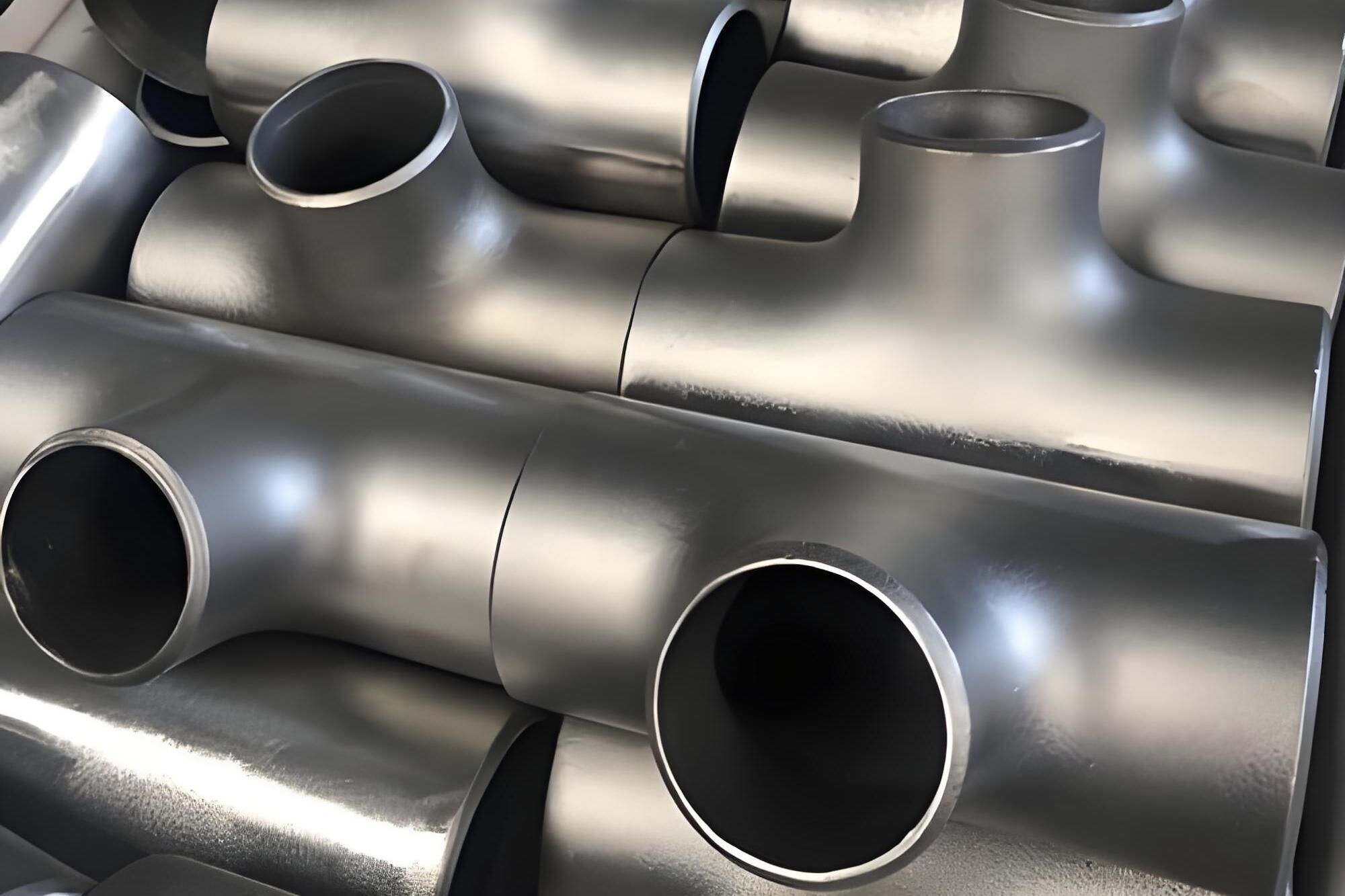
2. Tees: For high-temperature and high-pressure superheated steam main lines, integrally forged seamless tees are preferred; welded tees made by opening holes in plates are not recommended;The internal corners of the tee transition smoothly to reduce stress concentration and inhibit the initiation of creep voids.
3. Reducers: Concentric or eccentric forged reducers with gentle transitions, no abrupt steps, and smooth inner walls to reduce steam erosion; the local wall thickness must meet the minimum wall thickness calculation requirements for high temperature.
4. Flange selection: For medium- and low-temperature saturated steam with PN ≤ 2.5 MPa, raised-face flanges with neck butt welding may be used;For high-temperature and high-pressure superheated steam pipelines, tongue-and-groove face and trapezoidal groove flanges are recommended to improve high-temperature sealing stability. Plate-type slip-on flanges have insufficient rigidity and are prohibited for high-temperature and high-pressure steam main lines.
5. Caps: Elliptical forged head caps shall be used; flat-bottom heads shall not be used, to prevent bottom stress concentration and liquid accumulation corrosion.
The nominal inner diameters of the entire set of pipe fittings shall be kept consistent; steps in the inner diameter will generate vortices and erosion, accelerating local wall thickness reduction.It is recommended to purchase the entire set of high-temperature steam pipe fittings as a complete package, with unified material grades for fittings, flanges, gaskets, and fasteners;When supplied separately by multiple suppliers, material mismatches and inconsistent flange sealing face tolerances are likely to occur, leading to sealing failure under high temperature after assembly.
V. Procurement technical requirements for post-weld heat treatment, non-destructive testing, and pressure testing
Post-weld heat treatment is an essential key process in the procurement of high-temperature alloy steel pipe fittings; the welding process generates residual tensile stress, and under high-temperature service conditions, residual stress will accelerate the propagation of creep cracks.The procurement technical agreement shall specify the heat treatment process curve: heating rate, holding temperature, holding duration, and cooling rate. Alloy steels such as P91 and 12Cr1MoV must strictly undergo post-weld heat treatment. After heat treatment is completed, hardness testing shall be carried out; if hardness exceeds the limit, it indicates that the heat treatment is unqualified and the product must not leave the factory.
Non-destructive testing is a key means of detecting internal laminations and microcracks. For the body of forged pipe fittings for high-temperature and high-pressure steam, combined non-destructive testing of UT ultrasonic testing + MT magnetic particle testing + PT penetrant testing shall be performed;Butt welds shall be 100% tested by RT radiographic testing or UT ultrasonic testing in accordance with the NB/T47013 standard, with an acceptance grade not lower than Grade I;Non-destructive testing of alloy steel pipe fitting welds shall be carried out after heat treatment is completed, to avoid missed detection of new cracks generated by heat treatment.
Hydrostatic strength test: the test pressure shall be selected in accordance with GB/T32270 and GB/T20801;The hydrostatic test shall be conducted after heat treatment and non-destructive testing have all passed;The test medium shall be clean and non-corrosive; after the pressure test is completed, it shall be thoroughly blown dry to prevent corrosion of the inner wall.For high-temperature and high-pressure steam pipelines, an air tightness test shall be performed as necessary according to design requirements to inspect the flange sealing pair.
List of documents delivered at factory: material quality assurance certificate, heat number traceability table;UT/MT/PT non-destructive testing reports for forgings;post-weld heat treatment process curve, hardness testing records; hydrostatic test records; Inspection records for fitting drawings, dimensions, wall thickness, and out-of-roundness; Product certificate of conformity; Special equipment manufacturing license;Welding qualification WPS/PQR;Metallographic examination reports for high-temperature alloy steel provided as required;Material reports for gaskets and fasteners.
Incoming acceptance process: prioritize review of the complete set of technical documentation;Visual inspection of fitting surfaces for cracks, laps, and scratches;Focus on verifying the wall thickness reduction of elbows;sampling and spectral re-inspection of alloy steel;spot-checking the inner wall with an endoscope;re-testing hardness when necessary.If documents are missing, heat treatment records are incomplete, non-destructive testing fails, or wall thickness does not meet standards, the entire batch shall be rejected and must not be put into steam engineering.For GCD-class power station main steam projects, arrange factory supervision; the supervision shall focus on verifying forging flaw detection, the entire heat treatment process, wall thickness inspection, and hydrostatic testing.
VI. Control of Pipe Fitting Marking, Sealed Packaging, Storage and Transportation
After pipe fittings pass inspection, heat treatment, and hydrostatic testing, both ends of the fittings shall be plugged with oil-free sealing end caps to protect the bevels and keep the inside of the pipe clean;The flange sealing surface is wrapped with a dedicated protective film to prevent impact and scratches.The outer packaging shall prominently be marked with [High-Temperature Steam Pressure-Resistant Special Pipe Fittings], indicating the material, heat number, and pressure-temperature rating, with the markings permanently clear;It is strictly prohibited to mix and transport with ordinary carbon steel, sand and gravel, or hard materials, to prevent impact damage to the bevel and sealing surface.
The supplier and the receiving party shall set up dedicated storage areas for high-temperature pipe fittings, isolated by zone, moisture-proof and rust-proof;Alloy steel and ordinary carbon steel shall be stored separately to prevent carburization contamination;During lifting and handling, protect the bevel and flange sealing surface; hard objects are prohibited from directly contacting the sealing surface.Once the packaging is damaged or the bevel or sealing surface is impacted and damaged, re-machining and re-inspection are required, and it must not be used directly.The procurement technical agreement stipulates that impact damage to pipe fittings shall be deemed nonconforming, and the receiving party may reject them.
VII. Core Special Clauses of the Technical Agreement for the Procurement of High-Temperature Pressure-Resistant Pipe Fittings
The technical agreement of the procurement contract for steam high-temperature pressure-resistant pipe fittings shall include a separate special chapter for high-temperature operating conditions and shall not be merged into the general technical clauses.Core clauses: saturated/superheated steam as the medium, design pressure, design temperature, and pipeline GCD/GC classification;Applicable standards: GB/T32270, GB/T20801, TSG31;Pipe fitting material, forging grade, and creep verification requirements;Elbow wall thickness reduction and out-of-roundness control;Post-weld heat treatment process and hardness acceptance criteria;Non-destructive testing items, testing proportions, and acceptance levels; Hydrostatic test parameters; Flange type and sealing face form;Gasket and fastener materials and high-temperature performance;Pipe fitting identification and packaging protection;List of complete factory documentation;Factory pre-shipment supervision;Material substitution approval;Quality responsibility for creep failure and steam leakage; Safety breach clause.
Contractual provisions: The supplier shall not arbitrarily lower the material grade, omit heat treatment, or reduce the proportion of non-destructive testing;In the event of steam pipe burst or leakage accidents caused by material creep failure, absence of heat treatment, or insufficient wall thickness, the supplier shall bear all losses from rework, production shutdown, and safety accidents.Bid evaluation must not only compare prices; the focus should be on reviewing the supplier's manufacturing track record for heat-resistant steel pipe fittings, heat treatment capabilities, non-destructive testing qualifications, and special equipment manufacturing license.Low-priced products often simplify heat treatment, reduce the proportion of flaw detection, and use pipe fittings with insufficient wall thickness, posing major pipe burst safety hazards after being put into operation.The entire set of high-temperature pressure-resistant pipe fittings shall be packaged and purchased uniformly, with pipe fittings, flanges, gaskets, and fasteners supplied as a complete set, ensuring the complete matching of the high-temperature pressure-bearing sealing system.
VIII. Typical Misconceptions and Risk Prevention in the Procurement of High-Temperature Steam Pipe Fittings
Misconception 1: Selecting wall thickness based on nominal pressure at room temperature without recalculating allowable stress according to the design temperature, resulting in insufficient actual pressure-bearing capacity at high temperatures and long-term creep deformation.
Misconception 2: Using the same set of materials for saturated steam and superheated steam, and continuing to select ordinary carbon steel for working conditions above 450°C, resulting in graphitization and creep cracking.
Misconception 3: Selecting plate-rolled pipe fittings for high-temperature main pipelines, which have a large number of welds; creep damage develops preferentially in weld areas, causing pipe bursts.
Misconception 4: Omitting post-weld heat treatment, leaving residual stress inside the pipe fittings, which initiates thermal fatigue cracks under thermal cycling.
Misconception 5: Performing only sampling inspection for non-destructive testing instead of 100% flaw detection, so tiny internal defects go undetected and expand into macroscopic cracks during long-term high-temperature operation.
Misconception 6: Matching high-temperature flanges with ordinary non-metallic gaskets; at high temperatures the gaskets carbonize and age, causing steam jet leakage.
Misconception 7: Technical agreements are described too simply, lacking quantitative indicators such as creep verification, heat treatment, and wall thickness reduction limits, so there is no basis for judgment when quality disputes arise.
Misconception 8: Pipe fittings, flanges, and bolts are purchased separately; the thermal expansion coefficients and hardness from different manufacturers do not match, preload decays under high-temperature conditions, and sealing fails.
Risk prevention and control measures: In the early stage of the project, distinguish between saturated steam and superheated steam, determine the temperature and pressure ratings, and complete the material creep assessment;The technical agreement specifies heat-resistant materials, minimum wall thickness, heat treatment processes, and 100% non-destructive testing;The high-temperature and high-pressure main pipes use integrally forged components, with strict control of elbow wall thickness reduction;After heat treatment is completed, hardness is re-inspected, and pressure testing is conducted only after all non-destructive testing has passed;The bevels and sealing surfaces are protected throughout transportation; Factory supervision; Incoming documentation review + physical re-inspection;After pipeline installation is completed, a hydrostatic test and, if necessary, an airtightness test are conducted before commissioning.
IX. Full Life Cycle Safety and Economic Assessment for Procurement of High-Temperature Pressure-Resistant Pipe Fittings
For the procurement and selection of high-temperature steam pipe fittings, one must not merely compare initial purchase unit prices; evaluation must be based on safety throughout the full life cycle.For high-temperature and high-pressure main steam pipelines, P91 and 12Cr1MoV integrally forged pipe fittings are selected, with supporting heat treatment and a full set of non-destructive testing. The procurement cost is higher, but the creep resistance and thermal fatigue resistance are stable, greatly reducing the risk of pipe burst, shutdown, and safety accidents;For medium- and low-temperature saturated branch lines, qualified 20# carbon steel forgings can be selected. The procurement cost is relatively low, but wall thickness and oxidation conditions must be monitored regularly.
For medium- and low-temperature saturated steam branch lines, the risk is relatively low, and 20# forged carbon steel pipe fittings can be selected;For power plant main steam and chemical high-temperature superheated steam GC1/GCD main lines, chromium-molybdenum heat-resistant alloy steel integrally forged pipe fittings are preferred, with metal composite high-temperature gaskets.The core logic of selection is not to compress procurement costs, but to match the creep safety boundary corresponding to temperature and pressure. Once a high-temperature steam pipe burst occurs, the accident loss is far greater than the price difference in pipe fitting procurement.Procurement cost evaluation includes raw material procurement for pipe fittings, forging forming, heat treatment, non-destructive testing, hydrostatic testing, packaging and protection, factory supervision, subsequent metal supervision and testing, and the risk cost of pipe burst accidents.
X. Conclusion
The procurement of high-temperature and pressure-resistant pipe fittings for steam pipelines differs from the procurement of pipe fittings for normal-temperature pressure pipelines. Six major elements must be considered in a coordinated manner: high-temperature creep strength of materials, wall thickness verification, forging forming, post-weld heat treatment, non-destructive testing, and high-temperature sealing matching. The core objective is to suppress creep deformation and thermal fatigue cracks and prevent high-temperature steam leakage and pipe burst accidents.Domestic power station, chemical, and thermal high-temperature steam engineering shall be based on GB/T32270, GB/T20801, and TSG31 specifications;Foreign-related power station export steam projects may implement the ASME B31.1 power piping code.
Distinguish between saturated steam and superheated steam operating conditions; superheated steam above 425°C must use chromium-molybdenum heat-resistant alloy steel, and high-temperature and high-pressure main pipes shall not use cast or rolled pressure-bearing components;Alloy steel pipe fittings shall undergo post-weld heat treatment after welding to eliminate residual stress;Forgings and welds shall undergo 100% non-destructive testing, and overall strength shall be verified by hydrostatic testing;Elbows shall strictly control wall thickness reduction and out-of-roundness;High-temperature flanges shall be equipped with high-temperature-resistant sealing gaskets and heat-resistant fasteners.The procurement technical agreement shall include separate special high-temperature clauses to lock in material, creep assessment, heat treatment, and non-destructive testing indicators, and to implement supplier admission, factory supervision, and incoming re-inspection.
For steam engineering projects in thermal power plants, chemical facilities, and large-scale heat distribution networks, strictly implement the procurement rules for high-temperature and pressure-resistant pipe fittings for steam pipelines, avoid risks such as creep cracking, thermal fatigue failure, and steam jet leakage from the procurement source, eliminate safety accidents caused by high-temperature steam pipe bursts, and ensure the long-term stable and safe operation of high-temperature steam pressure pipelines.
References
[1] GB/T 32270-2016, Pressure piping code—Power piping [S].
[2] GB/T 20801, Pressure piping code—Industrial piping [S].
[3] TSG 31-2025, Safety technical regulation for industrial piping [S].
[4] DL/T 695-2014, Steel butt-welding pipe fittings for power stations [S].
[5] NB/T 47008, Carbon steel and alloy steel forgings for pressure equipment [S].
[6] NB/T 47013, Nondestructive testing of pressure equipment [S].
[7] GB 50235, Code for construction of industrial metallic piping engineering [S].
[8] DL/T 438, Technical supervision code for metals in fossil fuel power plants [S].
[9] ASME B31.1, Power Piping Code [S].
[10] ASTM A335, Standard specification for seamless ferritic alloy-steel pipe for high-temperature service [S].
[11] GB 50236, Code for construction of field equipment and industrial piping welding engineering [S].
[12] NB/T 47014, Welding procedure qualification for pressure equipment [S].