I. Introduction
Negative pressure pipelines are widely used in process scenarios such as chemical rectification towers, vacuum drying, negative pressure tail gas collection, condenser vacuuming, and vacuum distillation, where the medium pressure is lower than atmospheric pressure and the external atmospheric pressure becomes the load source.The failure of internal pressure pipelines is generally tensile yielding and bursting leakage;The typical failure of negative pressure pipelines is elastic buckling instability. When the wall thickness is insufficient, the length-to-diameter ratio is too large, or the cross-sectional stiffness is inadequate, pipe fittings will suddenly collapse inward. This kind of damage is a sudden instability, with almost no obvious deformation precursor before failure, and the risk is extremely concealed.
In procurement practice, there are widespread cognitive misconceptions: first, it is believed that since negative pressure is low, thin-walled standard pipe fittings can be selected at will;second, the internal pressure SCH wall thickness table is directly copied, ignoring the external pressure D/t and L/D stiffness ratio constraints;third, cast pipe fittings, fabricated welded elbows, and miter elbows are selected, and cross-sectional defects become weak points for buckling;fourth, sealing is configured according to atmospheric pressure flanges, and under vacuum conditions, micro-leakage gradually causes the system to lose vacuum and air to be sucked back, triggering oxidation and explosion risks;Fifth, acceptance only involves hydrostatic pressure testing, lacking strict airtightness testing.
Procurement of negative-pressure pipe fittings is not a simple low-pressure selection, but a specialized control system centered on external pressure stability verification, taking into account cross-sectional stiffness, continuous sealing performance, and manufacturing integrity.Conventional internal-pressure pipe fitting standards cannot directly replace dedicated procurement specifications for negative pressure; elbows, tees, reducers, pipe caps, and branch outlets each have independent external pressure verification logic and selection limitations.This article systematically reviews the full-chain specifications for procurement of negative-pressure pipeline fittings, covering material requisition, supplier evaluation, technical agreement preparation, supervision, and incoming acceptance, distinguishing the control differences between low vacuum and medium-high vacuum working conditions.
II. Pre-procurement working condition identification and boundary locking for negative-pressure pipe fittings
The first step in procurement must be to extract all boundary parameters of the vacuum working conditions; it is not sufficient to merely label them as "negative pressure."The following need to be confirmed: design external pressure (generally 0.1MPa full vacuum is taken as the conservative design value), working vacuum degree, maximum and minimum temperatures, medium composition, whether oxygen is present, flammable and explosive media, pipeline nominal diameter, effective calculated length between two supports or stiffening rings, and whether there are repeated pressure cycles during startup and shutdown.
The core parameters for external pressure stability calculation are the outer diameter-to-wall thickness ratio D/t and the unsupported length-to-outer diameter ratio L/Do; these two ratios determine the critical buckling pressure. At the same diameter, the longer the unsupported section, the thicker the allowable minimum wall thickness. For many large-diameter vacuum pipelines, even if the vacuum degree is not high, it is still necessary to thicken the pipe wall or add stiffening rings to improve stiffness.
Two types of negative pressure scenarios need to be distinguished: steady-state continuous vacuum;intermittent negative pressure formed after cooling and condensation—negative pressure generated by the cooling and condensation of steam pipelines is a secondary negative pressure condition that is easily overlooked, and it should likewise be checked against full vacuum.Process parameters and external pressure calculation conditions shall be written into the technical agreement and serve as the basis for the supplier's wall thickness and stiffness calculations; the supplier shall not simplify the process condition values on its own.
III. Material and Pipe Fitting Type Admission Specifications
For negative pressure pipe fittings, seamless forged and seamless push-formed structures shall be preferred, and weak structures shall be strictly restricted.Under the supporting control requirements of TSG 31-2025, cast pipe fittings, miter elbows, and segmentally welded pipe fittings are generally not permitted for vacuum high-hazard medium pipelines; splice welds reduce overall stiffness and preferentially crack under buckling stress.
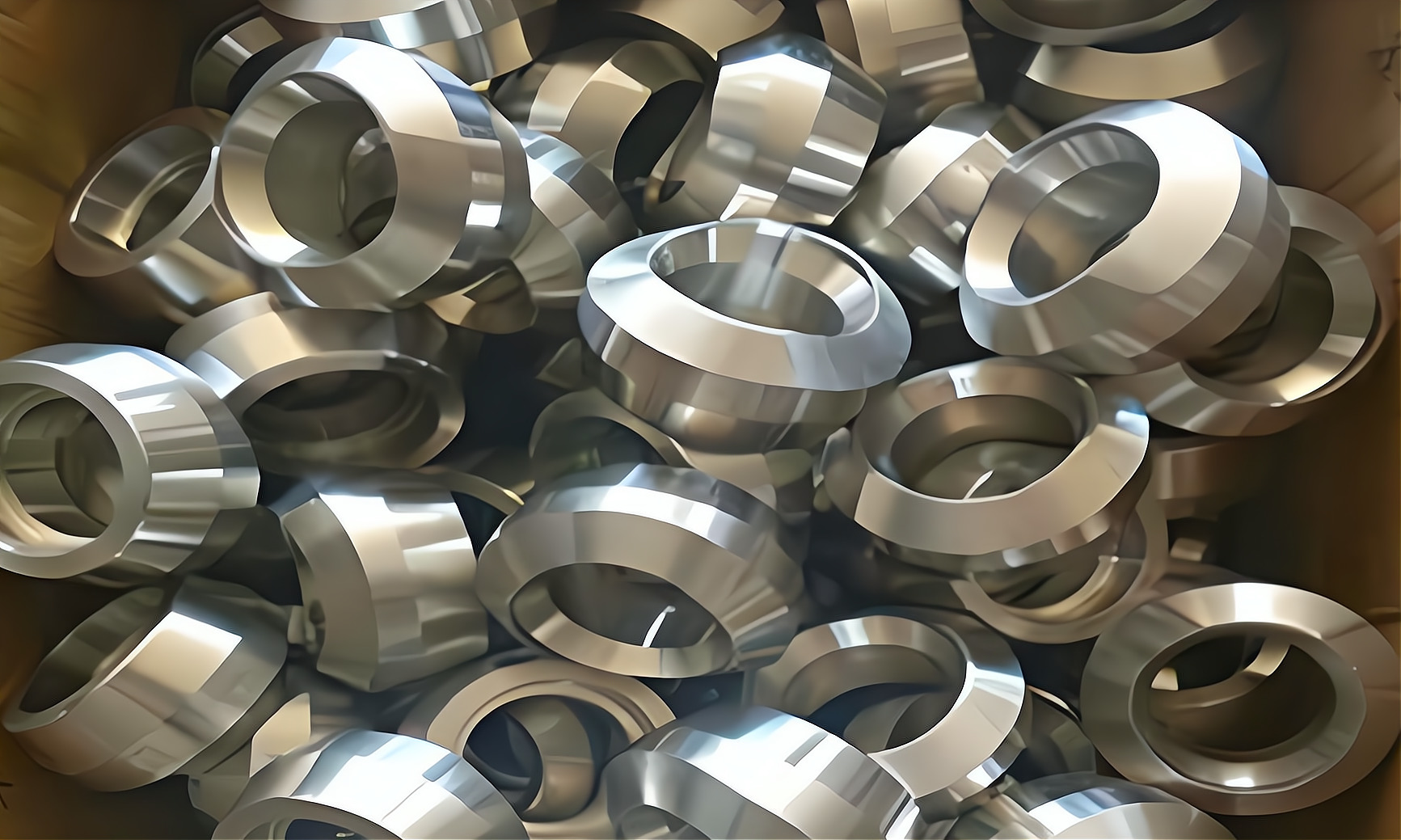
For elbows, long-radius seamless push-formed elbows shall be preferred; short-radius elbows shall be used only where space is limited and after a dedicated external pressure check;For tees, integrally forged seamless tees shall be preferred to avoid the reduction of cross-sectional stiffness caused by openings;For reducers, concentric reducers are preferred; eccentric reducers have an asymmetric cross-section and a lower critical buckling pressure, so they must be checked separately;For pipe caps, elliptical heads and dished heads are preferred; flat heads have poor stiffness and should be avoided as much as possible in large-diameter vacuum pipelines.For branch connections, integrally forged branch outlets are preferred; directly welding reinforcement pads onto openings in the main pipe is prohibited, as gaps under the pad are prone to leakage and at the same time disrupt the continuity of the shell, reducing external pressure stability.
In terms of material selection, carbon steel and austenitic stainless steel are commonly used materials; the materials must have good plasticity, with elongation meeting the lower limit specified in the code, and brittle materials are not suitable for alternating negative pressure conditions;For high-vacuum and oxygen medium pipelines, control internal porosity and slag inclusions in the material to reduce micro-leakage paths.
IV. Specifications for External Pressure Wall Thickness and Stiffness Verification
The wall thickness calculation of negative pressure pipe fittings follows the external pressure stability calculation method of ASME VIII-1 UG-28, which is completely different from the internal pressure Barlow formula; the controlling index is the critical buckling pressure, not the membrane tensile stress.
Verification process: first determine D/t and L/Do, consult the external pressure curves to obtain coefficients A and B, and verify the allowable external pressure Pa; Pa must be greater than or equal to the design external pressure with a safety factor reserved, and the stability safety factor for vacuum pipelines is generally not less than 3.0, higher than the internal pressure strength margin.When simply increasing the wall thickness is not economical, an external stiffening ring solution can be adopted to increase the critical buckling pressure by shortening the effective calculation length L.The stiffening rings must be continuously welded, and the cross-sectional moment of inertia must meet the requirements of the external pressure calculation sheet. Intermittent welding and local reinforcement pads cannot be used as reinforcing structures for vacuum piping.
Key points for marking the procurement list: SCH alone must not be the only marking; the technical agreement requires the supplier to simultaneously provide the external pressure stability calculation sheet, and to specify the allowable unsupported length and minimum formed wall thickness of pipe fittings;After the elbow is formed by bending, the thinning of the outer arc must also be included in the external pressure verification. The minimum wall thickness after forming must meet the stability requirements, and the SCH of the blank cannot be used as the acceptance basis.Many vacuum elbow instabilities are simply caused by the D/t ratio exceeding the limit after forming thinning.
V. Supporting specifications for vacuum sealing of flanges, gaskets, and fasteners
The sealing mechanisms of negative pressure and positive pressure are different: under positive pressure, the medium leaks outward; under negative pressure, outside air infiltrates inward. Tiny leak points will continuously damage the vacuum system. For pipelines carrying flammable and explosive media, air infiltration will form an explosive gas mixture, which is a major safety hazard.
For flanges, integrally forged flanges are preferred. The sealing face is selected according to the vacuum level: for low vacuum, RF raised-face may be used;For medium and high vacuum, MFM raised-face and RJ ring joint faces are recommended to prevent gasket slippage;Ordinary rubber gaskets are prohibited for long-term high-temperature service; for low vacuum, use temperature-resistant rubber or PTFE gaskets; for medium and high vacuum, use spiral-wound metal gaskets or solid metal ring gaskets, and the gasket sealing face compression specific pressure must meet vacuum sealing requirements.Bolt preload must be stable; select bolt materials resistant to relaxation; under temperature fluctuation conditions, use elastic gaskets or disc springs to compensate for stress relaxation.
For the same sealed joint, flanges, pipe fittings, gaskets, and bolts must be matched as a complete set; flange pressure class does not represent the vacuum sealing grade; even for low-pressure flanges, the sealing face machining roughness and flatness must be strictly controlled; scratches and pits on flange sealing faces are the most common cause of vacuum leakage.The technical agreement shall specify the acceptance criteria for flange sealing faces, and sealing face appearance inspection shall be added upon arrival.
VI. Specifications for Manufacturing, Welding, Heat Treatment, and Non-Destructive Testing
The forming and welding quality of negative-pressure pipe fittings directly affect stiffness and sealing performance.After forming pushed elbows and reducers, roundness deviation must be strictly controlled; excessive ovality will significantly reduce the critical buckling pressure; the roundness tolerance of vacuum pipe fittings is stricter than that of conventional internal-pressure pipe fittings.Welding shall prioritize full-penetration butt welds, with strict control of weld reinforcement and undercut; surface defects are not only strength defects but also leakage paths;Welding procedure qualification WPS/PQR must cover the corresponding materials, and post-weld stress relief heat treatment shall be performed according to material requirements to eliminate residual stress and avoid residual stress superimposing on buckling loads.
Non-destructive testing requirements: butt welds of GC-class negative-pressure process piping shall preferentially undergo 100% RT or UT, with surface MT/PT to detect surface cracks and porosity;Forged fittings with stress concentration such as forged tees and branch outlets shall be subject to additional UT volumetric inspection to detect internal laminations;Vacuum fittings shall not have through-thickness porosity or lack-of-penetration defects.
Difference from internal-pressure piping: small porosity under internal pressure is generally only a local defect, whereas through-thickness defects under negative-pressure conditions directly form leakage paths, causing continuous vacuum loss.
VII. Special requirements for test acceptance and document delivery
Negative-pressure piping testing is divided into two steps: hydrostatic test and airtightness test. The hydrostatic test mainly verifies strength, while the airtightness test is the core acceptance item for vacuum piping; passing the hydrostatic test does not mean the vacuum system is leak-free.The hydrostatic test shall be carried out in accordance with conventional specifications;For the airtightness test, helium leak detection or air tightness leak detection shall be used; for high-vacuum pipelines, helium mass spectrometer leak detection shall be preferred; the allowable leak rate index shall be set and written into the technical agreement, and any exceeding of the leak rate shall result in direct rejection.
Many projects only perform the hydrostatic test and omit the airtightness test, resulting in repeated vacuum loss after commissioning, and troubleshooting becomes extremely difficult.
In addition to the conventional certificate of conformity, material certificates, heat treatment curves, and NDT reports, the document delivery list shall mandatorily require the supplier to submit external pressure stability calculation sheets and buckling verification reports;Where the reinforcing ring scheme is adopted, the moment of inertia calculation document for the reinforcing ring shall be attached;The sealing specific pressure data of the gaskets matched with the flanges shall also be archived together, as the basis for later supervision and inspection and maintenance.In addition to the material and heat number, the physical steel stamp shall be marked with a special identification for vacuum service conditions, so as to facilitate on-site distinction between internal pressure and negative pressure pipe fittings and avoid mixed use during installation.
VIII. High-frequency Procurement Misconceptions and Risk Prevention and Control
Misconception 1: Low negative pressure is equated with low-pressure internal pressure piping, and thin-walled SCH fittings are selected directly.Prevention and control: Negative pressure is a stability issue, not a strength issue; the D/t ratio is the governing condition.
Misconception 2: Vacuum only requires attention to sealing, ignoring wall thickness stiffness.Prevention and control: For large-diameter vacuum pipelines with long unsupported sections, insufficient stiffness will directly cause buckling and collapse, which is more dangerous than leakage.
Misconception 3: Using welded elbows and cast tees to reduce procurement costs.Prevention and control: Segmented welded fabrication and cast pressure-bearing parts are prohibited for negative-pressure fittings; seamless forged integral structures are preferred.
Misconception 4: Acceptance testing only involves hydrostatic pressure testing, without airtightness leak detection.Prevention and control: Airtightness and leak rate indicators are the governing items for acceptance of negative-pressure pipelines.
Misconception 5: Intermittent welding or local spot welding of stiffening rings.Prevention and control: Stiffening rings must be continuously fully welded and meet the calculated moment of inertia.
Misconception 6: Internal-pressure and negative-pressure pipe fittings are stored and used interchangeably, and drawings do not distinguish between them.Prevention and control: The bill of materials, steel stamps, and documentation must clearly identify vacuum-specific items, and on-site storage must be managed by zoning.
IX. Conclusion
The core logic of procuring special pipe fittings for negative-pressure pipelines is to switch from a "strength pressure-bearing mindset" to a dual-control mindset of external-pressure buckling stability plus vacuum sealing.The complete procurement specification includes eight major modules: locking down operating condition boundaries, admission of materials and structural types, external-pressure stability verification, complete set selection of flange sealing, forming roundness control, welding nondestructive testing, airtightness leak detection, and closed-loop external-pressure calculation documentation.
Failures in vacuum pipelines are hidden, and air backflow brings the risk of secondary explosions. The procurement process cannot continue the habits of low-pressure internal-pressure pipeline procurement. The technical agreement must add special clauses such as external-pressure buckling verification, ovality control, vacuum leak rate limits, and prohibited selection structures, and require suppliers to provide stability calculation reports, taking stiffness indicators and sealing leak rates as the bottom line for acceptance upon arrival.In chemical negative-pressure equipment such as rectification, vacuum drying, and tail gas recovery, strictly implementing the procurement specifications for negative-pressure pipe fittings can effectively avoid problems such as instability and collapse of pipe fittings, continuous leakage, and process vacuum breakage, ensuring long-term stable and safe operation of negative-pressure processes.
References
[1] TSG 31-2025, Safety Technical Regulation for Industrial Pipelines [S]. State Administration for Market Regulation, 2025.
[2] GB/T 20801.3-2020, Pressure Piping Code—Industrial Piping—Part 3: Design and Calculation [S].
[3] ASME B31.3-2023, Process Piping Code [S]
[4] ASME BPVC VIII-1 UG-28, Design of Cylindrical Shells and Heads under External Pressure [S]
[5] GB 50184-2011, Code for Construction Quality Acceptance of Industrial Metallic Piping Engineering [S].
[6] GB/T 12459-2017, Steel Butt-Welding Seamless Pipe Fittings [S].
[7] Li Gang. Practical Handbook on Stability Calculation and Procurement Control of Vacuum and External Pressure Pipeline Components [M]. Beijing: Atomic Energy Press, 2022.