I. Introduction
High-pressure pipelines are widely used in coal chemical, hydrogenation unit, oil and gas gathering and transportation, high-pressure energy storage, synthetic ammonia and other projects. The medium pressure is high, and some are accompanied by coupled working conditions such as high temperature, hydrogen sulfide, hydrogen permeation, and erosion, belonging to GC1-level high-risk special equipment pipelines.High-pressure pipe fittings include elbows, tees, reducers, caps, branch outlets, etc. Abrupt changes in geometric structure bring stress concentration, making them the weakest positions in the entire pipeline.
In procurement practice, the most common erroneous logic is: after calculating the wall thickness of the straight pipe, directly selecting standard pipe fittings of the same SCH series, assuming that the pipe fittings and the straight pipe are equivalent at equal thickness.In reality, the push-bending and hot bending of elbows cause thinning of the outer arc;there is a stress peak at the opening position of the tee;there is an axial stress gradient in the conical section of the reducer;water hammer, pressure pulses, and start-stop impacts generate instantaneous overpressure.The wall thickness basis for standard SCH pipe fittings is mostly based on the internal pressure of straight pipe, and does not automatically include forming thinning, local reinforcement, or erosion allowance; direct application can easily cause the local minimum wall thickness to fail to meet the lower limit of the code.
Thickening of high-pressure pipe fittings is not simply a uniform increase in wall thickness, but a quantitative control system divided by scenario, component, and failure mode: part of the thickness is used to meet steady-state internal pressure strength;part compensates for corrosion and erosion;part compensates for forming thinning;part serves as opening reinforcement and pressure surge safety margin.Excessive thickening will increase weight, cost, and welding difficulty;insufficient thickening directly leaves hidden risks of pipe bursting.This article comprehensively sorts out the thickening selection rules for high-pressure pipe fittings from thickness composition, differentiated thickening rules, verification process, procurement implementation, and misconception prevention, for use in material requisition, technical agreements, supplier evaluation, and thickness measurement acceptance upon arrival.
II. Standard Composition Logic of Total Thickness for High-Pressure Pipe Fittings
According to GB/T20801.3, the nominal thickness of high-pressure pipe fittings is composed of the calculated thickness, thickness allowance, compensation for manufacturing negative deviation, and safety margin superimposed.
The calculated thickness is the theoretical wall thickness required to satisfy the allowable stress of the material under internal pressure and design temperature only, and is verified by the thin-wall formula for internal pressure;The thickness allowance includes corrosion allowance, erosion allowance, and thinning allowance for threads or grooves. The corrosion allowance is determined according to the corrosion rate of the medium and the design life. For pipelines containing solid particles and high-speed scouring, the erosion allowance needs to be superimposed separately;Compensation for manufacturing negative deviation: for seamless push-formed and forged pipe fittings, the standard allows negative wall thickness deviation. Under high-pressure conditions, strength margin cannot be absorbed by relying on the negative deviation range; the negative deviation must be included in the thickening amount in advance;The dedicated safety margin is used to cover additional loads caused by water hammer, pressure fluctuations, transient impacts, and stress concentration. For GC1 high-pressure flammable and toxic medium pipelines, this margin shall be taken at a stricter value.
A procurement boundary must be clearly understood: the minimum measured wall thickness is the bottom line for acceptance judgment, while the nominal wall thickness is only the ordering baseline.Many high-pressure disputes arise precisely because the order specifies SCH, but after arrival, the measured local wall thickness, after deducting negative deviation and corrosion allowance, is lower than the minimum requirement of the code.The technical agreement must specify the minimum allowable wall thickness at each position of the pipe fitting, rather than only marking the nominal SCH.
III. Differentiated Thickening Selection Rules for Different Pipe Fittings
(I) Thickening Rules for Long-Radius and Short-Radius Elbows
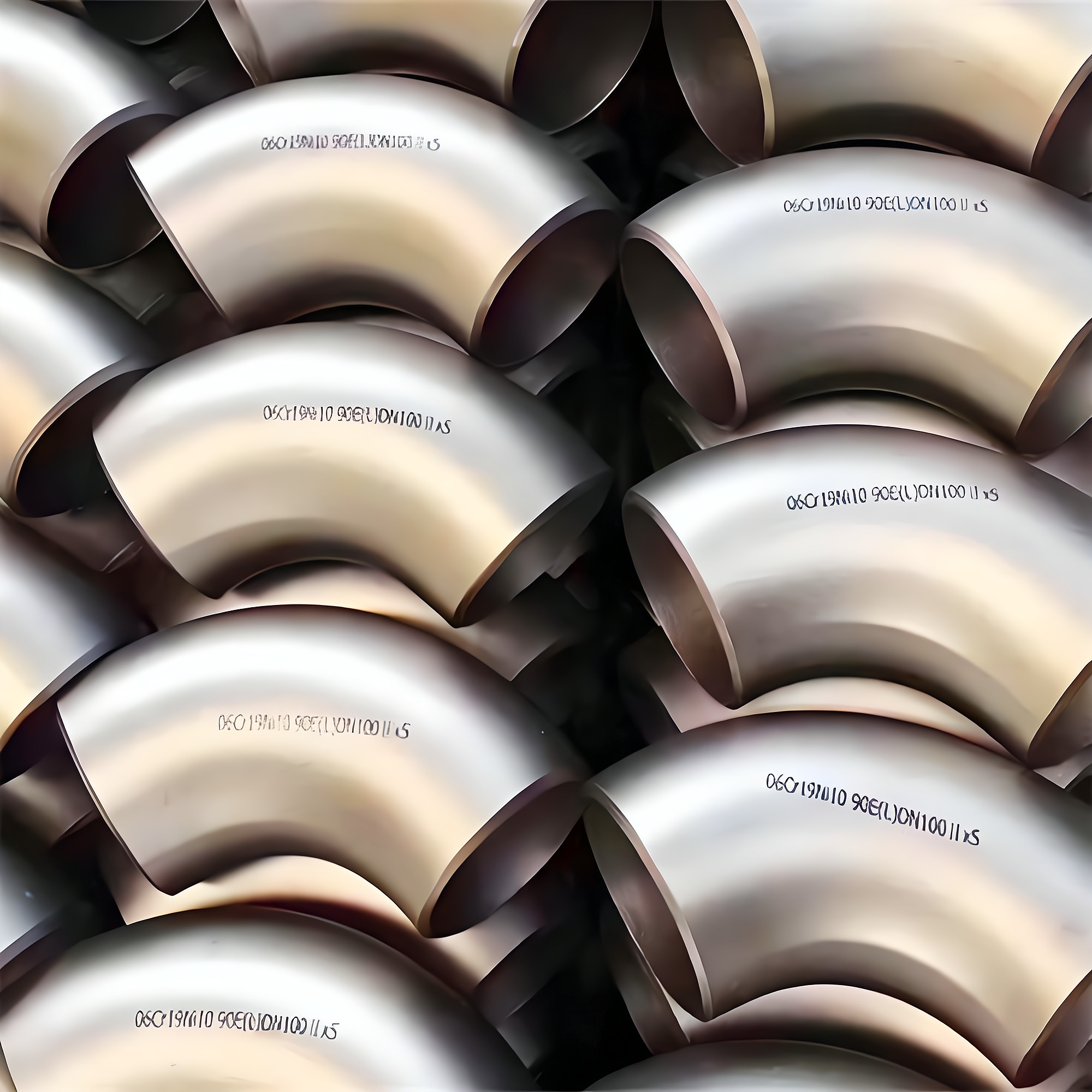
During the bending and forming process of elbows, the pipe wall on the outer arc side is stretched and thinned, while the inner arc side is thickened. The core of specification control is the minimum wall thickness of the outer arc.GB/T20801 explicitly stipulates that the outer arc wall thickness of formed elbows must not be less than the minimum design thickness of straight pipes;Short-radius elbows have a larger thinning coefficient and require additional thickening compared with long-radius elbows under the same working conditions.
For conventional long-radius elbows, the push-forming thinning rate is generally controlled within 12.5%;For high-pressure GC1 pipelines, the thinning rate is limited to ≤10%, and pre-thickening is applied when ordering to offset forming losses.In procurement selection order, long-radius elbows are preferred;short-radius elbows are only permitted when space is limited, and the SCH must be increased by one grade or additional forming compensation thickness must be added separately.There are two ways to achieve elbow thickening: first, selecting higher-SCH billet material for forming;second, using specially customized thickened billets so that the outer arc thickness meets the standard after forming. Post-forming weld overlay thickening is prohibited; weld-repaired elbows are prone to crack initiation under high-pressure alternating loads.
(II) Thickening rules for opening reinforcement of tees and branch outlets
Tees are the highest-risk components in high-pressure pipelines; the opening disrupts the continuity of the cylinder, and the stress concentration factor is significantly higher than that of straight pipe.Reinforcement schemes fall into three categories: integrally thickened tees, local reinforcement, and external reinforcement rings. For high-pressure conditions, integrally forged thickened tees are preferred; patch-plate reinforcement structures are not recommended, as reinforcement rings are prone to crevice corrosion and fatigue cracking.
For integrally thickened tees, the wall thickness of both the main pipe and the branch pipe is simultaneously greater than that of the connected straight pipe, and the intersection area is a key focus for thickness measurement;Branch outlets and nozzle connections must use integrally thickened forgings; it is not permitted to directly drill holes in straight pipe and weld small branch pipes.The verification logic follows the area replacement method, calculating the area lost by the opening and using the thickened pipe wall to provide the compensating area.The procurement list must not simply specify the same SCH as the main pipe; the minimum wall thickness after reinforcement of the tee must be noted in the drawings and technical agreement, and the supplier must be required to provide reinforcement calculation sheets.
(III) Thickening rules for reducers and pipe caps
The conical section of concentric reducers and eccentric reducers is subject to axial stress; the larger the half-cone angle, the higher the stress. GB/T20801 requires that for GC1 pipelines the half-cone angle of reducers should not exceed 30°, and reducers with large angles require additional thickening.The thickness at the large and small ends of the reducer shall match the upstream and downstream pipes respectively, and the middle of the conical section must not be thinner than the design thickness of the small end.
The thickness of hemispherical and elliptical pipe caps shall be calculated according to the head formula; flat plate pipe caps have a high stress level and should be avoided in high-pressure conditions wherever possible;If flat plate pipe caps are used, they must be substantially thickened and subjected to separate strength calculations.
(IV) Forged socket weld and threaded high-pressure pipe fittings
ASME B16.11 socket weld fittings are classified into 3000, 6000, and 9000 pound classes, and are widely used for high-pressure small-diameter branch pipes. Such fittings themselves are of forged thickened construction, but during selection it must be verified that: the pressure-bearing capacity of the fitting body is not lower than the pipeline design pressure, and the wall thickness at the socket root meets the requirements; one must not merely look at the pound class while ignoring root thinning.The thread roots of threaded fittings reduce the effective wall thickness; when calculating, the additional allowance for thread depth must be deducted, and in high-pressure hydrogen sulfide environments threaded connections should be minimized.
IV. Special additional thickening conditions for high-pressure operating cases
First, for water hammer, pressure pulsation, and reciprocating compressor inlet and outlet pipelines, transient impact pressures exist; an impact margin is added on the basis of the thickness calculated for internal pressure, generally 1.15 to 1.25 times, and for severe water hammer conditions the SCH may be increased by one grade.
Second, for pipelines conveying particle-containing media, high-speed fluids, and gas-solid two-phase flow, an erosion allowance is superimposed. Erosion is not uniform corrosion; localized scouring grooves will rapidly reduce the burst pressure, and corrosion allowance alone is insufficient for protection. When necessary, a wear-resistant lining layer should be added or the wall thickness further increased.
Third, for high-temperature and high-pressure coupled operating conditions, the allowable stress of the material decreases with temperature; the thickening calculation must use the allowable stress at the design temperature and must not use room-temperature strength values. The thickening requirements of many high-pressure hydrogenation pipelines come from high-temperature strength degradation.
Fourth, for severe cyclic loading and fatigue conditions, thickening must not only pursue static strength but also control the stress concentration factor; integral forgings and smooth transition structures are preferred to reduce abrupt cross-section changes.
V. Implementation and Control of Thickened Wall Selection in Procurement Documents
For the marking method in the procurement list, do not write only NPS+SCH; for high-pressure pipe fittings, it is recommended to mark the four elements: nominal diameter, material, design temperature and pressure, and minimum required wall thickness for each part.SCH is only used as a reference for the blank material, not as the acceptance baseline.
The technical agreement clauses need to clearly specify: forming thinning control indicators, thickness measurement points (elbow outer arc, tee intersection area, reducer cone section), wall thickness acceptance judgment rules, and allowable negative deviation range;For GC1 high-pressure pipe fittings, ultrasonic thickness measurement must be performed piece by piece after arrival, with key sampling inspection at stress concentration locations of tees and elbows;At the same time, it shall be agreed that if the measured minimum wall thickness is below the lower limit of the specification, the item shall be directly rejected, and downgraded concession acceptance shall not be allowed.
Supplier document delivery requirements shall include: wall thickness strength calculation sheet, opening reinforcement calculation sheet, forming process thinning verification calculation, and original thickness measurement records;For custom thickened pipe fittings, first article inspection and sample sealing are required to confirm that the minimum wall thickness after forming meets the standard before mass production is put into operation.
VI. Common Misconceptions in Thickening Selection for High-Pressure Pipe Fittings
Misconception 1: SCH rating equals strength, and fittings of the same SCH automatically match high pressure.Correction: SCH is the wall thickness series for straight pipes. After forming, elbows and tees are thinned, so local wall thickness may be lower than that of the straight pipe. SCH only represents the blank, not the minimum wall thickness of the finished product.
Misconception 2: Thickening means uniformly adding 2 mm, a one-size-fits-all increase in thickness.Correction: Thickening is divided into four categories: forming compensation, corrosion/erosion allowance, impact reinforcement, and opening reinforcement. The increment differs for different components. Blind thickening increases costs and welding stress.
Misconception 3: Standard equal-diameter tees are selected, assuming they come with reinforcement by default.Correction: The reinforcement of standard tees is intended for conventional pressure. Under high-pressure GC1 conditions, an equal-area reinforcement calculation must be redone, and custom integrally thickened tees must be used when necessary.
Misconception 4: Only the wall thickness at the end bevel is measured, without measuring the outer arc of elbows or the intersection of tees.Correction: The end thickness being qualified does not mean the stress concentration area is qualified; a large number of high-pressure failure points occur in the intersection areas and the outer arc of bends.
Misconception 5: Relying on negative deviation allowance to bear high-pressure strength.Correction: The strength allowance under high-pressure conditions cannot consume the manufacturing negative deviation; after deducting the negative deviation from the minimum wall thickness, the design baseline must still be met.
VII. Conclusion
For the thickening and selection of pipes and fittings under high-pressure conditions, the core is to abandon the inertial thinking of "directly applying the straight pipe SCH to fittings" and establish a quantitative thickening system of basic internal pressure thickness + additional allowance + forming thinning compensation + local reinforcement.For elbows, control the thinning of the outer arc; for tees, implement equal-area reinforcement; for reducers, control the stress in the conical section; for impact pipelines, add water hammer allowance; and set differentiated minimum wall thickness baselines for different components.
The thickening of high-pressure fittings is a key part of the safety of pressure piping special equipment. Insufficient thickening directly brings the risk of explosion and leakage, while excessive thickening causes resource waste and welding stress problems.In the stages of material requisition, technical agreement preparation, and incoming acceptance, procurement personnel should take the minimum measured wall thickness as the core acceptance indicator, and support it with strength calculation, reinforcement verification, fixed-point thickness measurement, and first-piece sealing sample mechanisms, so as to achieve safe, controllable, standard-compliant, and economically reasonable thickening and selection of high-pressure fittings, and ensure the long-term stable operation of high-pressure hydrogenation, coal chemical, and oil and gas units.
References
[1] TSG 31-2025, Safety Technical Regulation for Industrial Pipelines [S]. State Administration for Market Regulation, 2025.
[2] GB/T 20801.3-2020, Pressure Piping Code—Industrial Piping—Part 3: Design and Calculation [S].
[3] ASME B31.3-2023, Process Piping Code [S]
[4] GB/T 12459-2017, Steel Butt-Welding Seamless Pipe Fittings [S].
[5] ASME B16.9-2021, Factory-Made Wrought Butt-Welding Seamless Pipe Fittings [S]
[6] HG/T 20581-2011, Specification for Material Selection of Steel Chemical Vessels [S]
[7] Li Gang. Practical Guide to Wall Thickness Calculation and Reinforcement Design of High-Pressure Components in Pressure Piping [M]. Beijing: Atomic Energy Press, 2022.