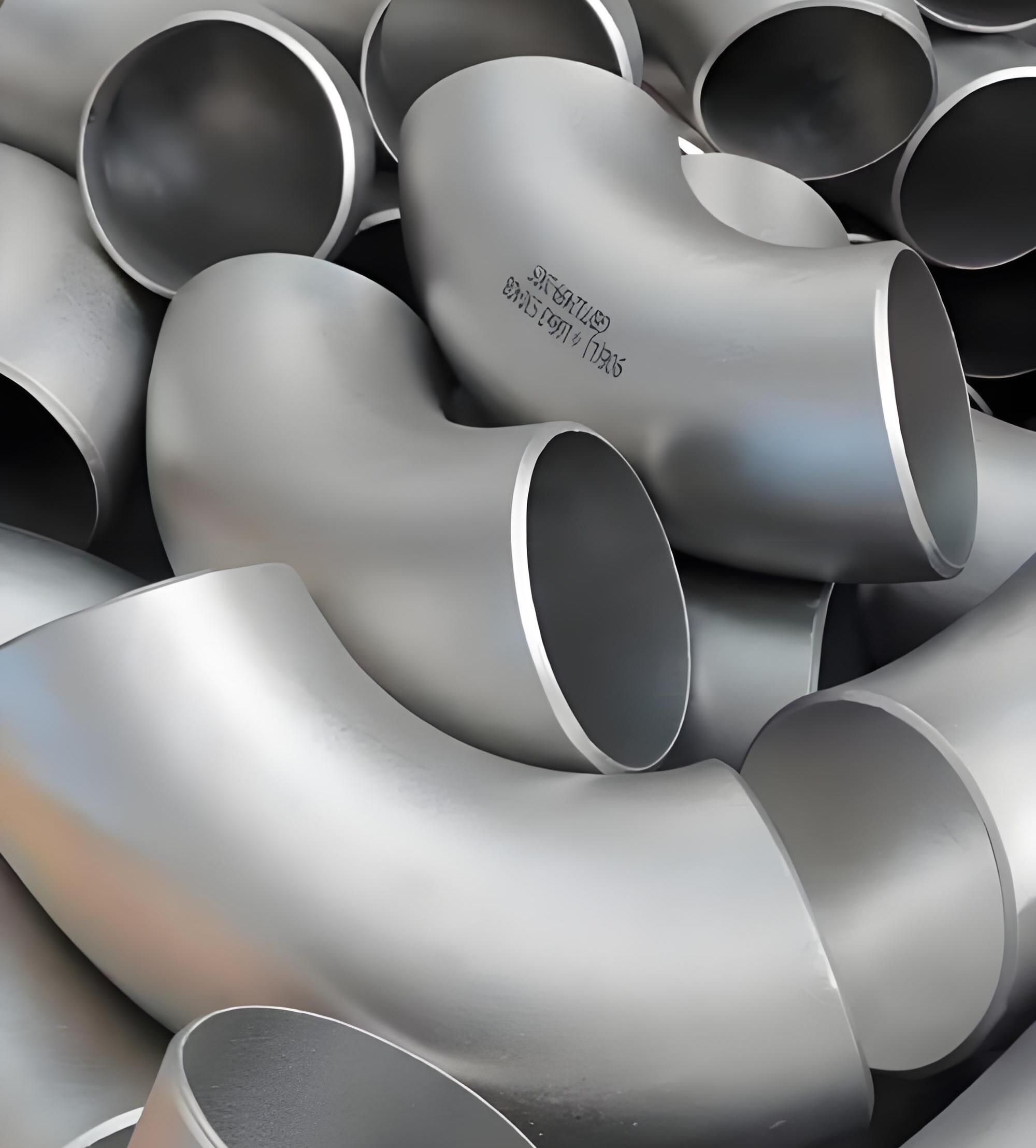
What does R=1.0D mean?Definition difference between short radius elbows and long radius elbows
R=1.0D and R=1.5D: Numerical meaning of bend radius
In R=1.0D, D refers to the pipeNominal diameter (DN), which is the nominal size of the pipe's outer diameter, not the inner diameter. R represents the bend radius of the elbow, that is, the distance from the centerline of the elbow to the center of the bend. Therefore, R=1.0D means the bend radius equals 1 times the pipe's nominal diameter, and R=1.5D means the bend radius equals 1.5 times the pipe's nominal diameter.
| Type | Bending radius | Features |
|---|---|---|
| Short radius elbow SR | R=1.0D | Compact structure, space-saving, relatively high fluid resistance |
| Long radius elbow LR | R=1.5D | The bend is gentle, with lower fluid resistance and a larger footprint. |
The smaller the bending radius, the more compact the elbow, but the more abrupt the change in medium flow direction and the greater the local resistance. Therefore, short-radius elbows are typically used in secondary pipelines with limited space, while long-radius elbows should be preferred for high-pressure, high-speed main pipelines.
Core parameters of short-radius elbow SR (R=1.0D)
The core parameters of short-radius elbow SR (R=1.0D) include:
- Bending angle: Standard angles are 90° and 45°;30° and 60° are non-standard custom items, subject to customer drawings, with a longer production lead time.
- Nominal diameter DN: Determines the matching size between the elbow and the pipeline.
- Wall thickness schedule SCH: The larger the SCH value, the thicker the wall thickness, which should be determined based on the medium pressure.
- Material grade: Carbon steel, stainless steel, alloy steel, etc., depending on the corrosiveness and temperature of the medium.
- Connection type: Common types include butt welding, as well as socket welding, etc.
- Execution standard: National standard GB/T 12459, GB/T 13401, American standard ASME B16.9;Short radius elbows correspond to ASME B16.28
It should be noted that the curvature of R=1.0D directly determines the fluid resistance of the pipeline, and careful selection is required for high-pressure and high-speed conditions. When selecting, the medium, temperature, and pressure conditions should be provided together to confirm the matching solution.
How to choose between short radius elbows and long radius elbows?The core difference lies in fluid resistance and space occupation
Choosing between short radius (SR, R=1.0D) and long radius (LR, R=1.5D) elbows essentially answers a question:Is your piping more constrained by space, or more concerned about pressure drop? These two dimensions are directly opposed, and there is no solution that excels in both.
Fluid resistance comparison: Why do short-radius elbows have higher resistance?
The bend radius of a short-radius elbow is only 1 times the nominal pipe diameter (R=1.0D), while that of a long-radius elbow is 1.5 times. The smaller the bend radius, the more abrupt the change in the direction of the medium flow. The fluid is forced to turn sharply inside the elbow, generating stronger centrifugal effects and eddies, intensifying local turbulence, and consequently increasing energy loss.
How significant is the impact? Under the same nominal diameter, medium, and flow rate, the local resistance coefficient of a short-radius elbow is typically about 30%–50% higher than that of a long-radius elbow. This means:
- High-pressure, high-speed main pipelines: Increased resistance can cause significant pressure drops, potentially affecting pump head selection and system efficiency; short-radius elbows are not recommended.
- Low-pressure, low-speed, or gravity-flow pipelines: The impact of resistance differences on the system is limited, and the disadvantages of short-radius elbows are acceptable.
- Media containing solid particles or prone to crystallization: Sharp turns are more likely to cause erosion wear or stagnation zones on the outer side of the elbow, and short-radius elbows can accelerate local failure.
Space footprint comparison: How much installation space do short-radius elbows save?
The core value of a short-radius elbow lies in its compact structure. Taking a DN100 90° elbow as an example, the installation dimension (the distance from the elbow center to the end face) of a long-radius elbow is approximately 150mm, while a short-radius elbow requires only 100mm—a single elbow can reduce the pipeline occupancy length by about 50mm. If there are multiple elbows on a pipeline, the space saved accumulates linearly.
More critically, short-radius elbows allow pipes to be laid closer to equipment or walls, offering distinct advantages in the following scenarios:
- Narrow pipe galleries: With dense pipe rows, long-radius elbows may not fit or may require raising the pipe rack.
- Close connection to equipment: The space around pumps, heat exchangers, and valve inlets/outlets is limited, and short radius enables compact connections.
- Internal piping of the unit: The internal space of complete equipment is extremely valuable, and short radius is a common choice.
- Local pipeline modification: When adding branches in existing pipe racks, short radius can avoid obstacles and reduce the scope of changes.
How to choose: a simple decision sequence
- First, consider the pipeline location: Is it a main line or a branch/secondary line?For the main pipe, long radius is preferred; for branch pipes, short radius can be considered.
- Next, consider the medium working conditions: high pressure, high speed, high viscosity, or containing particles?If any of these conditions apply, short radius requires caution, and design review is recommended.
- Finally, measure the space: if the installation space is indeed limited and the pipeline is a secondary circuit, short radius is a reasonable choice.
Special reminder: short radius elbows are covered by standards in both the national standard GB/T 12459 and the American standard ASME B16.9, butnon-standard angles such as 30° and 60° are custom parts, requiring a longer production lead time. If your project involves non-standard angles, you need to confirm the delivery time in advance.
In addition, the applicability of short radius elbows also depends on the specific medium, temperature, and pressure rating. If you are evaluating a specific working condition, it is recommended to provide the pipeline pressure, medium characteristics, and spatial dimensions to the Guojie team, and they will confirm the matching solution based on standards and the actual conditions of your project.
When should short radius elbows be used?These 4 scenarios prioritize R=1.0D
The core value of short radius elbows (R=1.0D) isto compress pipeline footprint while halving the bending radius, at the cost of increased fluid resistance. To decide whether to use it, first check whether the pipeline is truly constrained by space.
Applicable scenarios: narrow pipe galleries, close-range equipment connections, internal piping of units, and partial pipeline modifications.
1. Narrow pipe galleries
The width of the pipe gallery is fixed during the design phase. When multiple pipelines are laid in parallel, the clearance left for elbow turning is insufficient, and the turning arc length of long-radius elbows (R=1.5D) may exceed the pipe gallery boundary. In this case, short-radius elbows with R=1.0D can shorten the turning footprint and are a feasible means to resolve space collisions.
2. Close-range equipment connections
The inlet and outlet flange positions of equipment such as pumps, heat exchangers, and compressors are fixed, and the distance between the equipment body and surrounding structures is often only a few hundred millimeters. Long-radius elbows may not be able to complete the turn within a limited straight pipe section, while short-radius elbows can achieve it within a shorter distance. Judgment criteria:Whether the connection distance is less than the turning arc length of 1.5 times the pipe diameter。
3. Internal piping of the unit
The internal piping of turbine units and compressor skids is dense, with space occupied by equipment bodies, instruments, and support structures. Such internal piping mostly belongs to auxiliary media (lubricating oil, sealing gas, cooling water, etc.), with relatively low flow velocity and pressure levels. Using short-radius elbows to achieve a compact layout is a common practice.
4. Local pipeline modification
During renovation of old plants or pipeline additions, the original pipe positions are already fixed, and there is often no extra space for adding branches or changing the direction. Short-radius elbows can complete the rerouting without altering the surrounding piping. Before the modification, the pressure rating and medium parameters of the original pipeline must be verified; the working conditions cannot be ignored just because "only a section is being changed."
Non-applicable scenarios: Why can't short-radius elbows be used for high-pressure, high-velocity main lines?
High-pressure pipelines—The curvature of a short-radius elbow changes abruptly, causing a more drastic change in the direction of the medium flow, and the local stress concentration is higher than that of a long-radius elbow. Under pressure fluctuation conditions, the risk of stress fatigue inside and outside the elbow increases. Although ASME B16.28 covers the dimensional standards for short-radius elbows, standard compliance does not mean operational compliance—The higher the pressure rating, the less recommended it is to use R=1.0D。
High-speed main line—The higher the flow velocity, the more severe the local resistance loss and erosion at the elbow. Short-radius elbows have a higher resistance coefficient than long-radius elbows, which on high-speed main lines means additional energy consumption and accelerated wall thinning at the elbow. A failure in the main line affects the entire system, so it is not worth sacrificing reliability to save space.
Judgment criteria: If the pipeline is a main process line of the unit, with high medium flow velocity, high pressure rating, or transporting flammable, explosive, or highly corrosive media,default to long-radius elbows, unless the design institute provides a written review conclusion that space is insufficient.
One-sentence conclusion: For space-constrained secondary pipelines (auxiliary media, low flow rate, low pressure), prioritize short-radius elbows with R=1.0D;For high-pressure, high-speed main pipelines, they are not recommended; choosing long-radius elbows is more reliable.
Must-read before selecting short-radius elbows: standards, customization, and decision boundaries
The difficulty in selecting short-radius elbows (SR, R=1.0D) lies not in whether they can be used, but in whether they should be used. They save space, but at the cost of greater fluid resistance and higher local pressure drop. Below, we directly break down three issues: standards, customization, and decision boundaries.
Applicable standards and customization capabilities: national standards, American standards, and non-standard angles
There are mainly three standards that short radius elbows can be executed according to:GB/T12459(Steel butt-welding seamless pipe fittings),GB/T13401(General technical specification for steel butt-welding pipe fittings), andASME B16.9(Factory-made wrought steel butt-welding fittings). The three standards have slight differences in dimensional tolerances, wall thickness, and inspection requirements. Export or foreign-invested projects usually specify ASME B16.9, while domestic petrochemical and power projects mostly use the national standard. When selecting, first confirm which standard is specified in the project technical specification, as this directly determines the subsequent inspection and acceptance criteria.
Regarding customization, two situations need to be distinguished:
- Standard angles (90°, 45°): These are standard products, produced according to the above standards, with short delivery times.
- Non-standard angles (e.g., 30°, 60°): These are custom parts, with production based on the customer's drawings.Guojie supports such non-standard customization, but the production cycle is longer, and parameters such as bending angle, curvature radius (fixed R=1.0D), nominal diameter, SCH wall thickness class, and material grade need to be confirmed.
Key Reminder: There is no standard data available for the fluid resistance characteristics of non-standard angle elbows, so additional margin should be reserved during design.
Selection Decision Checklist: 4 Questions to Determine Whether to Use R=1.0D
The core feature of a short-radius elbow is that its bending radius equals 1 times the nominal pipe diameter, making it more compact than a long-radius elbow (R=1.5D). But compactness comes at a cost—the fluid turns more sharply, resulting in greater resistance. Use the following 4 questions to make the judgment:
Question 1: Is the installation space truly limited? In scenarios such as narrow pipe racks, close connections to equipment, internal piping of units, or partial pipeline modifications, short-radius elbows can save considerable installation space. If space is ample, prioritize long-radius elbows, which offer lower resistance and longer service life.
Question 2: Is the pipeline a main line or a secondary line? Short radius elbowNot recommended for high-pressure, high-speed main lines. The medium flow rate in the main pipeline is high, and short radius elbows will significantly increase local resistance, potentially causing vibration and erosion.
It is more suitable for secondary lines, auxiliary pipelines, or internal connections of equipment.
Question 3: Is the medium condition mild? The temperature, pressure, and corrosiveness of the medium need to be comprehensively evaluated. Under high pressure, high temperature, and high flow rate conditions, the local stress concentration of short radius elbows is more pronounced and should be used with caution.
If the working conditions are harsh, it is recommended to conduct a design review before making a decision.
Question 4: Is custom delivery time accepted? If the project requires non-standard angles such as 30° or 60°, confirm whether the delivery time meets the project schedule. Custom parts have a longer production cycle and are based on drawings, so communication in advance is necessary.
Conclusion boundary: If among the above 4 questions, the first is answered "yes" and the second and third are answered "no", then the short radius elbow is a suitable choice. If space is not tight or the pipeline is a high-pressure, high-speed main line, long radius elbows should be used instead. When in doubt, provide the Guojie team with the medium, temperature, pressure, diameter, and installation space dimensions, and let them confirm the matching solution.
Frequently Asked Questions
Q1: Can short radius elbows and long radius elbows be used interchangeably? They cannot be directly interchanged. The bending radius differs (R=1.0D vs R=1.5D), and there are differences in installation dimensions and fluid resistance characteristics.
Before replacement, it is necessary to confirm whether the pipeline layout space and design pressure meet the requirements.
Q2: What is the difference between short radius elbows manufactured to ASME B16.9 and GB/T12459? The two standards have slight differences in dimensional tolerances and inspection requirements. ASME B16.9 is an internationally recognized standard, suitable for export or foreign-funded projects;GB/T12459 is a domestic standard, suitable for domestic projects.
The specific details shall be subject to the project technical specification.
Q3: Why does the 30° short radius elbow have a longer delivery time? 30° and 60° are non-standard angles, not within the standard product range. They need to be produced separately according to the customer's drawings, involving mold adjustment and process confirmation, so the production cycle is longer than that of standard 90° and 45° elbows.
Q4: Can short radius elbows be used on high-pressure pipelines? Short radius elbows are not recommended for high-pressure, high-speed main pipelines. If they must be used, the designer needs to review local stress, wall thickness, and support methods, and confirm that they meet the working conditions before adoption.
Q5: How to select the wall thickness grade for short radius elbows? The wall thickness rating (SCH) should be determined based on the pipeline design pressure, temperature, and medium, and should be consistent with or higher than that of the straight pipe section. The specific rating to select should be confirmed based on the project design conditions, and cannot be determined solely by the elbow itself.
Learn More
If you are evaluating a specific working condition, it is recommended to provide the pipeline pressure, medium characteristics, diameter, and installation space dimensions to the Guojie team, who will confirm the matching solution based on standards and actual project conditions.
Related Products:Short Radius Elbow SR (R=1.0D)