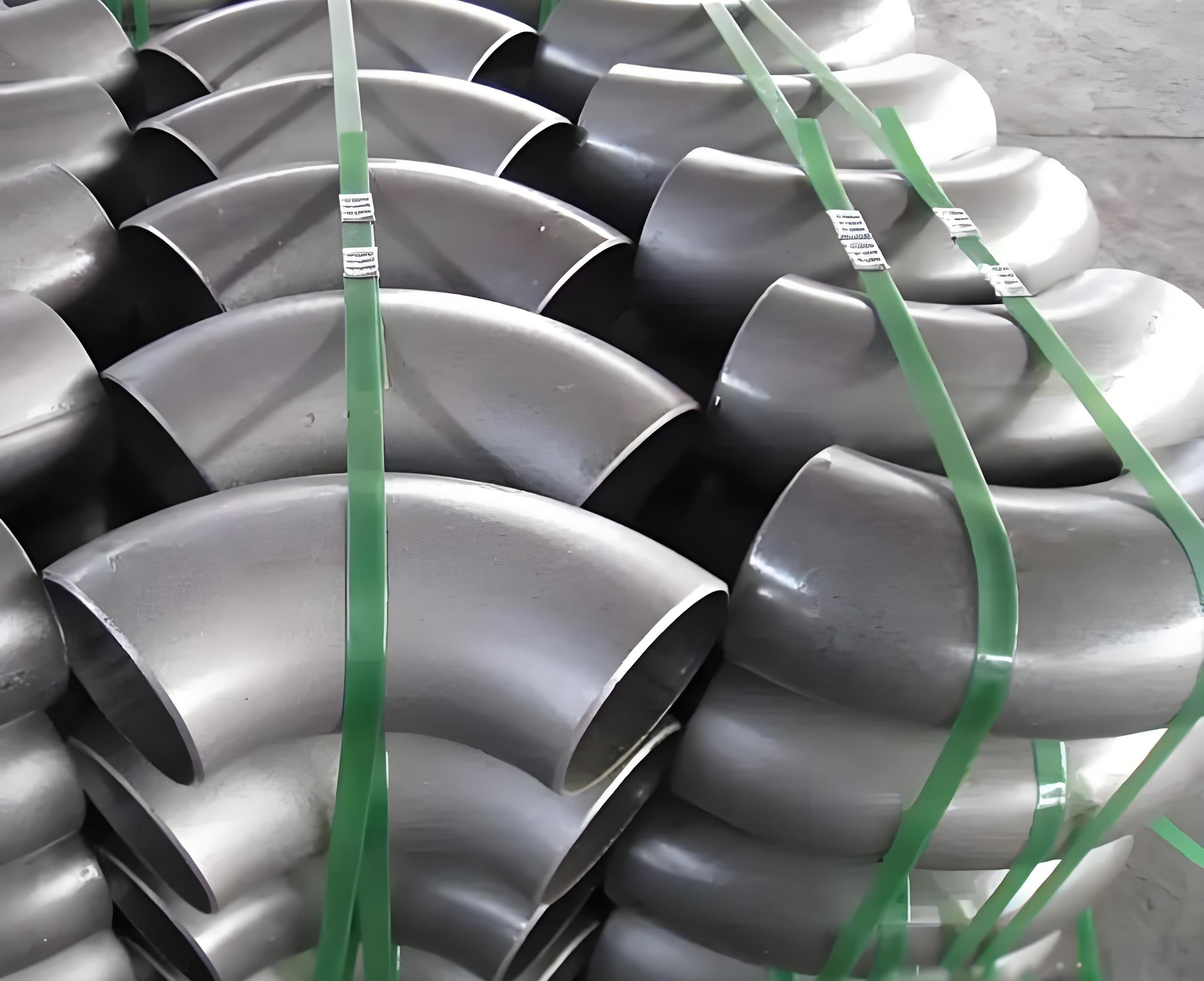
Hot-push elbows, also known as medium-frequency hot-push seamless elbows, are seamless butt-welding elbows integrally formed through the hot-push expansion bending process, which uses medium-frequency induction heating, a dedicated pushing machine, and a horn-shaped core die. The pipe blank is heated to a plastic state, and under thrust force, expansion and bending forming are completed simultaneously. The wall thickness of the inner and outer arcs of the elbow is compensated by the plastic flow of the metal. The finished product has uniform wall thickness and no welded seams, making it the mainstream production process for carbon steel and alloy steel seamless elbows. The products comply with GB/T12459 and ASME B16.9 standards. The mainstream angles are 45°, 90°, and 180°, with long radius LR (R=1.5D) as the primary option, while short radius SR (R=1.0D) specifications can also be produced. The diameter range covers DN20-DN800. Materials include 20# and A234-WPB carbon steel, 16Mn and 12Cr1MoV alloy steel, and stainless steel for some specifications. After forming, heat treatment is performed to eliminate processing stress, and the welding bevels are machined. The appearance is smooth and sleek, and the mechanical properties are stable, making it suitable for large-scale engineering procurement. The product uses butt-welding connections and is mainly used to change the direction of medium flow in piping systems. It is widely applied in high-temperature, medium- and high-pressure process pipelines in industries such as petroleum refining, thermal power generation, heating pipe networks, natural gas, chemical, and coal chemical industries, and is suitable for steam, oil and gas, and process flows.
Product Overview
Hot-formed elbow (medium-frequency induction hot-pushed seamless elbow) is a seamless butt-welding elbow formed in one piece by medium-frequency induction heating and hot-push expansion bending process. After the pipe blank is heated to a plastic state, expansion and bending are completed through a pushing machine and core mold, with uniform wall thickness and no welded seams. The product complies with GB/T12459 and ASME B16.9 standards, with diameter range covering DN20-DN800, angles including 45°, 90°, 180°, mainly long radius. Materials cover carbon steel, alloy steel, and stainless steel, suitable for high-temperature and medium-to-high-pressure pipelines in petroleum refining, electric power, thermal energy, chemical, and other industries.
Key Selling Points
The medium-frequency hot-push process achieves integral seamless forming, no weld seams, continuous overall metal structure, stable mechanical properties, and can withstand high-temperature and high-pressure working conditions. Uniform wall thickness, precise compensation of inner and outer arc wall thickness, reducing stress concentration. Products are manufactured according to GB/T12459 and ASME B16.9 standards, supporting customization of non-standard angles, curvature radii, and wall thickness. Diverse material options to meet different media and temperature requirements. Before shipment, dimensional, visual, and non-destructive flaw detection inspections are performed, and complete reports can be provided to ensure smooth project acceptance.
Applications
Hot-formed elbows are mainly used to change the direction of media flow in piping systems, widely applied in main steam pipelines and reheat steam pipelines of thermal power plant boilers, external networks of centralized heat supply, petroleum refining, natural gas transmission, chemical and coal chemical process pipelines. Alloy steel materials are suitable for high-temperature and high-pressure steam conditions, carbon steel materials are suitable for conventional industrial pipelines, and large-diameter specifications are commonly used in thermal pipeline networks.
Specifications
Connection form is butt welding (BW), with machined bevels at both ends. Bending angles include 45°, 90°, 180°, with non-standard customization supported. Curvature radii include long radius LR (R=1.5D) and short radius SR (R=1.0D). Nominal diameter DN20-DN800; sizes exceeding DN800 require rolled and welded elbows. Wall thickness schedules SCH20-SCH160, customizable according to drawings. Materials include carbon steel (20#, A234-WPB, 16Mn), alloy steel (12Cr1MoV, 15CrMo, A234-WP11, A234-WP22), and stainless steel (304, 316L). Execution standards GB/T12459-2017, ASME B16.9. Forming process is medium-frequency induction hot pushing; heat treatment methods are normalizing + tempering or solution treatment. Surface treatment includes sandblasting, rust-preventive oil, anti-corrosion paint, or pickling and passivation. Inspection items include visual and dimensional inspection, UT flaw detection, hardness testing, spectral analysis, and heat number traceability.
Procurement & Delivery
For regular in-stock specifications (DN50-DN300, 90°LR, SCH40/SCH80, carbon steel), the minimum order quantity is 1-5 pieces, and small-batch replenishment is supported. Medium and large diameters DN350-DN800 require production to order. In terms of delivery time, in-stock items ship within 2-5 working days, regular scheduled production takes 7-12 working days, and large diameters take 12-18 working days. Packaging uses bevel protective covers, rust-preventive oil, pearl cotton, and pallet packing; foreign trade orders use fumigation-free plywood pallets. Specific delivery times and packaging can be confirmed with us according to project requirements.
Service & Support
We provide free technical selection support, recommending suitable products based on working conditions such as medium, temperature, and pressure. We provide drawings, dimension tables, technical parameters, and inspection submission documents; English certificates can be provided for foreign trade orders. Products with original factory quality issues are subject to unconditional return or replacement, but damage caused by human welding or improper installation is not covered by the warranty. Orders are followed up throughout the entire process, with timely feedback on production, quality inspection, packaging, and container loading progress. Technical guidance on welding, installation, and working condition adaptation is provided.
FAQ
What is the difference between hot-pushed elbows and stamped elbows?
Hot-pushed elbows use a medium-frequency seamless push-forming process, have uniform wall thickness, and after heat treatment, offer strong pressure resistance and fatigue resistance, making them suitable for main high-pressure pipelines; stamped elbows are mostly used for low-pressure, ordinary plumbing and HVAC piping.
What is the maximum diameter for hot-pushed elbows?
The maximum diameter for the conventional hot-pushing process is DN800; beyond DN800, rolled and welded elbows are required.
What materials are supported for hot-pushed elbows?
Carbon steel (20#, A234-WPB, 16Mn), alloy steel (12Cr1MoV, 15CrMo, A234-WP11, A234-WP22), and stainless steel (304, 316L) are supported. The specific material can be selected based on the working conditions.
Can non-standard angles be customized?
Yes, we support customization of non-standard angles such as 30° and 60°, as well as short-radius SR specifications.
What is the lead time for hot-pushed elbows?
In-stock standard specifications ship within 2-5 working days, regular production scheduling takes 7-12 working days, and large-diameter DN350-DN800 requires 12-18 working days. Please confirm the specific lead time with us.