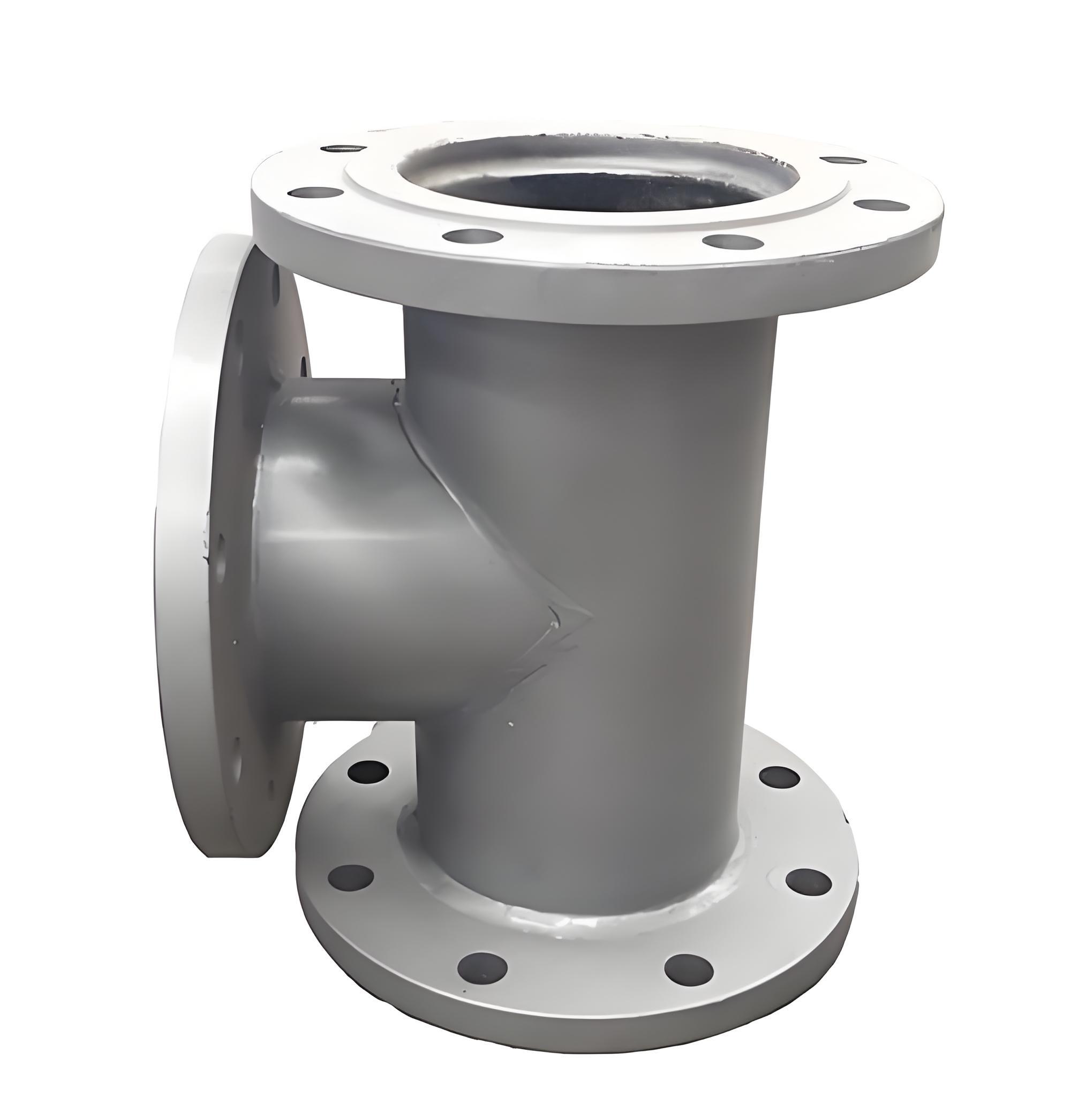
The biggest difference between a flanged tee and an ordinary welded tee is that all three ends come with their own flange plates; on-site installation is mainly done by tightening bolts, without the need for extensive welding. This structure allows the pipeline to be disassembled and replaced during later maintenance, capacity expansion, or modification, reducing the operation and maintenance pressure caused by weld corrosion and leakage. The products are forged and precision-machined according to standards such as GB/T12459, HG/T20592, ASME B16.9, ASME B16.5, EN, DIN, JIS, etc. The cavity has a smooth flow path, which helps reduce medium turbulence and fouling. We provide two types of structures: equal-diameter branching and reducing diameter change. Materials cover carbon steel, stainless steel, alloy steel, and anti-corrosion non-metal. Nominal diameters range from DN15–DN2000, and pressure ratings cover national standard PN10–PN40 and American standard Class150–Class600. For specific diameters, pressures, materials, and flange standards, please contact us to confirm.
Overview
A flanged tee is a composite pipe fitting used in industrial piping systems for medium diversion, merging, and branch connection. All three of its ports are equipped with standard flanges. During installation, the flanges are connected and tightened with bolts, without the need for extensive on-site welding work like traditional welded tees. This structure makes pipeline nodes detachable during later maintenance, replacement, or capacity expansion, reducing maintenance problems caused by weld corrosion and leakage. The product is forged and precision-machined according to standards such as GB/T12459, HG/T20592, ASME B16.9, ASME B16.5, EN, DIN, JIS, etc. The cavity has smooth flow lines, which helps reduce medium turbulence and fouling. We provide two structures: equal-diameter diversion and reducing-diameter diversion. Materials cover carbon steel, stainless steel, alloy steel, and anti-corrosion non-metal. Nominal diameters range from DN15–DN2000, and pressure ratings cover national standard PN10–PN40 and American standard Class150–Class600.
Key Features
The core value of the flanged tee lies in combining the diversion function of a tee with the quick-installation and detachable functions of flanges. The flanges at all three ends are flat, the bolt hole positions are precise, the gaskets fit tightly, and sealing remains stable during long-term operation. On-site installation is mainly based on bolt tightening, without the need for large-area welding, which can shorten the construction period and also reduce welding safety hazards and the probability of weld leakage. The fully flanged detachable structure makes it easier to operate during later pipeline modification, capacity expansion, or equipment connection adjustment, without the need for cutting and re-welding. The product is formed by integral forging or seamless stamping, with uniform cavity flow lines and smooth medium diversion and merging, which helps reduce pipeline energy consumption and medium impact damage.
Applications
The flanged tee is suitable for industrial piping projects that have requirements for sealing performance, ease of disassembly and assembly, and later maintenance efficiency. In municipal scenarios, it can be used for urban water supply and drainage, rainwater and sewage diversion, renovation of old pipe networks, and capacity expansion of branch pipe networks. In heating scenarios, it can be used for central heating, plant circulating heating, and diversion nodes of low-temperature steam pipe networks. In environmental protection scenarios, it can be used for sewage transportation, exhaust gas ventilation, and multi-pipeline confluence systems in water treatment. In chemical scenarios, it can be used for conventional process pipelines, storage tank branches, and medium diversion and merging pipelines. In power and electromechanical scenarios, it can be used for unit circulating pipelines, equipment branch connections, and multi-channel distribution systems for HVAC. In industrial and mining plant areas, it can be used for branch renovation and upgrading of water supply, oil supply, gas supply, and fire protection pipe networks.
Specifications
The flanged tee covers nominal diameters from DN15–DN2000, and pressure ratings cover national standard PN10–PN40 and American standard Class150–Class600. Structurally, it is divided into equal-diameter diversion and reducing-diameter diversion, and can also be provided in different forms such as T-type and L-type. Materials include carbon steel, stainless steel, alloy steel, and anti-corrosion non-metal, suitable for normal temperature, medium temperature, low pressure, medium pressure, high pressure, and slight corrosion working conditions. Implementation standards include GB/T12459, HG/T20592, ASME B16.9, ASME B16.5, EN, DIN, JIS, etc. For specific diameters, pressure ratings, material grades, flange standards, and sealing face forms, please contact us for confirmation.
Purchasing & Delivery
We provide stock supply and customized production of flanged tees. Conventional small and medium diameter national standard and American standard styles from DN15–DN200 are kept in stock. For specific minimum order quantities and delivery times, please contact us for confirmation. For customization, we can confirm special reducing ratios, non-standard wall thicknesses, special diversion angles, irregular flange hole spacing, and non-standard sealing face thicknesses according to project requirements. We can also produce according to overseas drawings, engineering technical agreements, and foreign standards. Packaging adopts an export-grade packaging system that is anti-collision, anti-scratch, anti-rust, and moisture-proof. Flange sealing faces and end faces are covered with protective film, bolt holes are fitted with protective plugs, small and medium diameter single items are individually wrapped and then boxed, and medium and large diameter heavy pipe fittings are wrapped on the outer layer with waterproof stretch film and moisture-proof woven cloth. Full-container bulk shipments are stacked on fumigation-free solid wood pallets. English shipping marks, specifications and models, batch numbers, and packing lists can be customized as needed.
Service & Support
We provide pre-sales selection support and after-sales technical service for engineering and foreign trade customers purchasing flanged tees. Before sales, we can assist in confirming the tee type, diameter ratio, pressure rating, and suitable material according to the medium, pressure, temperature, pipe network structure, and maintenance requirements. After sales, we can provide technical guidance for installation alignment, bolt tightening, diversion pipe network commissioning, and daily operation and maintenance, and assist overseas customers in handling customs clearance matters. Before leaving the factory, products undergo material sampling inspection, dimensional calibration, precision inspection of flange end faces, cavity flaw detection, and pressure testing. The product warranty is 18 months, with 7×24-hour response. If you need to know the specific service content, please contact us.
FAQ
What is the difference between a flanged tee and an ordinary welded tee?
All three ports of a flanged tee have their own standard flanges. During installation, they are connected and tightened with bolts, without the need for extensive on-site welding. During later maintenance, replacement, or pipe network capacity expansion, the flanges can be disassembled for operations. An ordinary welded tee is a fixed welded structure and is not detachable. Later modification requires cutting and re-welding, and the welds also carry the risk of corrosion and leakage.
How to choose between equal-diameter flanged tees and reducing flanged tees?
When the main pipe and branch pipe diameters are the same, an equal-diameter flanged tee is usually selected. When the main pipe diameter is large and the branch port diameter is small, and diversion or pressure-reducing connection is required, a reducing flanged tee is preferred. For specific diameter ratios and pressure ratings, please contact us for confirmation.
Can flanged tees be used in high-pressure or high-temperature working conditions?
PN40, Class600 high-pressure thickened models and alloy materials can adapt to high-temperature and high-pressure industrial pipeline networks. For specific pressure ratings, material grades, and temperature ranges, confirmation is required according to project working conditions; please contact us to provide the medium, pressure, and temperature parameters.
Are flanged tees corrosion-resistant?
Carbon steel material is suitable for conventional neutral media. 304, 316L stainless steel, and anti-corrosion models are suitable for acid-base, salt spray, and humid corrosive environments. For specific selection, the medium composition and working conditions must be considered; please contact us for confirmation.
Can flanged tees be customized? What are the minimum order quantity and delivery time?
We support customization of size, pressure rating, material, surface process, and packaging, and can produce according to overseas drawings and engineering technical agreements. DN15–DN200 conventional standard styles are kept in stock. For the specific minimum order quantity and delivery time, please contact us for confirmation.