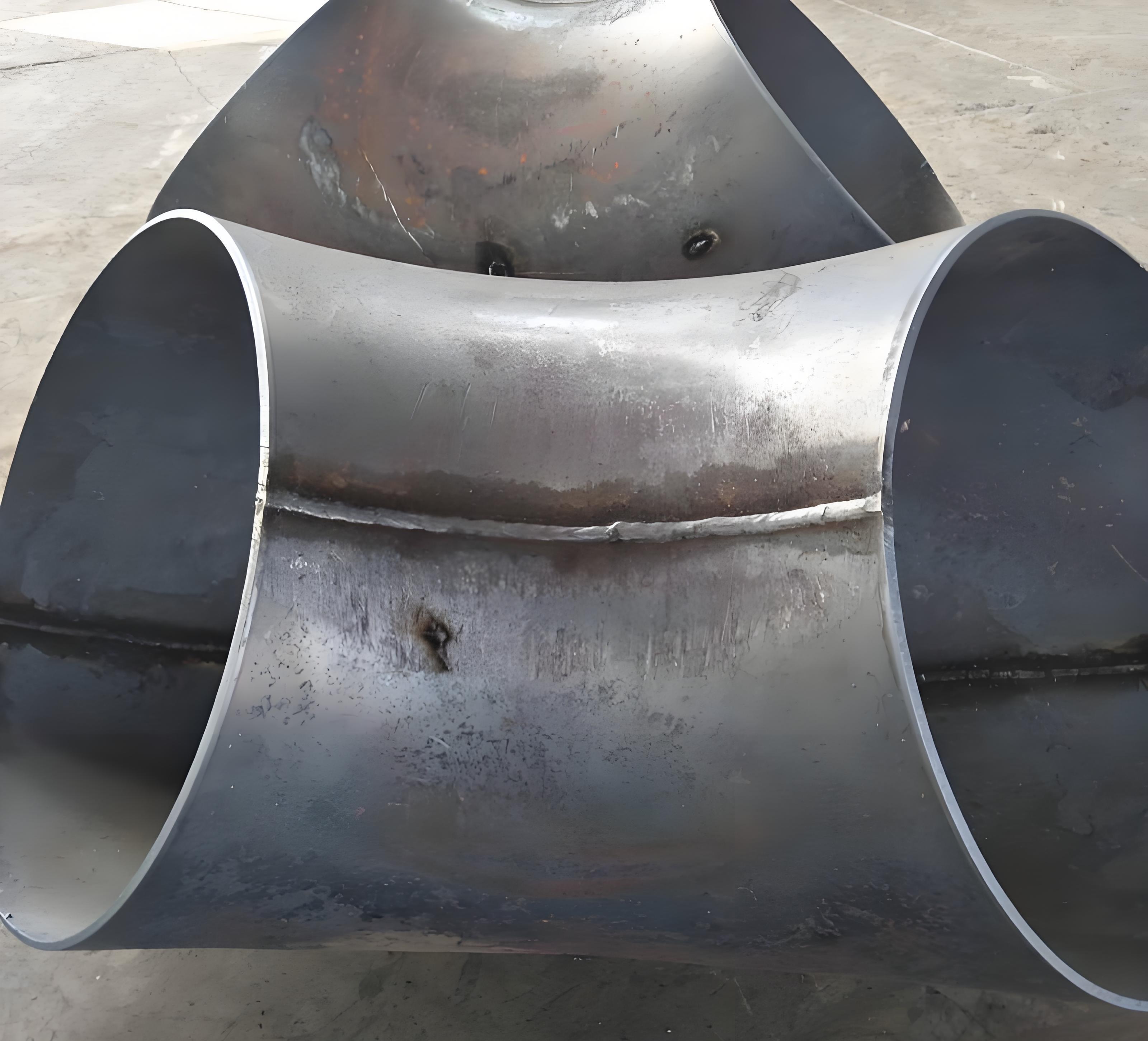
Butt welding elbows are the mainstream direction-changing pipe fittings in pressure piping systems, with both ends connected to the pipeline by beveled butt welding, relying on welds to achieve pipeline connectivity. The products can be manufactured in two curvatures: long radius LR (R=1.5D) and short radius SR (R=1.0D), covering multiple bending angles including 30°, 45°, 60°, 90°, and 180°. Materials include carbon steel, stainless steel, and alloy steel, executed in accordance with domestic and international standards such as GB/T12459, GB/T13401, and ASME B16.9. Manufactured using hot pushing and extrusion forming processes, the pipe fittings have uniform wall thickness, regular bevel processing, high overall strength and good sealing performance after welding, capable of withstanding high-temperature and high-pressure working conditions, with smooth fluid flow. Widely used in various pressure pipeline projects including petrochemical, electric power and heating, coal chemical, new energy, seawater desalination, and sewage treatment. Conventional 90°, 45°, and 180° specifications are kept in stock; 30° and 60° small angles, reducing, thickened, anti-corrosion and insulation types support non-standard customization, and can simultaneously supply domestic engineering projects and foreign trade export orders.
Product Overview
Butt weld elbows are the mainstream direction-changing pipe fittings in pressure piping systems, with both ends connected to pipelines through bevel butt welding, relying on welds to achieve pipeline connectivity. The product can be manufactured in two curvature types: long radius LR (R=1.5D) and short radius SR (R=1.0D), covering multiple bending angles of 30°, 45°, 60°, 90°, and 180°. Materials include carbon steel, stainless steel, and alloy steel, executed in accordance with domestic and international standards such as GB/T12459, GB/T13401, and ASME B16.9. Adopting hot push and extrusion forming processes, the pipe fitting wall thickness is uniform, bevel processing is neat, and after welding the overall strength is high with good sealing performance, capable of withstanding high temperature and high pressure working conditions with smooth fluid flow. Widely used in various pressure pipeline projects such as petrochemical, power and thermal, coal chemical, new energy, seawater desalination, and sewage treatment.
Key Features
Butt weld elbows use butt welding connections, offering high joint strength and reliable sealing, suitable for high-temperature and high-pressure conditions. The product provides LR/SR dual curvature options, with LR long radius preferred for main pipelines and SR short radius for localized positions with limited space. Covers full angles from 30° to 180°, with carbon steel, stainless steel, and alloy steel material options available to meet different medium and working condition requirements. Well-formed shaping, standard bevels, easy on-site welding installation, improving installation efficiency. Conventional 90°, 45°, and 180° specifications are kept in stock for rapid delivery; 30° and 60° small-angle and reducing, thickened, anti-corrosion, and insulation types support non-standard customization.
Application Scenarios
Butt weld elbows are widely used in pressure piping systems in industries such as petrochemical, electric power and thermal energy, coal chemical, seawater desalination, new energy, and wastewater treatment. Suitable for high-temperature, high-pressure, strongly corrosive, flammable, and explosive medium pipelines, applicable to main process lines, circulation piping, equipment connections, new plant construction, and pipeline renovation projects. LR long radius elbows are preferred for main flow lines, while SR short radius elbows are used for localized points with limited space.
Specifications
Butt weld elbows offer a variety of specification parameters: bending angles include 30°, 45°, 60°, 90°, and 180°; radius of curvature has two types, LR (R=1.5D) and SR (R=1.0D); connection method is BW butt weld (butt welding, with welding bevel); nominal diameter covers the full series from DN15 to DN1200; wall thickness grades range from Sch10 to Sch160; materials cover carbon steel, stainless steel, alloy steel, and plastic-lined anti-corrosion materials; standards implemented include GB/T12459, GB/T13401, and ASME B16.9. Inspection items include appearance and dimensional inspection, physical and chemical testing, and UT/MT/RT non-destructive testing. Surface treatment options include sandblasting, black paint, galvanizing, and anti-corrosion treatment. Complete model example: 90°-LR-BW-DN100-Sch40-20#. Specific parameters can be confirmed according to project requirements.
Procurement & Delivery
Conventional 90°, 45°, and 180° butt weld elbow specifications are kept in stock, with standard in-stock items shipping within 1-3 working days; small and medium diameter ordinary non-standard items within 7-15 working days; large diameter, alloy steel, 30°, 60° non-standard items with special processes within 15-30 working days. Foreign trade orders reserve time for packing and customs clearance, with specific delivery dates subject to the contract. MOQ: standard in-stock specifications start from 1 piece; large diameter, thick wall, alloy steel, and non-standard customized parts have minimum production order quantities. Supports mixed container loading, suitable for both domestic engineering and foreign trade export orders. For packaging, small diameters use rust-preventive paper wrapping on welding bevels, fixed with plywood wooden cases and shock-absorbing pads; medium and large diameters use solid wood pallets for support, wrapped with rain-proof stretch film and woven fabric for protection; export packaging prints product shipping marks, includes desiccant inside, wooden cases support fumigation, suitable for land and sea transport.
Service & Support
We provide selection technical guidance, helping distinguish between BW butt weld and SW socket weld selection, and provide complete documentation for materials, inspection, and export. Non-artificial body quality issues are handled according to contract terms. We track logistics progress, and for foreign trade assist in checking packing lists and shipping marks. We provide technical Q&A, answering storage and usage questions. Please note, we do not assume responsibility for quality issues caused by welding, modification, or incorrect selection. Welcome to contact us to confirm specific requirements.
FAQ
What is the difference between a butt weld elbow and a socket weld elbow?
Butt weld elbows (BW) use beveled butt welding connections, suitable for large diameter and high-pressure conditions; socket weld elbows (SW) use socket welding, suitable for small diameters. During selection, this must be determined based on pipe specifications and working conditions; we can provide selection guidance.
How to choose between long radius and short radius elbows?
Long-radius elbows (LR, R=1.5D) are preferred for main pipelines due to low fluid resistance; short-radius elbows (SR, R=1.0D) are used in space-constrained local positions, but design verification is required. For specific selection, please provide the working condition parameters, and we will assist in confirmation.
What standards and materials do butt-welded elbows support?
We implement standards such as GB/T12459, GB/T13401, and ASME B16.9, with materials including carbon steel, stainless steel, alloy steel, etc. Non-standard angles can be customized according to drawings, and various non-destructive testing (NDT) inspections are supported.
Are 30° and 60° elbows available in stock?
30° and 60° elbows are usually custom-made items, with a delivery time generally of 15-30 working days, subject to evaluation based on specifications and processes. Conventional 90°, 45°, and 180° specifications are kept in stock and can be delivered quickly.
What inspection services do you provide?
We provide appearance and dimensional inspection, physical and chemical testing, and UT/MT/RT non-destructive testing (NDT). Specialized flaw detection and heat treatment can be performed according to project requirements.