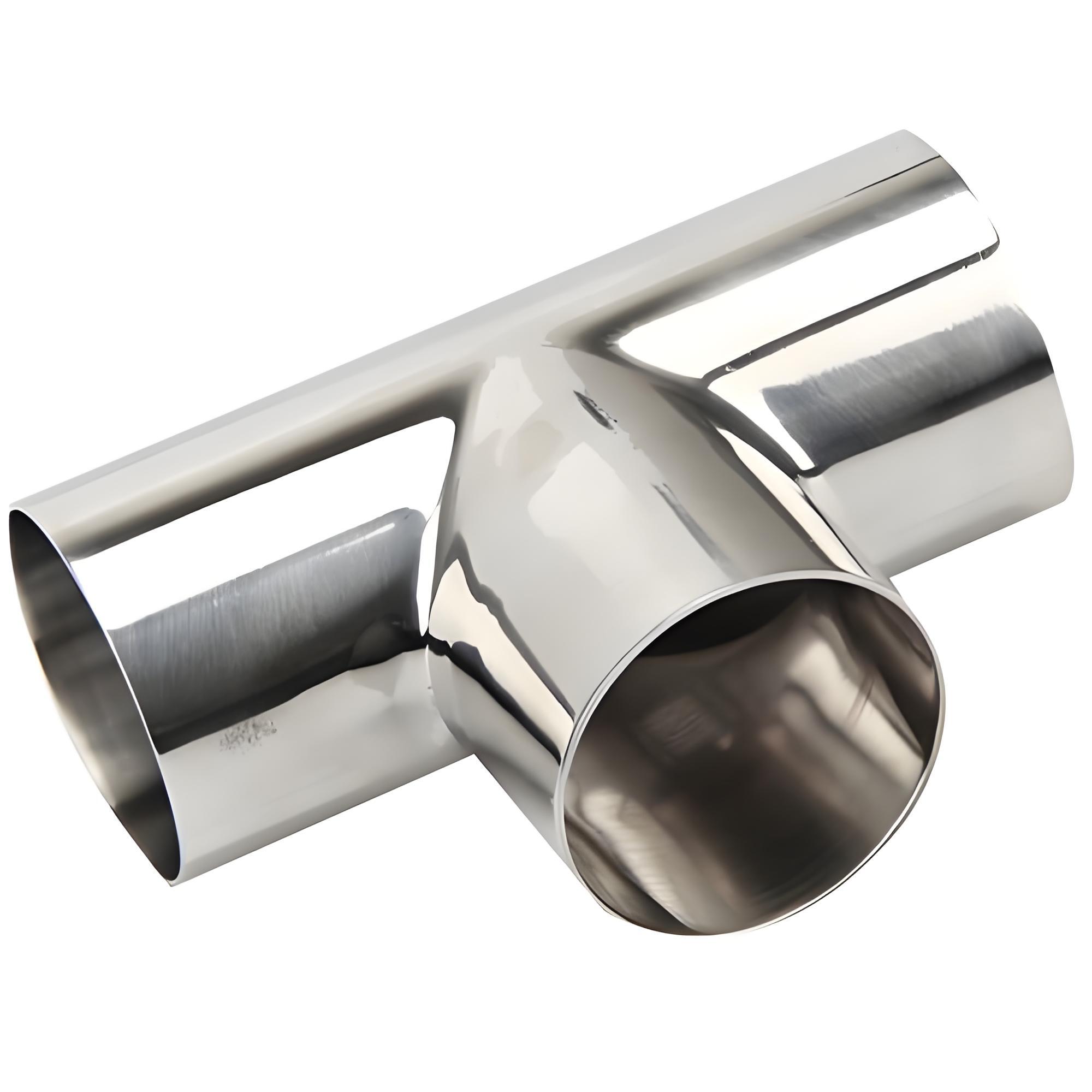
Rolled and welded tees are non-standard pipe fittings we developed for the branch requirements of extra-large-diameter medium- and low-pressure pipelines. Unlike integrally pressed tees for small and medium diameters, they are formed by rolling and welding medium-thick steel plates, are not limited by mold specifications, and can produce extra-large specifications from DN300 to DN3400. The entire product series uses butt welding connections, with precision-machined port bevels that can directly connect to on-site pipelines. Structural forms include equal-diameter branching, reducing diameter transitions, and 45° oblique branching. Pressure adaptation is PN6–PN40, and wall thickness supports SCH10 to SCH80 as well as engineering-customized reinforcement. Materials cover carbon steel, austenitic stainless steel, duplex steel, and low-alloy steel. Finished products undergo post-weld stress-relief heat treatment and 100% UT/RT non-destructive testing. If you are looking for matching pipe fittings for large-diameter pipeline branches, welcome to contact us to confirm specifications and materials.
Overview
The rolled and welded tee is a butt-welding branching and merging pipe fitting that we produce for extra-large diameter, medium and low pressure industrial pipeline systems. It is formed through CNC rolling of medium-thick steel plates, segmented fit-up, automatic submerged arc welding, overall shaping, and post-weld stress relief heat treatment, specifically solving the problem of supporting extra-large specification tees above DN300 that cannot be mass-produced with conventional molds. The product follows ASME B16.9, GB/T12459, SH/T3408, and HG/T21635 standards, with butt-welding connections across the entire series, and precisely machined port bevels that can be directly connected to on-site pipelines. Structural forms include equal-diameter branching, reducing diameter transition, and 45° angled branch, suitable for medium and low pressure pipeline branch nodes in large-scale infrastructure projects such as municipal, heating, water conservancy, environmental protection, and chemical industries.
Key Features
First, wide diameter coverage. It can produce extra-large specifications from DN300–DN3400, not limited by molds, and irregular non-standard sizes can be customized according to drawings. Second, strong process adaptability. The forming method of steel plate rolling plus segmented welding is suitable for the production of pipe fittings with medium-thick plates, large diameters, and non-standard structures. Third, controllable welding quality. Automatic submerged arc welding combined with overall post-weld shaping and stress relief heat treatment, with welds subjected to 100% UT/RT non-destructive testing. Fourth, flexible pressure and wall thickness. It is suitable for PN6–PN40 medium and low pressure working conditions, and wall thickness supports SCH10 to SCH80 as well as engineering-customized reinforcement. Fifth, complete material system. Carbon steel, austenitic stainless steel, duplex steel, and low-alloy steel can all be confirmed according to project requirements.
Applications
The rolled and welded tee is mainly used in large-diameter medium and low pressure pipeline branch nodes that standard mold pipe fittings cannot cover. In municipal water conservancy, it is suitable for urban water supply and drainage main pipeline networks, large-scale water conservancy water transmission pipelines, and large-diameter heating networks for township central heating. In the energy industry, it is suitable for ventilation and dust removal networks in thermal power plants, waste heat recovery transmission pipelines, wind power engineering medium transmission pipelines, and auxiliary circulation pipelines of large boilers. In environmental protection and chemical industries, it is suitable for process pipeline networks of sewage treatment plants, medium and low pressure fluid transmission in chemical plants, and waste gas dust removal pipelines. In terms of media, it can adapt to the transmission needs of clean water, sewage, mildly corrosive media, and high-temperature airflow. If you are not sure whether the specific working conditions are applicable, you are welcome to contact us for confirmation.
Specifications
Diameter range DN300–DN3400, supporting non-standard customization. Pressure rating PN6–PN40 medium and low pressure. Wall thickness grade SCH10 to SCH80, with engineering-customized reinforcement thickening available. Connection method is butt welding. Structural forms include equal-diameter branching, reducing diameter transition, and 45° angled branch. Materials can be selected from carbon steel, austenitic stainless steel, duplex steel, and low-alloy steel; please contact us to confirm the specific material matching. Executive standards are ASME B16.9, GB/T12459, SH/T3408, and HG/T21635. Customization capability covers all diameters, all wall thicknesses, all materials, and irregular non-standard sizes, and production can be carried out according to customer drawings or on-site measured data.
Procurement & Delivery
For conventional DN300–DN600 standard in-stock specifications, MOQ is as low as 1 piece, suitable for local pipeline network renovation and engineering replacement parts. For other specifications, the minimum order quantity is determined according to diameter, material, and quantity; please contact us for confirmation. For conventional DN300–DN600 standard in-stock specifications, quality inspection, rust prevention, protective packaging, and warehouse dispatch are completed within 48 hours after order confirmation; the delivery cycle for non-standard customized specifications must be confirmed according to drawings and quantity. Packaging adopts a heavy-duty shockproof and anti-collision solution, with protective collars and anti-collision guard rings added to the ports, anti-rust primer and topcoat sprayed on the outer wall, solid wood support bases added for large products, and heavy-duty steel straps used for reinforcement for full-container shipments, suitable for ocean shipping. Outer packaging can be customized with English shipping marks, engineering batch, specification parameters, and customer LOGO identification.
Service & Support
We provide pre-sales technical selection support for engineering and foreign trade customers purchasing rolled and welded tees, including large-diameter working condition selection, material matching, wall thickness grade adaptation, and welding construction supporting guidance. Before leaving the factory, products undergo full visual inspection, dimension re-measurement, spectral material verification, weld non-destructive testing, and pressure adaptation verification. The warranty period is 18 months, with 7×24 hour after-sales response. After-sales support provides answers on welding processes, anti-corrosion maintenance, and pipeline network operation and maintenance, and tracks logistics throughout the process to assist overseas customers with customs clearance. If you have specific project requirements, you are welcome to contact us to confirm configuration and quotation.
FAQ
What is the difference between a rolled and welded tee and an ordinary pressed tee?
Ordinary pressed tees are limited by molds and generally can only produce small and medium diameter specifications. Rolled and welded tees are formed by steel plate rolling, segmented fit-up, and automatic submerged arc welding, specializing in extra-large diameter non-standard specifications above DN300, not limited by mold specifications, and suitable for branch supporting of large-diameter medium and low pressure pipeline networks.
What is the maximum size you can make?
We can produce rolled and welded tees in the full diameter range from DN300 to DN3400, supporting any ultra-large diameter and special-shaped non-standard customization. If you have size requirements beyond the conventional range, please contact us to confirm.
What is the applicable pressure range?
The product is suitable for PN6–PN40 medium and low pressure working conditions, and is applicable to conventional pipeline systems such as municipal, heating, water conservancy, and environmental protection. Wall thickness supports SCH10 to SCH80 and engineering customized reinforcement thickening. For the pressure rating and wall thickness matching of specific projects, please contact us to confirm.
Can the material and structural form be customized?
Yes. Material options include carbon steel, austenitic stainless steel, duplex steel, and low alloy steel. Structural forms include equal-diameter branching, reducing diameter transition, and 45° oblique branching. We can produce one-on-one according to customer drawings, on-site measured data, or engineering technical agreements. For specific material and structural solutions, please contact us to confirm.
What are the minimum order quantity and delivery lead time?
For conventional DN300–DN600 standard in-stock specifications, the MOQ is as low as 1 piece, and quality inspection and outbound shipment are completed within 48 hours after order confirmation. The minimum order quantity and delivery lead time for other specifications are determined according to diameter, material, and quantity; please contact us to confirm.