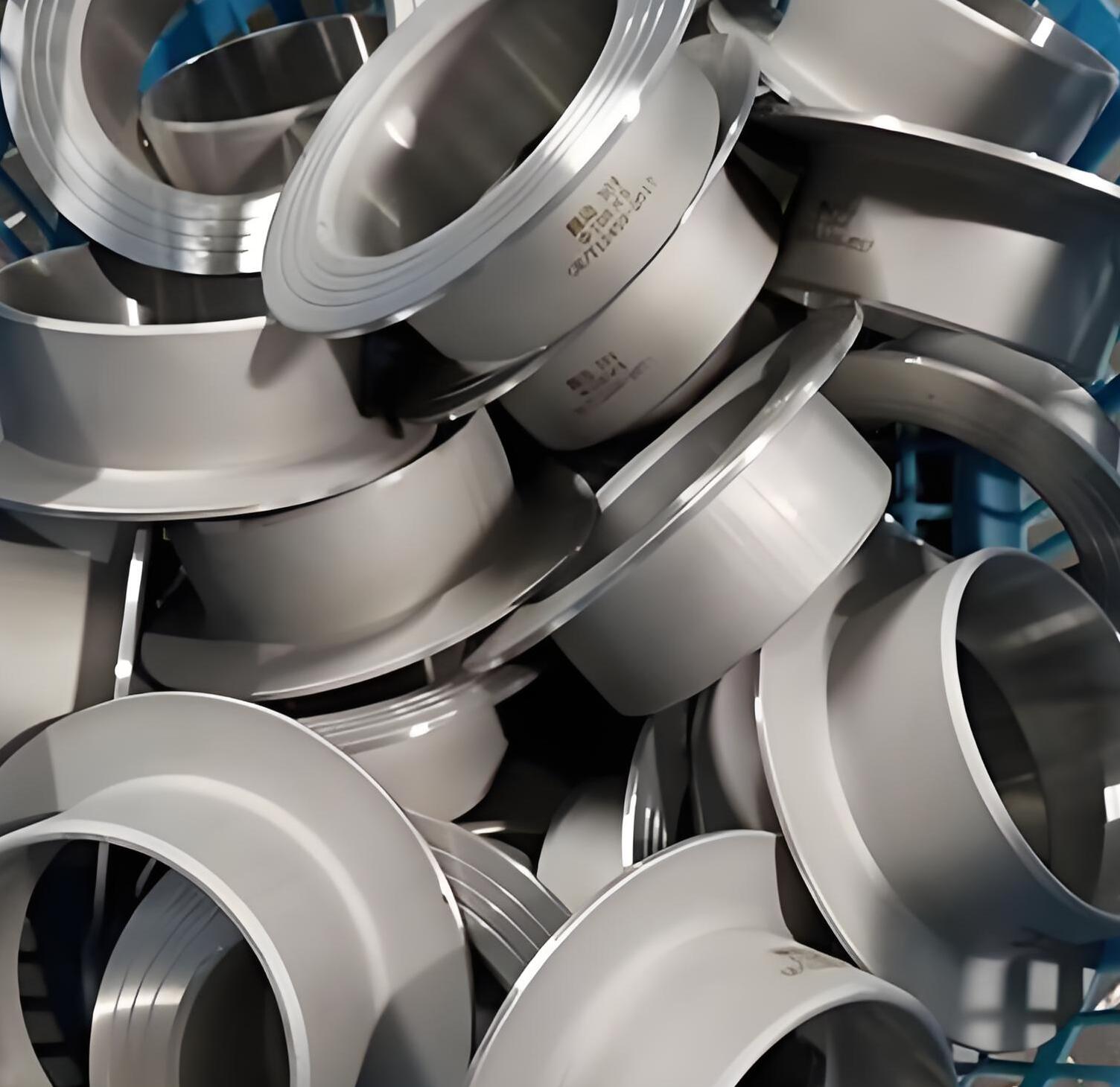
Austenitic stainless steel lap joint stub ends play the role of lap joint connection in piping systems, working with slip-on flanges to achieve 360° rotational alignment, solving construction problems such as on-site bolt hole misalignment, fixed equipment nozzles, and connections in confined spaces. One end of the product is a standard butt weld groove, which can be homogeneous fusion-welded with stainless steel pipes; the other end is formed by hot pressing or CNC precision turning to create a flat lap joint sealing surface, which fits the gasket over the entire area. We provide two structures: long pattern LP and short pattern SP, covering three types of processes: integrated stamping, seamless pipe precision turning, and large-diameter plate rolling, with a diameter range of DN15–DN3000. Materials include 304, 304L, 316, 316L, 321, 904L, 254SMO and other austenitic stainless steels. Low-carbon L-grade materials help reduce the risk of weld intergranular corrosion. A common matching solution is an austenitic stainless steel stub end plus a carbon steel slip-on flange, which controls project cost while maintaining the pipeline's anti-corrosion performance.
Product Overview
Austenitic stainless steel lap joint stub ends are core pipe fittings in the detachable connection system of industrial loose flange systems, used for corrosive media, clean fluids, and high-temperature humid and hot pipeline systems. One end of the product is a standard butt-weld bevel, which can be homogeneously fusion-welded with stainless steel pipes; the other end is formed by hot-press forming or CNC precision turning into a flat lap joint sealing surface, which cooperates with a loose flange to achieve 360° free rotational alignment. We provide two structures, long pattern LP and short pattern SP, covering three types of processes: integrated stamping, seamless pipe precision turning, and large-diameter plate rolling. The diameter range is DN15–DN3000, and the materials include austenitic stainless steels such as 304, 304L, 316, 316L, 321, 904L, 254SMO, etc.
Key Features
Austenitic stainless steel material has a passive film protective performance, can resist atmospheric corrosion, water corrosion, mild acid and alkali corrosion, and coastal salt spray erosion. During long-term operation, the pipe wall remains smooth, with no rust and no impurity shedding. Low-carbon L-type materials help avoid welding intergranular corrosion, and the weld area maintains stable anti-corrosion performance. The pipe fitting is integrally formed, structurally dense, and highly tough, suitable for alternating hot and cold working conditions. The lap joint end face is precisely flat and fits the gasket over the entire area. With a loose flange, it can rotate 360° for alignment, solving construction problems such as on-site bolt hole misalignment, fixed equipment nozzles, and connection in narrow spaces. The classic industry combination solution is an austenitic stainless steel stub end plus a carbon steel loose flange, controlling project cost while ensuring the overall pipeline anti-corrosion performance and hygiene grade.
Applications
Chemical scenarios are suitable for acid and alkali liquid chemicals, mildly corrosive solvents, chemical circulating anti-corrosion pipe networks, and reactor external piping systems. Clean water and clean scenarios are suitable for pure water, ultrapure water, food transportation, and pharmaceutical fluid sanitary pipelines, with stable materials, no precipitation, and no contamination of the medium. Water affairs and environmental protection scenarios are suitable for seawater desalination, sewage anti-corrosion pipelines, humid and hot outdoor pipe networks, and municipal pipelines in coastal salt spray areas. Energy and ship scenarios are suitable for engine room anti-corrosion pipelines, power station cooling circulating pipelines, and new energy medium transportation pipelines. High-temperature scenarios rely on the high-temperature oxidation resistance of 321 material and are suitable for medium-temperature steam auxiliary pipe networks and high-temperature process branch pipes.
Specifications
Materials are optional: 304, 304L, 316, 316L, 321, 904L, 254SMO; structures are divided into long pattern LP and short pattern SP; processes cover integrated stamping, seamless pipe precision turning, and large-diameter plate rolling; diameter range is DN15–DN3000; standards implemented include GB/T12459, ASME B16.9, MSS SP43, DIN, JIS, etc.; connection method is one end with butt-weld bevel and the other end with lap joint sealing surface matched with a loose flange. For customization, options such as non-standard diameters, widened and thickened lap joint sealing surfaces, internal and external mirror polishing, pickling and passivation, non-magnetic treatment, and precision zero-tolerance turning can be provided. Please contact us to confirm the specific solution.
Procurement & Delivery
DN15–DN300 conventional stamping and pipe-made stock specifications, with mainstream materials 304 and 316L, MOQ as low as 1 piece, supporting scenarios such as sample submission for inspection, project replenishment, bulk centralized procurement, and foreign trade distribution. DN15–DN300 conventional stamping and pipe-made standard stock specifications, pickling, passivation, and fine inspection completed within 24–48 hours after order confirmation. For other diameters, materials, and non-standard customized orders, please contact us to confirm the minimum order quantity and delivery time. Packaging uses full sealing of each piece with PE film, anti-scratch protective film pasted on the lap joint sealing surface, plastic anti-collision protective rings installed on the welding bevel, small pieces packed into thickened moisture-proof cartons with built-in desiccant, medium and large diameter products wrapped on the outer layer with pearl cotton and waterproof stretch film, and full-container orders uniformly stacked on fumigation-free solid wood pallets. Custom English shipping marks, customer LOGO, and specification batch labels are supported.
Service & Support
We provide pre-sales technical selection support for customers purchasing austenitic stainless steel lap joint stub ends, including corrosive working condition selection, material matching, cleanliness grade adaptation, flange matching, and installation protection guidance. Products undergo multiple quality inspections before leaving the factory, including spectral material verification, pickling and passivation testing, precision dimensional re-inspection, end face flatness testing, and hydrostatic pressure testing. The warranty period is 18 months. During the warranty period, non-human damage is repaired or replaced free of charge, with 7×24-hour after-sales response. After-sales service provides technical Q&A for stainless steel welding protection, passive layer protection, and anti-corrosion pipe network operation and maintenance, full-process logistics tracking for orders, and assistance for overseas customers with customs clearance and receiving goods.
FAQ
What are the commonly used materials for austenitic stainless steel lap joint stub ends?
We provide four mainstream austenitic materials: 304 general anti-corrosion, 304L low-carbon intergranular corrosion resistance, 316L salt spray and acid-base resistance, and 321 high-temperature oxidation resistance. We can also provide grades such as 316, 904L, and 254SMO. For specific selection, please contact us to confirm according to medium corrosiveness, temperature working conditions, and project standards.
Can it be used for food and pharmaceutical clean pipelines?
Yes. The product is one-piece seamless, with no welding slag and no iron ion precipitation, and can undergo acid pickling and polishing treatment, meeting the cleanliness and no-precipitation requirements of sanitary-grade pipelines. For specific cleanliness levels and surface treatment requirements, please contact us for confirmation.
How should one choose between the long-type LP and the short-type SP?
The long-type LP is suitable for high-temperature, medium- and high-pressure main anti-corrosion pipelines, and can isolate the welding heat zone to protect the sealing surface; the short-type SP is economical and practical, suitable for low-pressure clean auxiliary pipe networks. When selecting a model, it is necessary to consider the pipeline pressure rating, temperature conditions, and installation space. You are welcome to contact us for assistance with confirmation.
Is it resistant to seawater corrosion?
The 316L material can withstand mild seawater and salt spray corrosion, making it suitable for seawater desalination and coastal pipeline network conditions. For high-concentration seawater or special corrosive media, it is recommended to provide specific operating condition parameters so that we can assist in confirming the material solution.
Can it be used with carbon steel flanges?
Yes. The austenitic stainless steel lap joint stub end used together with a carbon steel loose flange is a classic industry cost-reduction combination, controlling project cost while ensuring the overall anti-corrosion performance and sanitary grade of the pipeline. For flange specifications and material combinations, please contact us for confirmation.