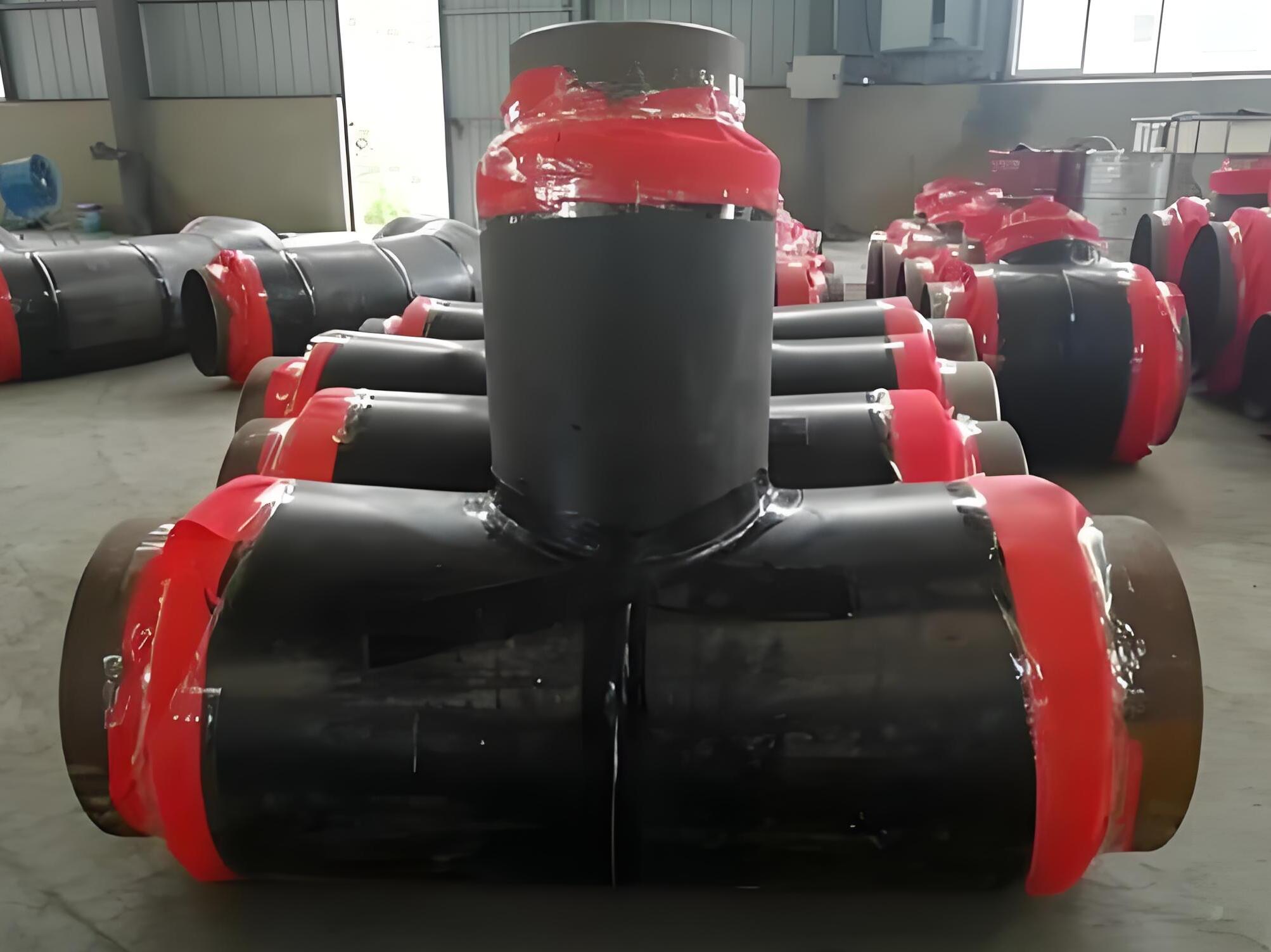
Insulated tees are used at branch, merging, and direction-change locations of heating pipe networks, solving once and for all during the factory prefabrication stage the problems of ordinary bare tees such as easy heat loss, winter freezing and blockage, and uneven on-site wrapping insulation. The product adopts a three-layer composite structure consisting of an inner working base body, a middle thermal insulation layer, and an outer protective shell. The inner layer can be selected from 20# carbon steel, 304 stainless steel, or heat-resistant alloy steel; the middle layer is mainly high-density polyurethane foam, and rock wool or aerogel can be customized for high-temperature working conditions; the outer layer can be selected from HDPE polyethylene, fiberglass reinforced plastic, galvanized iron sheet, or stainless steel. According to the laying method, it is divided into three categories: prefabricated directly buried, aboveground, and jacketed heat tracing. Structurally, it covers equal-diameter, reduced-diameter, 45° oblique tee, and crossing tee. The temperature resistance range covers -40°C low-temperature cold preservation to 160°C high-temperature heating supply, and it is suitable for hot water, steam, heat transfer oil, chilled water, and high-viscosity chemical media. Specifications cover DN20–DN1200, and customization according to drawings and overseas standards is supported.
Overview
Insulated tees are prefabricated insulated pipe fittings used for flow splitting, merging, and direction changing in central heating, industrial thermal power, low-temperature cold preservation, chemical constant-temperature, and high-viscosity medium transportation pipeline networks. They integrally form the working inner pipe, thermal insulation layer, and outer protective casing in the factory in one molding process, eliminating the need for on-site secondary insulation wrapping, and mainly solve the problems of ordinary bare tees such as heat loss at branch positions, cold energy loss, winter pipe freezing and blockage, medium crystallization and solidification, and aging and leakage of open-air pipeline networks. Products are divided by laying method into three categories: prefabricated directly buried, overhead, and jacketed heat tracing; structurally they cover equal-diameter, reducing, 45° oblique tees, and crossover tees; specifications cover DN20–DN1200; the temperature resistance range covers -40℃ to 160℃; and they can adapt to hot water, steam, heat transfer oil, chilled water, and high-viscosity chemical media.
Key Features
First, integrated prefabrication. The insulation layer is foam-molded in the factory, with uniform density and tight fit, without the gaps and thermal bridges commonly found in on-site manual wrapping, resulting in more stable insulation performance. Second, the three-layer structure has clear division of functions. The inner working base body bears pressure and seals, and can be made of 20# carbon steel, 304 stainless steel, or heat-resistant alloy steel; the middle layer is high-density polyurethane foam for temperature locking, and rock wool or aerogel can be used instead under high-temperature conditions; the outer layer of HDPE polyethylene, fiberglass reinforced plastic, galvanized iron sheet, or stainless steel protective casing is responsible for waterproofing, anti-corrosion, and UV resistance. Third, models are divided by working conditions. Buried pipeline networks use the prefabricated directly buried PE waterproof model, open-air overhead pipeline networks use the anti-aging UV-resistant model, and high-viscosity, easily crystallizing media such as heavy oil, asphalt, and glue liquid use the jacketed steam heat tracing model. Fourth, the range of specifications and customization is wide. Full-diameter coverage from DN20–DN1200, supporting non-standard pipe diameters, special insulation thicknesses, non-standard branch angles, and crossover avoidance special-shaped structures, and can be prefabricated according to drawings and overseas standards.
Applications
Municipal heating scenarios are suitable for urban main heating pipeline networks, community secondary heating pipeline networks, and township central heating projects, with emphasis on temperature locking and energy saving at branch nodes and winter freeze prevention and explosion prevention of pipes. Industrial thermal energy scenarios are suitable for factory high-temperature steam, heat transfer oil, and waste heat recovery constant-temperature pipeline networks, stabilizing medium temperature and preventing temperature drop and solidification. Chemical process scenarios are suitable for the transportation of high-viscosity media such as heavy oil, asphalt, and glue liquid, ensuring medium flowability through jacketed heat tracing and completely preventing crystallization and pipe blockage. Cold chain and air conditioning scenarios are suitable for central air conditioning chilled water and industrial low-temperature cold preservation pipeline networks, locking in cold energy and reducing energy consumption loss. Geothermal hot spring scenarios are suitable for hot spring water transmission and geothermal heating pipeline networks, providing waterproofing, anti-corrosion, and constant-temperature heat preservation. Severe cold open-air scenarios are suitable for northern outdoor and high-altitude overhead thermal pipelines, resisting weathering and rain and snow erosion.
Specifications
Insulated tee specifications cover DN20–DN1200 and comply with GB/T29047, CJ/T114, and EN253 standards. The inner working base body can be made of 20# carbon steel, 304 stainless steel, or heat-resistant alloy steel; the middle layer is mainly a high-density polyurethane foam insulation layer, and rock wool or aerogel insulation layers can be customized for high-temperature conditions; the outer layer can be HDPE polyethylene, fiberglass reinforced plastic, galvanized iron sheet, or stainless steel protective casing. The temperature resistance range covers -40℃ low-temperature cold preservation to 160℃ high-temperature heating, adapting to hot water, steam, heat transfer oil, chilled water, and high-viscosity chemical media. Processes are divided into three categories: prefabricated directly buried, overhead, and jacketed heat tracing; structures cover equal-diameter, reducing, 45° oblique tees, and crossover tees. For specific diameters, insulation thicknesses, branch angles, and material combinations, please contact us to confirm.
Purchasing & Delivery
Insulated tees belong to the category of engineered prefabricated customized pipe fittings, with many specifications and models and strong adaptability to working conditions, and we have set relaxed tiered minimum order rules. For DN20–DN300 conventional directly buried and overhead standard in-stock specifications, the MOQ is as low as 1 piece, suitable for heating engineering supplementary parts, energy-saving technical upgrades, and bulk centralized procurement. For DN20–DN300 conventional directly buried and overhead standard in-stock styles, quality re-inspection, protective reinforcement, and sealed packaging are completed within 24–48 hours after order confirmation. For other diameters and customized styles, please contact us to confirm the delivery cycle. Packaging adopts foreign-trade-grade pressure-resistant, drop-resistant, scratch-resistant, waterproof, and moisture-proof solutions; pipe ends, welding bevels, and flange sealing surfaces are reinforced with thickened protection; small and medium specifications are individually foam-shaped and sealed; medium and large diameters use multi-layer waterproof stretch film and rainproof woven cloth; extra-large diameters are equipped with solid wood load-bearing bases; full-container fumigation-free pallets and high-strength steel straps are used for reinforcement; and English shipping marks, specification batches, and customer LOGOs can be customized.
Service & Support
We provide full-process services for global thermal engineering and foreign trade customers procuring insulated tees. The pre-sales technical team provides one-on-one matching of insulation structure and thickness solutions according to medium temperature, laying environment, and working condition type. All products undergo appearance fine inspection, dimensional re-measurement, base body pressure resistance testing, insulation layer density sampling inspection, and thermal conductivity verification before leaving the factory. For quality defects in factory prefabrication, foam encapsulation, and processing and manufacturing, free returns and exchanges and free replacements are supported. After-sales service provides answers to questions on thermal pipeline network installation, insulation operation and maintenance, and aging maintenance, with full-process logistics tracking and assistance for overseas customers in rapid customs clearance. The product warranty period is 18 months, with 7×24-hour response.
FAQ
What is the difference between insulated tees and ordinary tees?
Ordinary tees have no insulation layer, so heat or cold energy loss at branch positions is large, they are prone to freezing and blockage in winter, and open-air pipeline networks are also prone to aging and leakage. Insulated tees integrally prefabricate the working inner pipe, thermal insulation layer, and outer protective casing in the factory, providing stable temperature locking performance, reducing cold and heat loss in pipeline networks, and also eliminating the need for on-site secondary insulation wrapping.
How to choose between directly buried and aboveground styles?
For buried underground pipe networks, choose the prefabricated directly buried PE waterproof style, with the key points being moisture protection and corrosion resistance; for outdoor high-altitude open-air pipe networks, choose the aboveground anti-aging and UV-resistant style, with the key points being that the insulation layer does not fall off and resists rain and snow erosion. If the installation environment is special, please contact us to confirm the specific structure and outer protective shell material.
Can the jacketed insulation style solve medium crystallization and pipe blockage?
The jacketed insulation style uses interlayer steam tracing and is specifically suited for high-viscosity, crystallization-prone media such as heavy oil, asphalt, and glue liquid. Its purpose is to ensure medium flowability and reduce crystallization and pipe blockage. For specific tracing parameters and jacket structure, it is necessary to contact us for confirmation based on the medium characteristics and working conditions.
What specifications and customizations are supported for insulated tees?
Specifications cover DN20–DN1200, and support non-standard pipe diameters, special insulation thicknesses, non-standard branch angles, special-shaped structures for crossing and avoidance, and eccentric flow-splitting forms. The inner layer can be selected from 20# carbon steel, 304 stainless steel, or heat-resistant alloy steel; the insulation layer can be customized with polyurethane, rock wool, or aerogel; and the outer protective shell can be selected from HDPE polyethylene, fiberglass-reinforced plastic, galvanized iron sheet, or stainless steel. It can be prefabricated according to customer drawings and overseas standards.
How are the minimum order quantity and delivery lead time calculated?
For DN20–DN300 conventional directly buried and aboveground standard in-stock specifications, the MOQ is as low as 1 piece. After order confirmation, quality re-inspection, protective reinforcement, and sealed packaging are completed within 24–48 hours. For other diameters and customized styles, please contact us to confirm the minimum order quantity and delivery lead time.