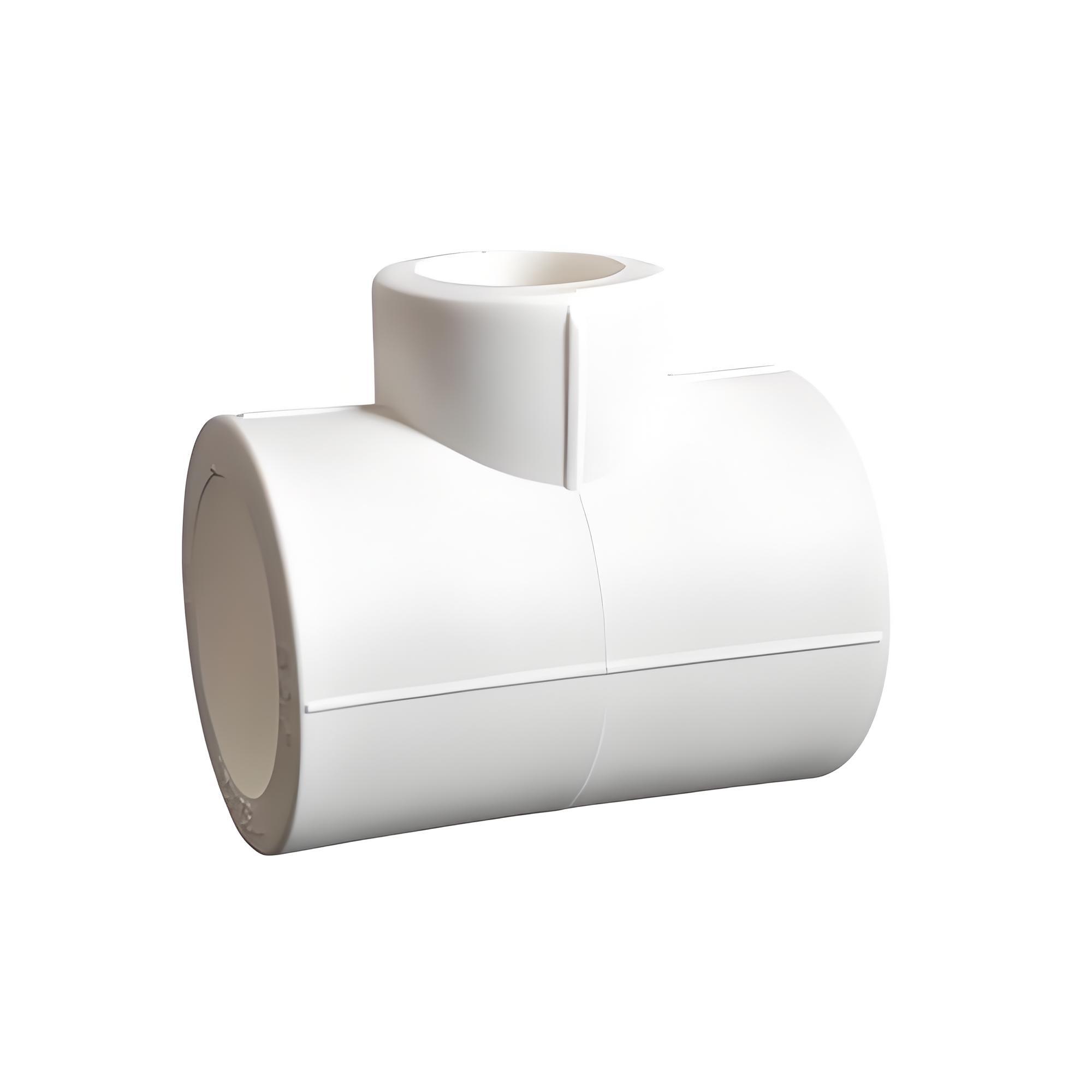
Our non-metallic tees use inert polymer materials to replace metal pipe fittings such as carbon steel and stainless steel, solving from the source the problems of metal tees being prone to corrosion, scaling, and rusting, as well as secondary contamination of the medium. The products are strictly manufactured according to standards such as GB/T13663, GB/T5836, ASTM D1785, and ISO4427. The nominal diameters cover DN15–DN1200, suitable for PN6, PN10, and PN16 medium- and low-pressure normal-temperature working conditions. The structures include equal-diameter, reducing, 45° diagonal tees, and sweep tees. The connection methods support adhesive bonding, hot-melt socket welding, flange connection, and threaded connection. The inner wall is smooth, and during long-term operation it does not scale or reduce flow. The material system includes six major categories: PVC-U, PPH, HDPE, PVDF, FRP fiberglass, and ceramic composite, and can be selected for differentiated working conditions such as ordinary sewage, weak acids and weak bases, strongly corrosive chemical liquids, high-purity water, and high-flow abrasive media.
Overview
Non-metal tees are polymer diversion pipe fittings we launch for pipeline networks such as corrosive fluids, high-purity water, and municipal sewage. Unlike metal tees such as carbon steel and stainless steel, they are integrally injection molded, compression molded, or sintered from inert non-metal polymer materials, with no welding seams or oxide layers, a smooth inner wall, and no scaling or flow reduction during long-term operation. The products are manufactured according to standards such as GB/T13663, GB/T5836, ASTM D1785, and ISO4427, with nominal diameters covering DN15–DN1200, suitable for PN6, PN10, and PN16 medium-low pressure normal-temperature working conditions. Structurally, they include equal-diameter, reducing, 45° diagonal tees, and sweep tees; connection methods support bonding, hot-melt socket fusion, flange connection, and threaded connection, and they can be used for new pipelines and are also convenient for connection and renovation with existing pipeline networks.
Key Features
First, anti-corrosion and clean. The material has stable chemical properties and does not react with media such as acids, alkalis, salts, pure water, or seawater, fundamentally eliminating rust, scaling, and secondary pollution. Second, good flow performance. The smooth inner wall increases water flow by more than 30% compared with metal pipe fittings, and it does not clog or reduce flow during long-term use. Third, many material options. Six major systems—PVC-U, PPH, HDPE, PVDF, FRP fiberglass, and ceramic composite—can be selected for differentiated working conditions such as ordinary sewage, weak acids and weak alkalis, strongly corrosive chemical liquids, high-purity water, and large-flow abrasive media. Fourth, complete specifications. Full-diameter coverage from DN15–DN1200, with equal-diameter, reducing, 45° diagonal tees, and sweep tees all available. Fifth, lightweight installation. Non-metal materials are lightweight and support multiple connection methods, reducing construction difficulty. Sixth, weather resistance and anti-aging. Resistant to moisture, salt spray, and aging, suitable for buried, open-air, and coastal highly corrosive environments.
Applications
Chemical and environmental protection scenarios: used for branch diversion and direction change in pipeline networks conveying acid-base waste liquids and chemically corrosive fluids, solving the problem of metal tees being prone to corrosion and leakage. Pharmaceutical pure water scenarios: used in high-purity water and clean pharmaceutical liquid conveyance systems; the material is inert and non-polluting, ensuring that medium purity meets standards. Municipal water conservancy scenarios: used in urban water supply and drainage, rainwater-sewage separation, and buried farmland irrigation pipeline networks, with strong moisture resistance, soil corrosion resistance, and weather resistance. HVAC and mechanical scenarios: used for central air-conditioning circulating water and industrial cooling water pipe networks, with a smooth inner wall that does not scale, and unobstructed flow without reducing resistance. Coastal engineering scenarios: used in high salt spray and high humidity corrosive environments, completely eliminating metal oxidation and rust failures. Seawater desalination scenarios: used for conveying seawater saline corrosive media.
Specifications
Nominal diameters cover DN15–DN1200, and pressure ratings are suitable for PN6, PN10, and PN16 medium-low pressure normal-temperature working conditions. Material systems include six major categories: PVC-U, PPH, HDPE, PVDF, FRP fiberglass, and ceramic composite. For applicable temperature, PVC-U ≤45°C, PP ≤80°C, PVDF ≤100°C, FRP ≤80°C; for other materials, please contact us for confirmation. Connection methods include bonding, hot-melt socket fusion, flange connection, threaded connection, and integral molding. Structural forms include equal-diameter, reducing, 45° diagonal tees, and sweep tees. For specific models, wall thickness, pressure-bearing ratings, and other parameters, please contact us for confirmation.
Purchasing & Delivery
Non-metal tees are general standardized pipe fittings, and we have tiered minimum order rules, suitable for engineering replenishment, sporadic renovations, batch project centralized procurement, and foreign trade cross-border distribution. Conventional small-diameter standard stock styles from DN15–DN110 have a relatively low minimum order threshold; for the specific MOQ, please contact us for confirmation. Conventional specifications are kept in stock; after order confirmation, counting, re-inspection, and packaging are completed within 24 hours, and the specific delivery time is confirmed according to order quantity and material requirements. Packaging uses foreign-trade-grade dust-proof, scratch-proof, compression-deformation-proof, light-blocking, and moisture-proof solutions; socket ports, bonding bevels, sealing end faces, and threaded positions are individually fitted with dust plugs and protective sleeves. Small specifications are individually wrapped in pearl cotton and then packed into thickened hard cardboard boxes; medium and large diameter pipe fittings are wrapped on the outer layer with waterproof stretch film and dust-proof protective film; large hollow products are fitted with packing corner protectors and wrapped woven bags. Full-container shipments are stacked on fumigation-free pallets, reinforced with overall wrapping film and shaped with steel straps. English shipping marks, specifications and models, batch numbers, and customer LOGOs can be customized on demand.
Service & Support
We provide full-process after-sales service for engineering and foreign trade customers worldwide who purchase non-metal tees. All products undergo batch-by-batch dimensional calibration, appearance inspection, material sampling, and pressure compliance testing before leaving the factory. For quality defects such as factory production process issues, material nonconformity, and specification mismatches, we support free returns and exchanges and free replacements. The pre-sales technical team can match materials and models one-on-one according to medium acidity and alkalinity, temperature and pressure, and usage environment, avoiding corrosion failure and insufficient temperature resistance caused by selection. After-sales service provides hot-melt and bonding construction guidance for non-metal pipeline network installation and answers questions on daily operation, maintenance, and care, with full-process logistics tracking to assist overseas customers with rapid customs clearance. The product warranty is 18 months, with 7×24-hour response.
FAQ
What advantages do non-metallic tees have compared to metal tees?
Non-metallic tees are made entirely of non-metallic inert materials, never rust, resist acid and alkali corrosion, do not scale on the inner wall, and cause no secondary pollution of the medium. Compared with metal tees, they are lighter in weight, easier to install, and lower in operation and maintenance costs, making them more suitable for corrosive, clean, and humid pipeline network environments.
How should common materials be selected?
For ordinary sewage and cold water, choose PVC-U; for industrial circulating water and weak acids and weak bases, choose PP; for municipal buried water supply and drainage, choose PE; for highly corrosive fine chemicals and high-purity liquid medicines, choose PVDF; for large-diameter sewage and wear resistance, choose FRP fiberglass. For specific selection, please contact us to confirm based on the medium's acidity and alkalinity, temperature and pressure, and usage environment.
Can non-metallic tees be used in drinking water pipeline networks?
Drinking water grade products have hygiene licenses, are non-toxic and odorless, and can be used in drinking water pipeline networks. For hygiene license documentation for specific batches and specifications, please contact us to confirm.
What connection methods do non-metallic tees support?
They support bonding, hot-melt socket fusion, flange connection, threaded connection, and integral molding. They can be selected according to the existing pipeline network interface form, and also support customization of special bonding bevels, non-standard flanges, extended sockets, and special-shaped threaded structures.
How do I confirm the MOQ and delivery time for non-metal tees?
DN15–DN110 conventional small-diameter standard in-stock models have a relatively low minimum order threshold. For the specific MOQ and delivery time, please contact us to confirm based on material, specifications, quantity, and delivery address. Conventional specifications are kept in stock, and after order confirmation, inventory counting, re-inspection, and packaging will be completed within 24 hours.