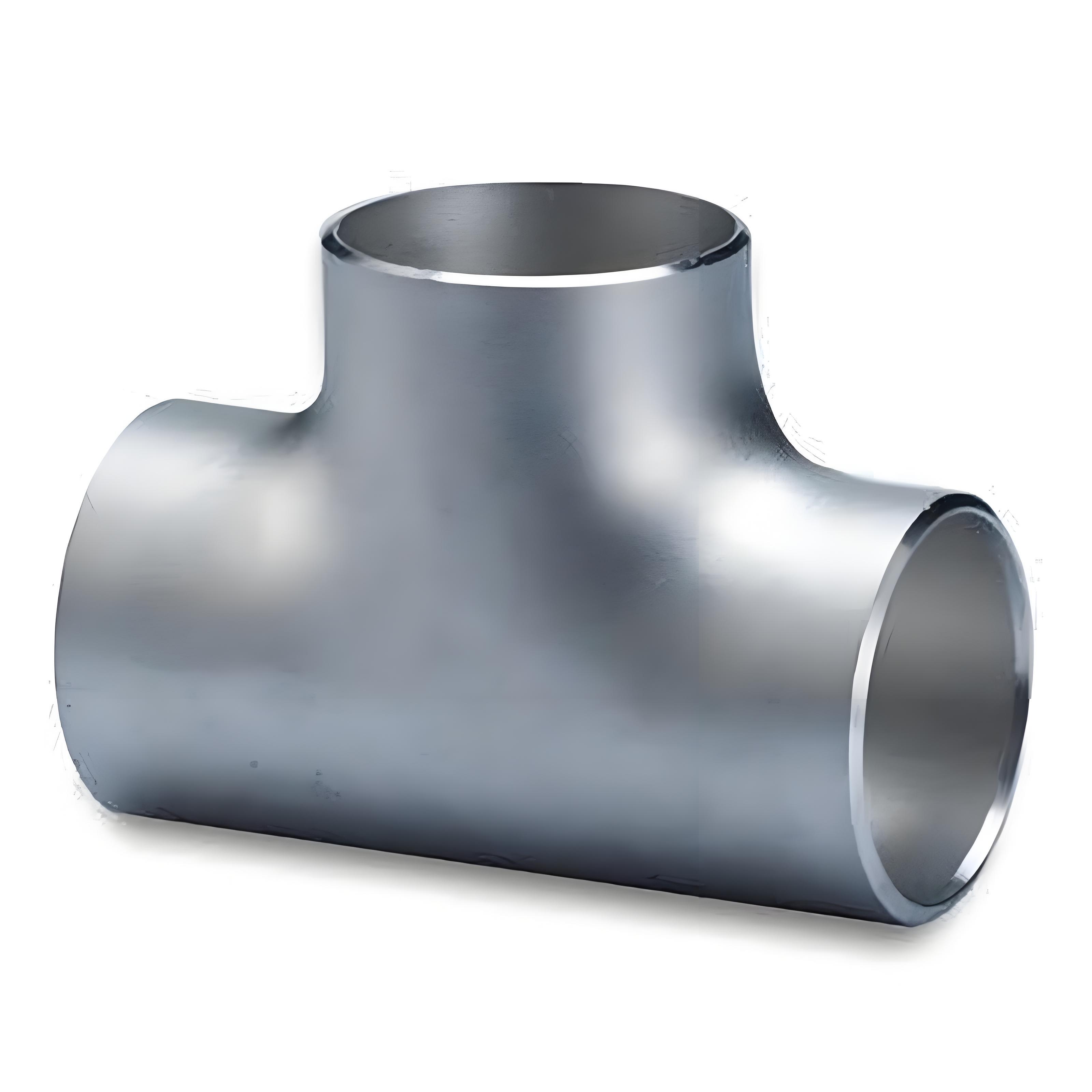
The stainless steel tees we supply are used for splitting, merging, and branch diversion of media in industrial piping systems, commonly found in humid, acid-base, salt spray, clean, and high-temperature working conditions where carbon steel pipe fittings are difficult to handle. Product materials include 304, 304L, 316, 316L, 321, 904L austenitic stainless steel as well as 2205, 2507 duplex stainless steel, and can be produced according to ASME B16.9, GB/T12459, SH/T3408, MSS SP43 standards. In terms of process, they are divided into three categories: seamless pressing, high-pressure forging, and large-diameter rolled and welded: the seamless type has smooth flow channels and few welds; the forged type has dense grains and is suitable for high-pressure pipelines; the rolled type can achieve extra-large pipe diameters. The surface can be treated with pickling and passivation, mirror polishing, or sandblasting, and the connection methods include butt welding, socket welding, and threading. Before purchasing, it is recommended to confirm the medium, diameter, wall thickness, material, and connection standard, and we will assist in matching the process and providing a quotation.
Overview
Stainless steel tees are used for splitting, merging, and branch direction change of media in industrial pipelines. The materials of the products we supply include 304, 304L, 316, 316L, 321, 904L austenitic stainless steel and 2205, 2507 duplex stainless steel, and can be produced according to ASME B16.9, GB/T12459, SH/T3408, MSS SP43 standards. Compared with carbon steel pipe fittings, stainless steel tees are more suitable under humid, acid-base, salt spray, clean, and high-temperature working conditions, and can reduce the risk of rust blockage and medium contamination. Products cover DN15–DN3000 diameters; processes are divided into three categories: seamless pressing, high-pressure forging, and large-diameter rolled welding; connection methods include butt welding, socket welding, and threading; surfaces can be acid-pickled and passivated, mirror-polished, or sandblasted.
Key Features
In terms of material, 304 and 316L are commonly used choices for conventional corrosive working conditions, while 904L, 2205, and 2507 are suitable for high-chloride, strong acid-base, or seawater environments. In terms of process, the seamless pressed type has smooth flow channels and few welds, suitable for small and medium-diameter clean pipeline networks; the forged type has dense grains, suitable for high-pressure and high-temperature equipment pipelines; the rolled welded type can achieve extra-large pipe diameters, filling the gap in mold specifications. In terms of surface treatment, acid pickling and passivation and mirror polishing can meet the requirements of high-purity fluid transportation for inner wall cleanliness. Connection methods cover butt welding, socket welding, and threading, making it convenient to match different pipeline designs and maintenance needs. The temperature resistance range can cover -196℃ to 650℃, with stable performance under alternating hot and cold working conditions.
Applications
In the chemical field, it can be used for fine chemical acid-base transportation, desulfurization and denitrification pipeline networks, and organic solvent circulation pipelines; in the pharmaceutical and food fields, it can be used for aseptic transportation, pure water purification, and beverage processing pipeline networks, requiring no metal precipitation and no contamination of the medium; in the marine engineering field, it can be used for seawater desalination, coastal salt spray pipeline networks, and offshore platform transportation pipelines, requiring resistance to chloride ion corrosion; in the energy field, it can be used for high-temperature steam in power stations, waste heat circulation, and high-temperature pipelines in new energy processes; in the environmental protection field, it can be used for industrial sewage, waste gas treatment, and corrosive wastewater transportation pipeline networks. If your working conditions involve the above media or environments, you are welcome to contact us to confirm material and process selection.
Specifications
Diameters cover DN15–DN3000; materials can be selected from 304, 304L, 316, 316L, 321, 904L, 2205, 2507. Processes are divided into seamless pressing, high-pressure forging, and large-diameter rolled welding. Connection methods include butt welding, socket welding, and threading. Implementation standards include ASME B16.9, GB/T12459, SH/T3408, MSS SP43. Surface treatment can be acid pickling and passivation, mirror polishing, or sandblasting finishing. Temperature resistance range is -196℃ to 650℃. For DN15–DN300 conventional 304 and 316L standard stock specifications, MOQ is as low as 1 piece; for other specifications and customization needs, please contact us to confirm.
Purchasing & Delivery
For DN15–DN300 conventional standard stock styles, after order confirmation, acid pickling and passivation, fine inspection, and protective packaging are completed within 24–48 hours. For other diameters, materials, and customized styles, please contact us to confirm the delivery time. Packaging uses anti-rust oiled paper, pearl cotton, plastic thread protector caps, and moisture-proof cartons; for medium and large-diameter butt-welded types, protective film and anti-collision rings are added to the bevels; for extra-large-diameter rolled products, the outer wall is wrapped with waterproof stretch film and rainproof woven fabric; full-container shipments use fumigation-free pallets and steel strip reinforcement. Custom English shipping marks, specification batches, and customer LOGOs are supported. If you need a quotation, please provide diameter, material, wall thickness, connection method, and quantity.
Service & Support
We provide pre-sales selection support and can assist in matching materials and processes according to medium, temperature, pressure, and cleanliness requirements. Before leaving the factory, products undergo visual fine inspection, dimensional re-measurement, spectral material verification, passivation layer testing, non-destructive testing, and cleanliness sampling inspection. The warranty period is 18 months, with 7×24-hour response. After-sales support provides technical answers on stainless steel welding, passivation maintenance, and clean pipeline network operation and maintenance, and assists overseas customers with customs clearance matters. In case of factory production or process quality problems, free returns, exchanges, and replacements are supported. You are welcome to contact us to confirm specific service terms.
FAQ
What is the difference between stainless steel tees and carbon steel tees?
Stainless steel tees are more suitable for harsh working conditions in terms of corrosion resistance, cleanliness, and high-temperature resistance. Carbon steel pipe fittings are prone to rust in humid, acid-base, and salt spray environments, which may cause medium contamination or pipeline network blockage. Stainless steel material has its own passivation protective layer, which can resist acid-base, salt spray, seawater, and oxidation corrosion, does not rust during long-term operation, and does not peel, making it suitable for pipeline systems in chemical, pharmaceutical, food, marine engineering, and other fields that require cleanliness and corrosion resistance.
How to choose between 304 and 316L stainless steel tees?
For ordinary atmospheric environments or weakly acidic corrosion conditions, 304 or 304L can be selected. For seawater, high chloride ions, and strong acid-base fine chemical conditions, it is recommended to choose 316 or 316L, which has stronger corrosion resistance. If the medium is more corrosive or the temperature is higher, 321, 904L, 2205, or 2507 can also be considered. For specific selection, please provide the medium composition, concentration, and temperature, and we will assist in confirming.
How to choose among the three processes: seamless pressing, forging, and rolled welded?
For small and medium diameters under conventional corrosion conditions, the seamless pressed type can be selected, with smooth flow channels and few welds. For high-pressure and high-temperature equipment pipelines, the forged type is recommended, with dense grains and no welding defects. For extra-large diameter pipeline networks, the rolled welded type can be selected, enabling non-standard customization of larger diameters. If you are not sure which process to choose, welcome to contact us and provide the diameter, pressure, and temperature parameters, and we will assist in matching.
Can stainless steel tees be used in the food and pharmaceutical industries?
Yes. We can perform mirror polishing and sterile acid pickling and passivation treatment on stainless steel tees, making the inner and outer walls clean and free of impurities and free of oxide scale, meeting the requirements for high-purity fluid transportation. Food, pharmaceutical, and pure water purification pipeline networks usually use 304 or 316L material. For specific surface treatment grades and cleanliness requirements, please contact us to confirm.
What is the temperature resistance range of stainless steel tees?
The stainless steel tees we supply can withstand a temperature range of -196℃ to 650℃, with stable performance under alternating hot and cold and pressure impact conditions. The applicable temperature of different materials and processes will vary. If you have specific operating temperatures, welcome to contact us to confirm the suitable material and process.