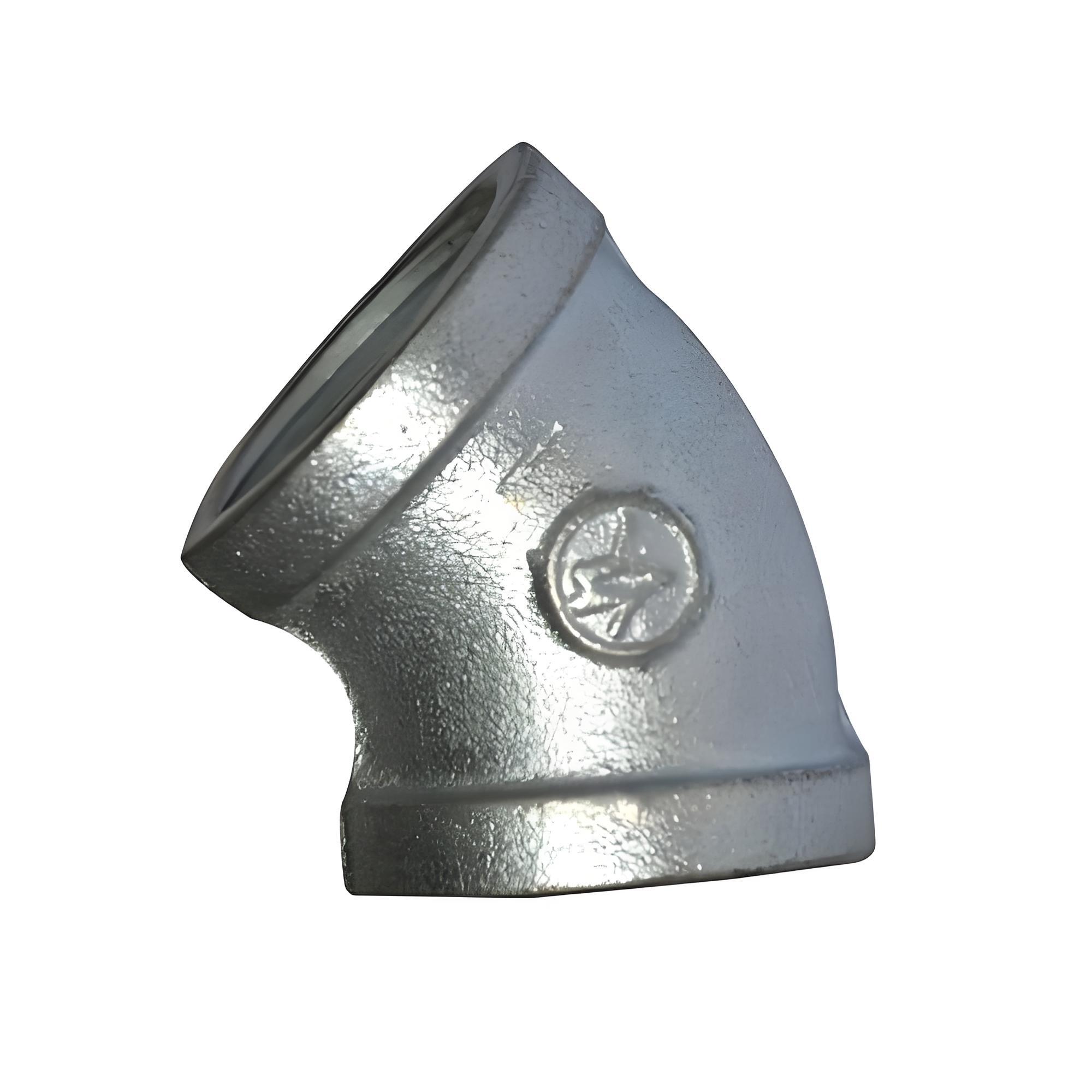
45° flanged elbows are the angled direction-change pipe fittings we supply to the pipeline engineering market, integrating a 45° elbow direction-change structure with flanged quick-installation connections. Compared with 90° elbows, 45° angled bends are more targeted for fine-tuning pipeline slopes, misaligned connections, and dispersing fluid impact, making them suitable for occasions requiring control of pipeline stress, reduction of scale buildup, or avoidance of installation dead zones. The products are divided into two specifications: long-radius 1.5D and short-radius 1.0D, with nominal diameters covering DN15-DN2000, and pressure compatibility with national standard PN10-PN160 and American standard Class150-Class2500. Materials cover carbon steel, stainless steel, and alloy steel, and can be selected according to medium type, working temperature, and corrosion conditions. The flange end faces are precision-machined, bolt hole positions are configured according to standards, and both single-flange and double-flange forms are supported. Regular carbon steel and stainless steel stock styles can be quickly arranged for shipment after order confirmation, while non-standard sizes, special materials, and surface processes can be customized according to project requirements.
Overview
45° flanged elbows are the diagonal direction-changing pipe fittings we supply, integrating the direction-changing function of a 45° elbow with a flanged bolted quick-installation structure. They are mainly used on pipe sections that require fine adjustment of pipeline angle, adjustment of drainage slope, or avoidance of installation dead zones. Compared with 90° elbows, 45° diagonal bends are more targeted in dispersing fluid impact and reducing pipeline stress. The products are manufactured according to standards such as ASME B16.9, ASME B16.5, GB/T12459, HG/T20592, DIN, and EN, with nominal diameters covering DN15-DN2000, and pressure compatibility for national standard PN10-PN160 and American standard Class150-Class2500. Materials are divided into three categories: carbon steel, stainless steel, and alloy steel, which can be selected according to medium type, working temperature, and corrosion conditions.
Key Features
The 45° diagonal direction-changing design is suitable for pipeline slope adjustment and offset connection, and can reduce the resistance concentration and fouling problems caused by 90° right-angle turns. The flanged connection method eliminates the need for hot work welding during on-site installation, making disassembly, assembly, and later maintenance more convenient, and also supports reuse during pipeline network renovation. The products adopt an integral forming process, with smooth inner walls, flat flange end faces, and bolt hole positions configured according to standards, ensuring tight fitting during connection. We provide two specifications: long radius 1.5D and short radius 1.0D, as well as two forms: single flange and double flange, which can be selected according to pipeline space and connection requirements. In terms of materials, carbon steel, stainless steel, and alloy steel are covered, capable of matching different working conditions from conventional medium and low pressure to corrosive media, high temperature, and high pressure.
Applications
45° flanged elbows are mainly used in diagonal direction changes, slope adjustment, and offset connection positions in various pipeline systems. In municipal water supply and drainage and rainwater-sewage diversion projects, they are used for fine adjustment of pipeline slope to help avoid water and dirt accumulation. In heating and fire sprinkler systems, they are suitable for diagonal connections in locations with limited space in pipe galleries. In the chemical, pharmaceutical, and food and beverage industries, stainless steel materials are selected for corrosion-resistant and clean medium pipelines. In ship pipelines, offshore platforms, and seawater desalination systems where salt spray corrosion resistance is required, stainless steel or alloy steel styles can be selected. In thermal power steam pipelines, coal chemical high-temperature process pipeline networks, and high-pressure oil and gas transmission systems, alloy steel thickened styles can be selected.
Specifications
Nominal diameters cover DN15-DN2000, and pressure compatibility includes national standard PN10-PN160 and American standard Class150-Class2500. Bending radius is divided into long radius 1.5D and short radius 1.0D. Connection forms include single flange and double flange. The material system includes carbon steel, stainless steel, and alloy steel, and specific grades can be confirmed according to medium and working conditions. Implementation standards cover ASME B16.9, ASME B16.5, GB/T12459, HG/T20592, DIN, and EN. For conventional DN15-DN200 carbon steel standard in-stock styles, MOQ is as low as 10 pieces. For conventional DN15-DN200 carbon steel and 304/316L stainless steel in-stock styles, shipment is made within 24 hours after order confirmation. Non-standard diameters, thickened pipe walls, special angles, non-standard flange hole spacing, and surface processes can be customized according to project requirements; please contact us to confirm specific parameters.
Purchasing & Delivery
We adopt flexible tiered minimum order quantities. For conventional DN15-DN200 carbon steel standard in-stock styles, MOQ is as low as 10 pieces, suitable for sporadic project replenishment, local renovation, and foreign trade sample inspection. For conventional DN15-DN200 carbon steel and 304/316L stainless steel in-stock styles, re-inspection, packaging, and shipment are completed within 24 hours after order confirmation. The delivery time for non-standard customized orders must be confirmed according to specific specifications and quantities. Packaging adopts a standardized foreign trade protection system: flange sealing surfaces and precision-machined end faces are covered with protective film, bolt holes are fitted with plastic plugs, small and medium diameters use pearl cotton and hard cardboard boxes, medium and large diameters add anti-rust oil paper and waterproof woven fabric, and full-container shipments are reinforced with fumigation-free solid wood pallets. English shipping marks, model specifications, material batches, and customer logos can be customized as needed.
Service & Support
In the pre-sales stage, we can assist in confirming the adaptation plan for materials, pressure ratings, and surface processes according to medium type, working pressure, operating temperature, and construction environment. After-sales, we provide technical guidance on pipeline installation and connection, bolt tightening, pressure testing and commissioning, and pipeline network operation and maintenance. Before leaving the factory, products undergo dimensional verification, sealing surface inspection, hydrostatic pressure testing, and material spectral re-inspection. The warranty period is 18 months, with 7×24-hour after-sales response. For overseas customers, we can assist with logistics tracking and rapid customs clearance. If you need to confirm specific configurations or request a quotation, please contact us and provide information such as dimensions, quantity, material, and pressure rating.
FAQ
How to choose between 45° flanged elbows and 90° elbows?
If the pipeline requires a right-angle turn and space is sufficient, a 90° elbow can be selected. If the scenario involves fine adjustment of pipeline slope, diagonal connection, dispersing fluid stress, or avoiding water and dirt accumulation, a 45° flanged elbow is more suitable. For specific selection, you can contact us to confirm according to pipeline routing and working conditions.
What is the difference between single-flange and double-flange styles?
A single-flange 45° elbow has one end for welding and one end with a flange, suitable for mid-pipeline modification and local connections. A double-flange 45° elbow has flanges on both ends, allowing weld-free disassembly and convenient maintenance, suitable for process pipelines that require regular maintenance. You can choose based on the connection method and maintenance needs, and we can also assist with confirmation.
What working conditions are different materials suitable for?
Carbon steel material is suitable for conventional low and medium pressure working conditions such as municipal, heating, and fire protection. Stainless steel material is suitable for pipelines with corrosive or cleanliness requirements such as chemical, pharmaceutical, and food and beverage. Alloy steel material is suitable for high-temperature and high-pressure working conditions, such as thermal power steam pipelines and coal chemical process pipelines. For specific grade selection, please contact us to confirm based on the medium and working conditions.
What are the minimum order quantity and delivery time for conventional styles?
The MOQ for conventional DN15-DN200 carbon steel standard in-stock styles is as low as 10 pieces. For DN15-DN200 carbon steel and 304/316L stainless steel conventional in-stock styles, re-inspection, packaging, and shipping are completed within 24 hours after order confirmation. The delivery time for non-standard customized orders needs to be confirmed based on specifications and quantities; please contact us to obtain the specific schedule.
Can you customize non-standard sizes or special materials?
Yes. We support customization of non-standard diameters, thickened high-pressure pipe walls, special long and short radii, precise fine-tuned angles, and non-standard flange hole spacing. In terms of materials, we can customize carbon steel, stainless steel, chrome-molybdenum alloy steel, duplex steel, and special corrosion-resistant alloys. Surface processes support hot-dip galvanizing, cold galvanizing, sandblasting rust prevention, mirror polishing, pickling and passivation, etc. Please provide drawings or technical agreements, and we will assist with confirmation.