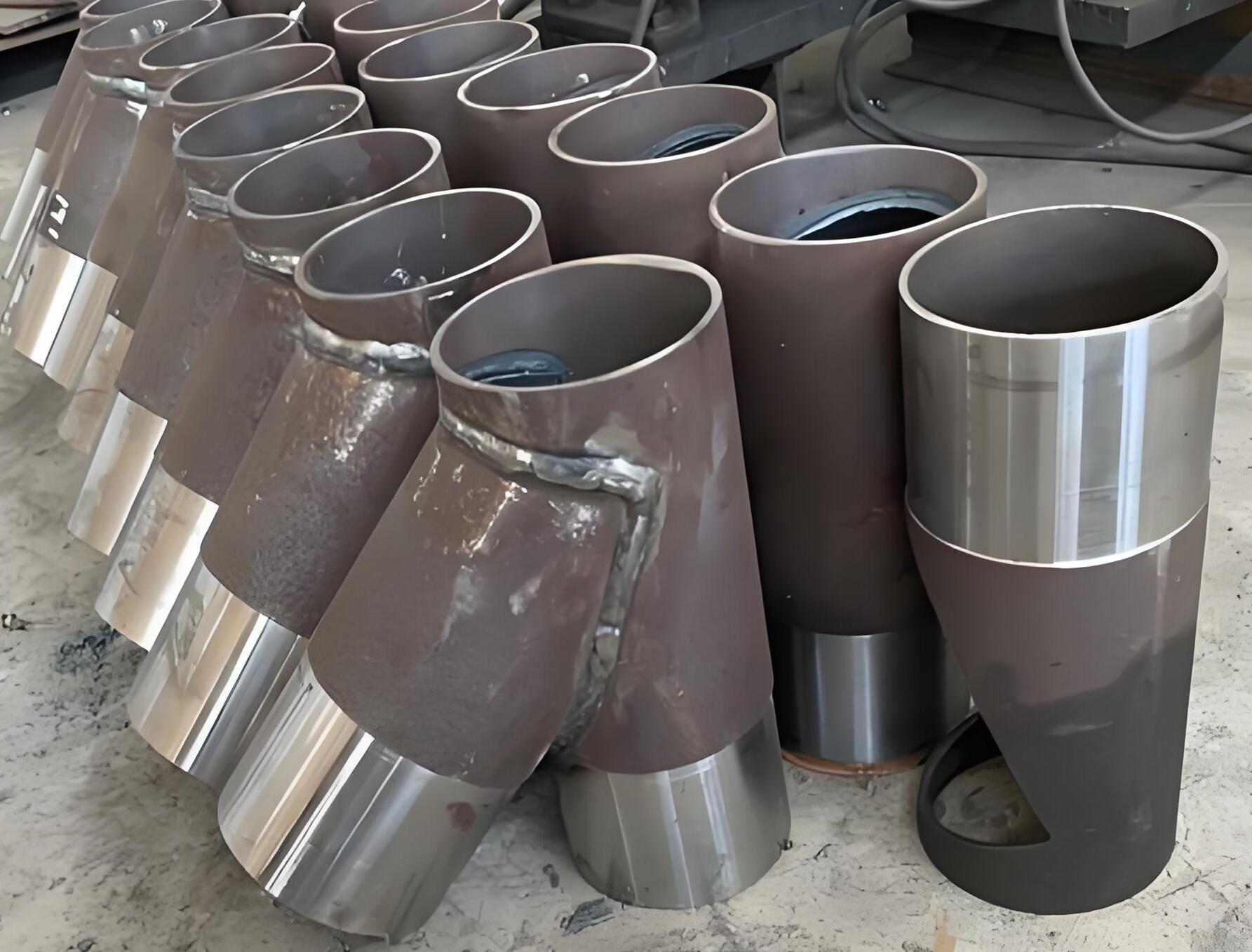
Oblique tee, also known as lateral tee or 45° oblique tee, is a special pipe fitting used for low-resistance smooth flow diversion in industrial piping systems. Compared with the 90° straight tee, the oblique tee adopts a 45° oblique branch design, and some non-standard products can be made with a 30° or 60° inclination angle, allowing the main pipe fluid to smoothly divert to the side branch, significantly reducing fluid turning impact, turbulent disturbance, and local pressure drop. The product is integrally formed by hot-pressing seamless push forming, hydraulic bulging, integral forging, or steel plate rolling and welding processes, with smooth flow passage transitions and no right-angle dead corners, effectively solving problems such as air accumulation, liquid accumulation, vortex erosion, and local wear in high-speed fluid, slurry medium, and gas pipelines. The full range covers carbon steel, stainless steel, alloy steel, and duplex steel materials, with nominal diameters from DN15 to DN2000, including both equal-diameter and reducing structures, and supports high-pressure thickened, wear-resistant, thermal insulation, anti-corrosion, and sanitary-grade customization. The product strictly implements standards such as GB/T12459, GB/T13401, ASME B16.9, SH/T3408, and HG/T21635, and is widely used in municipal drainage, long-distance thermal transmission, electric power, petrochemical, mining slurry, HVAC gas, and wastewater treatment fields. We provide free model selection and technical support, and you are welcome to contact us to confirm specific configurations.
Overview
A lateral tee is a specialized branch fitting in industrial piping systems, featuring a 45° inclined branch design; some non-standard versions can be made with 30° or 60° inclination angles, allowing the main pipe to smoothly divert a branch line laterally, significantly reducing fluid turning impact, turbulent disturbance, and localized pressure drop. The product is manufactured integrally through hot-pressed seamless push forming, hydraulic bulging, integral forging, or steel plate rolling and welding processes, with smooth and rounded flow channel transitions and no right-angle dead corners, effectively solving problems such as gas accumulation, liquid retention, vortex erosion, and localized wear in high-speed fluid, slurry media, and gas pipelines. The full range covers carbon steel, stainless steel, alloy steel, and duplex steel materials, with nominal diameters from DN15 to DN2000, including both equal-diameter and reducing structures, and supports high-pressure thickened, wear-resistant, insulated, anti-corrosion, and sanitary-grade customization. It strictly complies with standards such as GB/T12459, GB/T13401, ASME B16.9, SH/T3408, and HG/T21635, and is widely used in municipal drainage, long-distance thermal transmission, power generation, petrochemical, mining slurry, HVAC gas, and sewage treatment fields.
Key Features
The core advantages of the lateral tee are low resistance and energy saving, impact and wear resistance, no gas or liquid accumulation, no silting or clogging, stable flow conditions, and reliable strength. The 45° inclined branch design makes fluid turning gentler, reducing pressure drop and turbulence, and lowering energy consumption. The flow channel is smooth and free of dead corners, avoiding media retention and deposition, making it especially suitable for slurry and gas pipelines. The product supports multifunctional upgrades such as high-pressure thickening, wear resistance, insulation, and anti-corrosion, meeting special working condition requirements. Standard parts can directly replace equal tees in place, and non-standard angles and special reducers can be customized to suit retrofitting of older systems.
Applications
Lateral tees are suitable for piping systems with strict requirements for flow stability, pressure drop, and anti-clogging performance. Specific scenarios include: municipal drainage systems, which require gentle flow diversion to reduce sedimentation; long-distance thermal transmission pipelines, which require low resistance and stable flow conditions; power plant and petrochemical installations, which handle high-speed fluids or slurry media to prevent erosion and wear; mine slurry conveying pipelines, which require wear resistance and anti-clogging performance; HVAC gas pipelines, which need to avoid gas and liquid accumulation; and sewage treatment systems, which need to prevent silting and clogging. In addition, foreign trade purchasers can source lateral tees that meet international standards for overseas project support.
Specifications
The main specification parameters of lateral tees include: product classification (equal diameter, reducing, non-standard angle), material (carbon steel, stainless steel, alloy steel, duplex steel), nominal diameter range (DN15–DN2000), execution standards (GB/T12459, GB/T13401, ASME B16.9, etc.), and customization options (angle, reducer, size, wall thickness, material, function, testing). Specific parameters can be confirmed based on project requirements. Detailed technical requirements are welcome, and we will assist with product selection.
Procurement & Delivery
Regular-specification lateral tees can be shipped as single pieces, while high-pressure special types and non-standard-angle special shapes can be individually customized, suitable for small-quantity purchases, engineering retrofits, sample acceptance, and complete foreign trade package support. Regular products are delivered quickly, high-pressure precision products are quality-assured, and non-standard products are made to order, fully accommodating urgent engineering timelines and on-schedule foreign trade container loading. Packaging focuses on protecting bevels, threads, sealing surfaces, and functional composite layers, preventing deformation, collision damage, moisture, and contamination, ensuring the product can be installed immediately upon arrival after long-distance transport.
Service & Support
We provide long-term quality assurance, free and precise product selection, full-process technical support, and extremely fast after-sales response, helping customers resolve issues such as incorrect lateral tee selection, poor flow conditions, and erosion or leakage. We support full-dimensional customization of angle, reducer, size, wall thickness, material, function, and testing, solving problems where standard parts cannot fit special flow conditions, special pipe racks, or replacement of old irregular fittings. Please feel free to contact us to confirm specific requirements, and we will provide professional technical support.
FAQ
What is the difference between a lateral tee and a straight tee?
A lateral tee uses a 45° angled branch design, allowing the fluid to turn more gently, with lower pressure drop and less susceptibility to air accumulation, liquid accumulation, and blockage; a straight tee has a 90° right-angle branch, with a simple structure but greater flow resistance. For pipelines carrying high-speed fluids, slurries, gases, and similar media, the lateral tee is the better choice.
Can lateral tees be customized with non-standard angles?
Yes. We support customization with non-standard angles such as 30° and 60°, as well as special reducers, dimensions, wall thicknesses, and materials, to meet special pipe rack and flow regime requirements. Please contact us to confirm your specific needs.
What materials are available for lateral tees?
We offer materials including carbon steel, stainless steel, alloy steel, and duplex steel, among others. The specific choice can be made based on the medium and operating conditions. Please contact us to confirm the most suitable material.
What is the minimum order quantity for lateral tees?
Standard specifications can be shipped as single pieces, while high-pressure special or non-standard angle items can be customized individually, accommodating sporadic purchases and engineering retrofits. Please contact us to confirm the specific minimum order quantity.
Can a Y-branch tee replace an existing straight tee?
A standard Y-branch tee can usually replace a straight tee in place, but the connection dimensions and pressure rating need to be confirmed. Non-standard angles or special reductions can be customized; you are welcome to provide on-site dimensions so that we can assist with the evaluation.