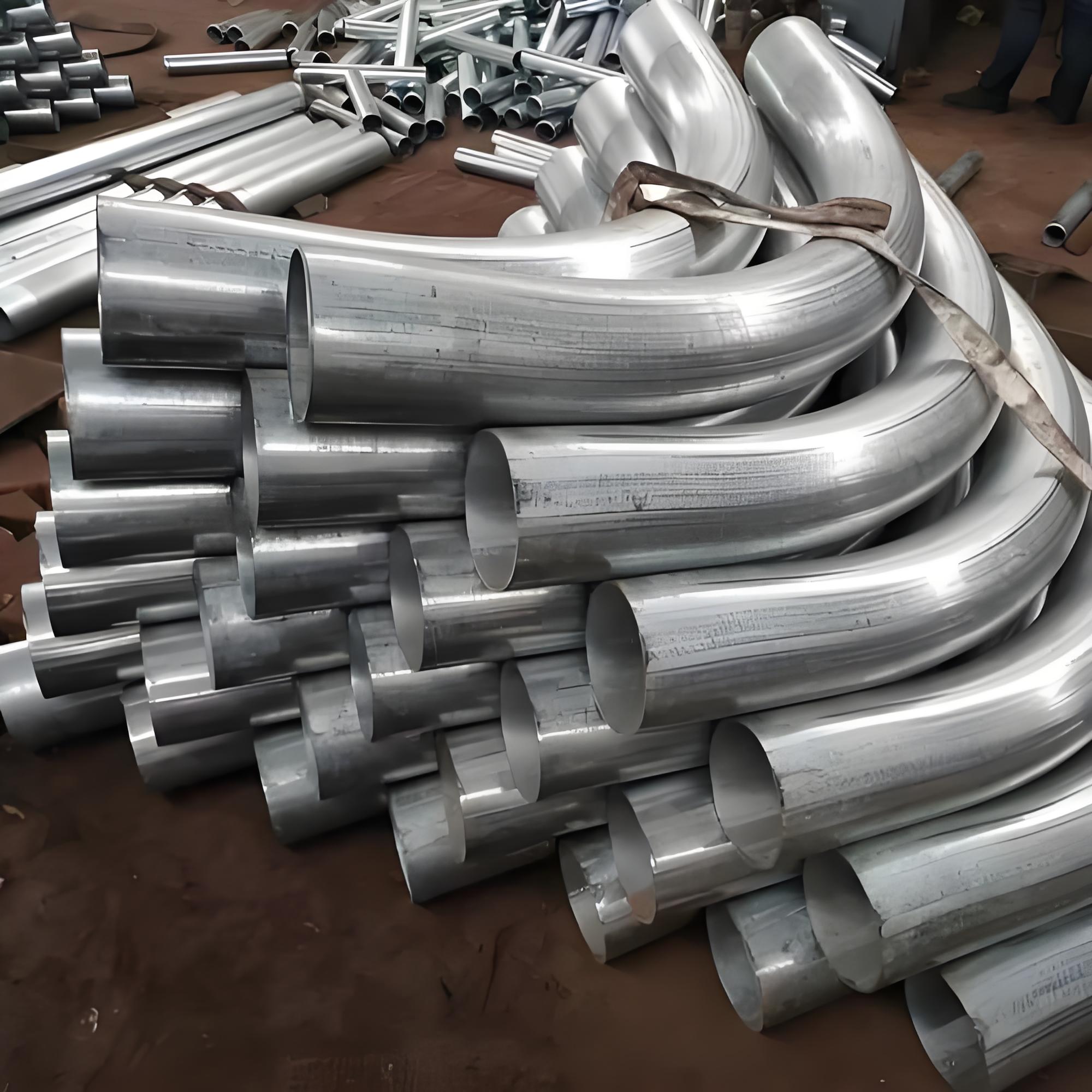
Induction bending elbows are divided into two processes: cold bending and hot bending (medium-frequency induction heating). Using seamless steel pipe or longitudinally welded steel pipe as the base material, they are formed by bending under external force at room temperature or by locally heating to a plastic state via medium-frequency induction and then mechanically pushing to form the bend. Unlike standard stamped or hot-pushed elbows, induction bending elbows can achieve any bending angle (30° to 180°), large curvature radii (commonly R=3D-10D), and large-diameter thick-wall forming, and can reserve straight sections at both ends for convenient on-site welding. After forming, heat treatment is performed to eliminate internal stress, ensuring mechanical properties consistent with the base material, smooth inner surface of the flow channel, and low flow resistance for the medium. Product materials cover carbon steel, alloy steel, stainless steel, and line pipe steel, and can comply with domestic and international standards such as GB/T, ASME, SH, SY, and DL/T. Widely used in high-pressure conditions including long-distance oil and gas transmission pipelines, boiler piping of thermal power plants, chemical process piping, municipal heating networks, and marine engineering, especially suitable for complex pipeline layouts with limited on-site space and the need for non-standard curved bends.
Product Overview
A induction-bent elbow is a non-standard custom-bent pipe fitting formed by bending steel pipe through cold bending or medium-frequency induction hot bending processes. Unlike standard stamped elbows, it supports a larger bending radius (R=3D-10D), any angle (30°-180°), and straight end sections at both ends, making it especially suitable for projects with complex pipeline routing, the need to avoid obstacles, or the need to reduce weld seams. The product uses seamless steel pipe or longitudinally welded steel pipe as the base material, with materials covering carbon steel, alloy steel, stainless steel, and line pipe steel, and can be manufactured to various domestic and international standards. After forming, heat treatment is performed to eliminate internal stress, ensuring mechanical properties consistent with the parent material, smooth flow channels, and low medium resistance.
Key Features
1. Large-curvature non-standard customization: bending radius up to 3D-10D, any angle, can include straight sections, solving complex pipeline layouts that standard elbows cannot cover. 2. Integral forming without welds: integrally bent, reducing leakage risk, excellent pressure resistance, suitable for high-pressure working conditions. 3. Diverse material options: carbon steel, alloy steel, stainless steel, line pipe steel, adapting to different media and temperatures. 4. Strict quality control: wall thickness thinning rate, roundness, and angular tolerance are all controlled, and non-destructive testing is performed before shipment. 5. Flexible customization and delivery: drawing-based customization supported, flexible minimum order quantity, and anti-corrosion and insulation services available.
Applications
Induction-bent elbows are widely used in the following fields: - Power stations: main steam, feed water, and other high-temperature, high-pressure pipelines. - Oil and natural gas: long-distance transmission pipelines, gathering and transmission pipelines, and LNG projects, especially suitable for complex terrains such as mountainous areas and river crossings. - Chemical and petrochemical: high-temperature, high-pressure, flammable and explosive medium transmission. - Municipal heating: central heating and steam pipeline renovation. - Marine engineering: offshore platforms and ship high-pressure pipelines. - Large steel structures: curved components such as bridge arches and stadium domes.
Specifications
Main parameters include outer diameter DN80-DN1200, wall thickness according to the parent pipe or SCH class, bending radius R=3D-10D, angle 30°-180°, adjustable straight end section lengths at both ends, materials covering carbon steel, alloy steel, stainless steel, and line pipe steel, and execution standards including SY/T5257, DL/T515, GB/T, and ASME B16.49. Specific parameters can be customized according to project requirements. Detailed dimensions and technical requirements are welcome, and we will assist in confirmation.
Purchasing & Delivery
Induction-bent elbows are custom products with no stock items. Minimum order quantity: small and medium diameters DN80-DN300 start from 1 piece; medium and large diameters DN350-DN800 are 2-5 pieces; extra-large diameters DN900-DN1200 can be produced as single pieces; alloy steel, stainless steel, and line pipe steel require a minimum of 3 pieces. Delivery time: 15-20 working days for small and medium diameter carbon steel, 20-30 working days for medium and large diameters, 30-45 working days for extra-large diameters and alloy steel, and urgent order scheduling is supported. Packaging adopts four-layer protection, meeting domestic transportation and international ocean shipping requirements.
Service & Support
We provide a 12-month product quality warranty, with full traceability of production materials for all batches. 24-hour technical consultation, supporting drawing verification, supervision, and welding installation guidance. For domestic orders, we handle arrival disputes quickly; for foreign trade orders, we provide a complete set of English technical documents and support spare parts for overseas projects. Returns and replacements are available for manufacturing quality issues; damage caused by human error or use beyond working conditions is not covered by the warranty.
FAQ
What is the difference between induction bending elbows and ordinary hot push elbows?
Hot push elbows are mostly standard R=1.5D finished elbows and are readily available in stock; whereas induction bending elbows (medium-frequency hot induction bent pipes) mainly feature large curvature R=3D-10D, non-standard angles, and include straight sections for welding at both ends. They are custom-fabricated parts with no stock, suitable for long-distance pipelines, power stations, and other complex pipeline routing. The two cannot be directly substituted for each other.
What parameters can be customized for induction bending elbows?
We can customize the bending radius (3D-10D or larger), bending angle (any angle from 30° to 180°), straight section length at both ends, outer diameter (DN80-DN1200), wall thickness (according to the parent pipe or SCH grade), material (carbon steel, alloy steel, stainless steel, line pipe steel), and execution standards (GB/T, ASME, etc.). You are welcome to provide drawings or technical requirements, and we will assist in confirmation.
What are the minimum order quantity and delivery time for induction bending elbows?
The minimum order quantity varies by diameter and material: small and medium diameter carbon steel starts from 1 piece, medium and large diameter from 2-5 pieces, extra-large diameter can be produced as a single piece, and alloy steel starts from 3 pieces. In terms of delivery time, small and medium diameter carbon steel takes about 15-20 working days, medium and large diameter 20-30 working days, and extra-large diameter or alloy steel 30-45 working days. Rush orders can be scheduled into production.
How is the quality of induction bending elbows ensured?
We strictly control the wall thickness reduction rate (≤9%-10%), roundness (≤2.5%), and angular tolerance (±0.5%), and perform non-destructive testing (UT, MT, PT) and physical and chemical testing before delivery to ensure mechanical properties are consistent with the base material. Quality certification documents are provided for all products.
What working conditions are induction-bent elbows suitable for?
They are suitable for pressure pipelines operating under high temperature and high pressure, long-distance transportation, and complex pipeline routing, such as main steam pipelines in power plants, long-distance oil and natural gas transmission pipelines, chemical process pipelines, and municipal heating pipe networks. They can also be used for curved shapes in large steel structures.