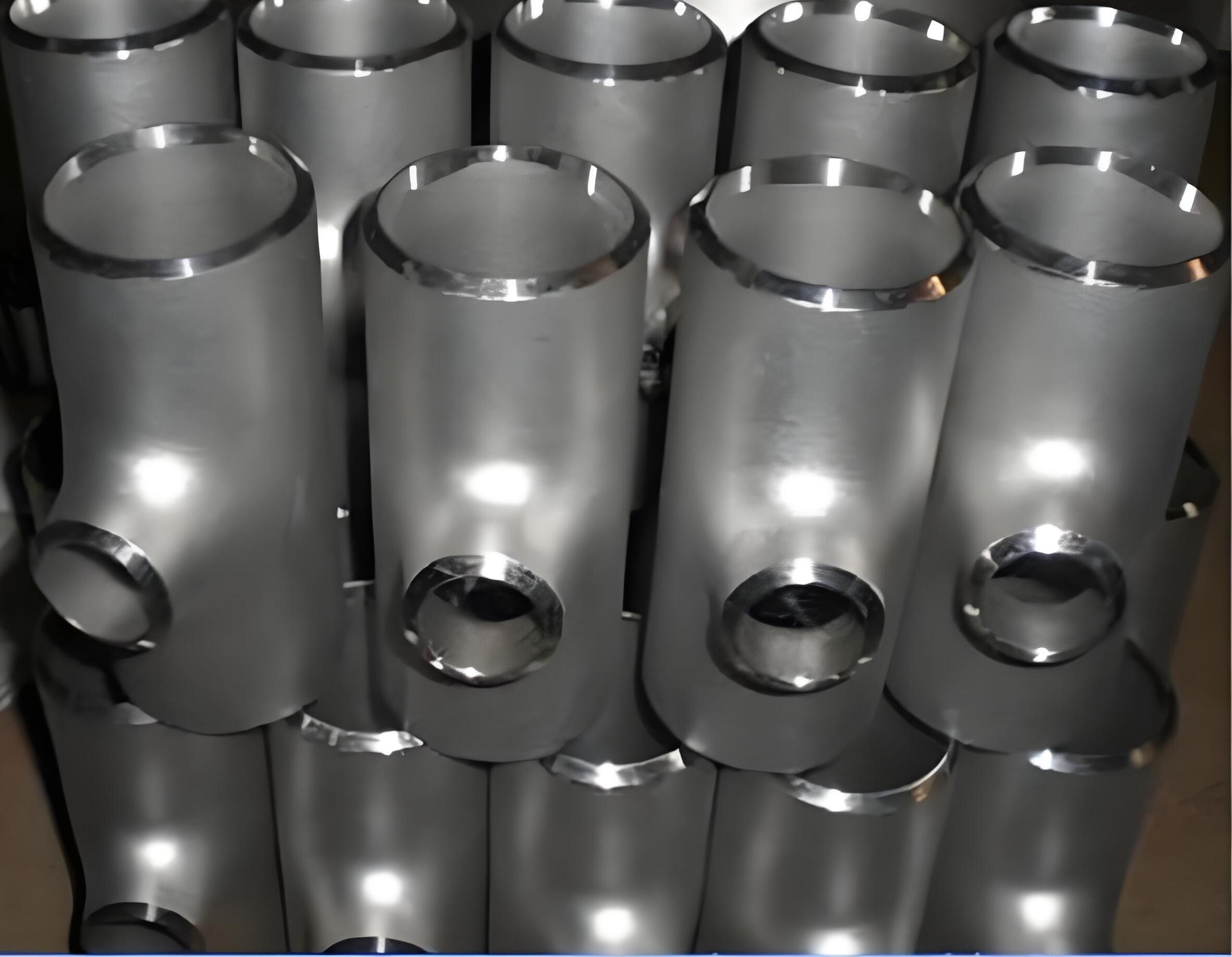
Hydraulic bulged tees belong to steel seamless butt-welded pipe fittings, formed integrally by the hydraulic bulging process, which relies on high-pressure liquid inside the pipe blank to apply pressure while cooperating with external dies to cause plastic flow of the material and directly bulge out the branch pipe, resulting in an overall weld-free structure. Different from hot-pushed and hot-pressed tees, hydraulic bulging is mostly cold working forming, with uniform material deformation, smooth inner and outer surfaces of the fitting, controllable wall thickness reduction, and high dimensional accuracy. Executed according to standards GB/T12459 and ASME B16.9, materials cover carbon steel, alloy steel, and stainless steel. The product ends are machined with welding bevels and connected by butt-weld BW. It is mostly used in medium and high pressure chemical, pharmaceutical, food, and municipal process pipelines, especially suitable for the production of stainless steel tees; limited by the process, large-diameter and extra-thick-wall fittings rarely adopt hydraulic bulging, while small and medium diameters with small and medium wall thicknesses are its advantageous range, and the metal structure has no high-temperature oxide scale, with surface quality superior to the hot-pushing process.
Overview
A hydraulic bulged tee is a seamless butt-welding pipe fitting integrally formed by the hydraulic bulging process. It applies high-pressure liquid inside the pipe blank, combined with external dies to cause plastic flow of the material, directly bulging out the branch pipe, with no welds throughout the entire piece. This cold forming method differs from hot-pushed and hot-pressed tees; the material deformation is uniform, the inner and outer surfaces of the fitting are smooth and clean, the wall thickness reduction is controllable, and the dimensional accuracy is high. The product complies with GB/T12459 and ASME B16.9 standards, and the materials cover carbon steel, alloy steel, and stainless steel. The ends are machined with welding bevels and connected by butt welding. It is mainly used in medium and high pressure chemical, pharmaceutical, food, and municipal process pipelines, and is especially suitable for the production of stainless steel tees. Due to process limitations, large-diameter and extra-thick-wall pipe fittings rarely use hydraulic bulging; small and medium diameters with small and medium wall thicknesses are its advantageous range.
Key Selling Points
The core advantages of the hydraulic bulged tee lie in cold-formed one-piece seamless construction, zero oxidation, high cleanliness, and high precision. Using the hydraulic internal high-pressure bulging process, forming is done at room temperature; the pipe material undergoes no high-temperature burning, no oxide scale, and no carbon deposition, and the inner wall is smooth without scaling or contaminating the fluid medium, making it the preferred process for sanitary-grade pipelines. The integral one-piece forming has no welds, completely eliminating defects such as weld leakage, cracks, and pinholes. During the forming process, the metal plastic deformation is uniform, the wall thickness reduction is controllable, the dimensional accuracy is extremely high, and no secondary grinding or polishing is required. The structural toughness is good, the stress distribution is uniform, the pressure resistance is stable, and the appearance is refined. Compared with hot-pushed tees, it offers higher surface quality and stronger hygienic grade.
Application
The hydraulic bulged tee is primarily aimed at clean, precise, oxidation-free, and pollution-free pipeline scenarios, and is a dedicated fitting for high-end industrial pipelines. It is widely used in biopharmaceutical workshops, food processing production lines, beverage and purified water delivery systems, fine chemical anti-corrosion pipelines, pure water and ultrapure water equipment pipe networks, and medium-pressure circulating pipelines for HVAC central air conditioning. It is suitable for municipal clean water supply, cooling pipelines for new energy equipment, supporting pipelines for precision instruments, and corrosion-resistant delivery pipe networks in light industry. Cold forming produces no high-temperature oxide scale that could detach and contaminate the medium, making it especially suitable for engineering projects with strict sanitary-grade acceptance requirements. It is not applicable to ultra-high-pressure, ultra-thick-wall, or high-temperature power plant extreme conditions; it focuses on medium-pressure, clean, anti-corrosion, and high-precision industrial pipeline scenarios.
Specifications
The product execution standards are GB/T12459 and ASME B16.9, and the materials cover carbon steel, alloy steel, and stainless steel (such as 304, 316L, etc.). The connection method is butt welding (BW), with pre-machined welding bevels at the ends. The standard diameter range is DN15-DN200, and other specifications can be customized. Wall thickness series include SCH10, SCH40, SCH80, etc.; please confirm according to project requirements. Non-standard customization is supported, such as special reducers, special wall thicknesses, and special angles. For detailed parameters, please contact us to confirm the configuration.
Procurement & Delivery
We support flexible and diverse procurement modes, suitable for sample inspection, project supplementary orders, batch centralized procurement, and foreign trade export orders. Regular DN15-DN200 mainstream specifications have a minimum order quantity of 1 piece, supporting small-area renovations, sample inspection, and sporadic project replenishment. For regular engineering batch procurement, the MOQ is 10 pieces, with tiered wholesale discount pricing. For regular foreign trade MOQ, please contact us to confirm. Regular specifications are in ample stock and ship within 24 hours; regular medium and large diameters and non-standard reducer specifications take 3-5 working days to complete processes such as forming, finish turning, and flaw detection. Packaging uses dust-free premium protection, with each piece individually sealed in a PE dust-proof bag, pipe ends fitted with thickened plastic protective caps, small and medium specifications packed in thickened rigid cartons, large pieces wrapped in multiple layers of bubble film plus waterproof film, secured on solid wood pallets, with the outer box marked with specification, material, standard, batch number, and origin information, and each box includes a certificate of conformity, flaw detection report, and material analysis report.
Service & Support
We provide exclusive quality assurance and after-sales service for high-end precision pipe fittings. All hydraulic bulged tees carry a three-year quality warranty and lifelong technical consulting services. Every product undergoes 100% ultrasonic non-destructive testing, appearance inspection, and hydrostatic pressure testing before leaving the factory, ensuring no defective products are shipped. For quality issues not caused by human factors, such as cracking, leakage, material mismatch, or precision deviation, we provide free replacement and unconditional after-sales service. Products damaged by bumps, scratches, or deformation during transportation are replenished free of charge without delaying the project schedule. We provide free technical support for clean pipeline selection, welding process guidance, and anti-corrosion solution matching. We support reissuance of qualification documents, invoicing and account reconciliation, and batch quality assurance coordination. A dedicated one-on-one customer service representative follows up throughout the entire process, with rapid after-sales response, maximizing the protection of high-end engineering construction quality and procurement rights.
FAQ
What is the difference between a hydraulic bulged tee and a hot-pressed tee?
Hydraulic bulging is cold forming at room temperature, producing no oxide scale, with clean surfaces and high precision, suitable for food and pharmaceutical clean pipelines; hot pressing is high-temperature forming, leaving an oxide layer on the surface, suitable for ordinary high-pressure heavy-industry pipelines.
Does the hydraulic bulging tee have no welds?
Yes, it is formed in one complete hydraulic bulging process, completely seamless, with a high pass rate in flaw detection.
Can it be used for drinking water and pharmaceutical pipelines?
Yes. Cold forming results in no impurity precipitation and no oxidation contamination, meeting high cleanliness requirements.
What materials and standards are supported?
We offer carbon steel, alloy steel, stainless steel, and other materials, and implement GB/T12459 and ASME B16.9 standards. Specific materials and standards can be customized according to project requirements; please contact us to confirm.
What is the minimum order quantity?
For regular DN15-DN200 specifications, the minimum order is 1 piece; for bulk purchases, the minimum is 10 pieces. For foreign trade orders, please contact us to confirm the MOQ.