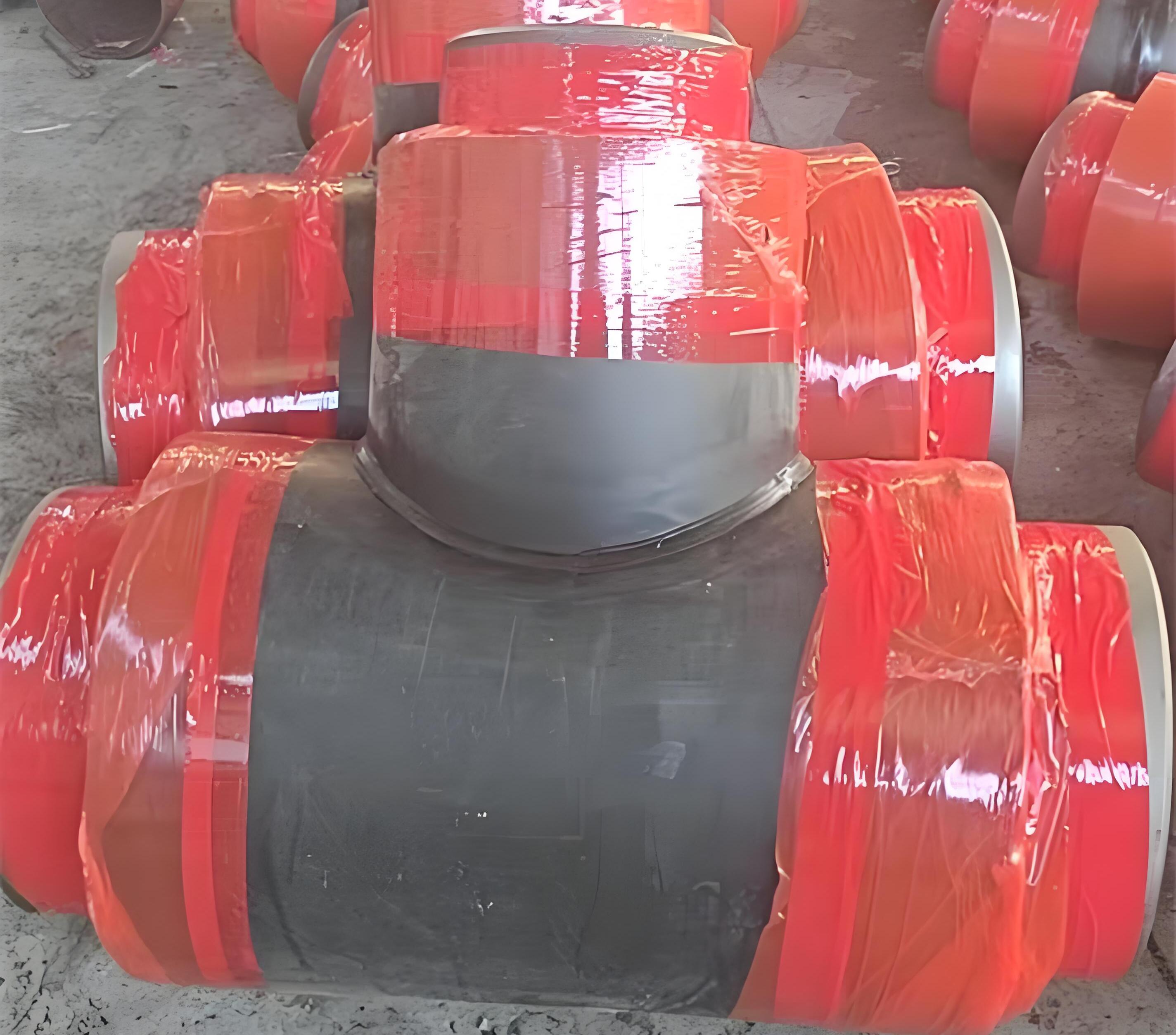
The insulated wear-resistant composite tee is designed to address the problems that ordinary wear-resistant tees are not insulated and ordinary insulated tees are not resistant to scouring. The inner wear-resistant layer can be selected from ceramic lining, bimetal surfacing welding, rare earth alloy or rubber lining; the middle layer is a Q235B or 20# carbon steel pressure-bearing substrate; the outer layer is a high-density polyurethane or rock wool insulation layer; and the outermost layer can be optionally a PE, fiberglass-reinforced plastic or galvanized iron sheet protective shell. The product covers DN50–DN1200, with pressure ratings PN10–PN40, supports butt welding and flange connections, and includes equal-diameter, reducing and 45° inclined tee structures. It is suitable for branch diverting transportation of high-temperature dry powder, hot pulverized coal, high-temperature ore slurry, hot slag, desulfurization slurry and thermal circulation media. For specific configurations and prices, please contact us for confirmation.
Overview
The thermal insulation and wear-resistant composite tee is a diverging and converging pipe fitting used for high-temperature powder, hot slag, high-temperature slurry and thermally worn pipeline networks. It integrates the wear-resistant layer, carbon steel pressure-bearing layer, thermal insulation layer and outer protective layer into an integrated composite structure, solving the problems that ordinary wear-resistant tees are not insulated and have large heat loss, and that ordinary insulated tees are not resistant to erosion and are easily worn through. Products cover DN50–DN1200, pressure rating PN10–PN40, support butt welding and flange connection, and include equal-diameter, reducing and 45° oblique tees. Suitable for pipeline network operation and maintenance, technical transformation and new construction projects in electric power, metallurgy, building materials, chemical and thermal industries.
Key Features
First, the four-layer composite structure combines wear resistance and thermal insulation together, reducing on-site secondary insulation construction. Second, the wear-resistant layer has four options: ceramic lining, bimetal overlay welding, rare earth alloy and rubber lining, which can be matched according to different working conditions such as high-temperature dry abrasion, wet abrasion and heavy-load impact. Third, the thermal insulation layer uses polyurethane or high-temperature rock wool, density ≥60kg/m³, thermal conductivity ≤0.028W/(m·k), helping to reduce pipeline network heat loss. Fourth, the outer protective layer can be PE, FRP or galvanized iron sheet, adapting to direct burial, overhead and severe cold outdoor environments. Fifth, before delivery, documents such as wear-resistant hardness testing, thermal insulation thermal conductivity testing, hydrostatic pressure testing and material verification can be provided, facilitating engineering approval and foreign trade customs clearance.
Applications
In the electric power industry, it is used for branching and converging of high-temperature ash conveying and hot pulverized coal conveying pipeline networks in thermal power plants. In the building materials cement industry, it is used for high-temperature powder and lime hot material conveying, preventing powder material from cooling and caking and pipeline wear. In the metallurgy and mining industry, it is used for high-temperature ore slurry and hot slag aggregate conveying, withstanding heavy-load impact and thermal wear. In the chemical desulfurization industry, it is used for high-temperature desulfurization slurry and humid and hot waste gas slurry pipeline networks, balancing resistance to wet abrasion and corrosion and thermal insulation to prevent crystallization. In the thermal heavy industry, it is used for high-temperature waste heat and thermal erosion circulation pipeline networks, as well as new construction and renovation of open-air or buried high-temperature wear pipelines in severe cold regions.
Specifications
Nominal diameter DN50–DN1200, pressure rating PN10–PN40. The wear-resistant layer can be selected as ceramic lining (HV1000–1500), bimetal overlay welding (HRC55–65), rare earth alloy (high-temperature resistant 350℃) or rubber lining (thickness 4–6mm). The thermal insulation layer uses polyurethane or high-temperature rock wool, density ≥60kg/m³, thermal conductivity ≤0.028W/(m·k). The base body uses Q235B or 20# carbon steel, and the outer protection can be PE, FRP or galvanized iron sheet. The structure includes equal-diameter, reducing and 45° oblique tees, and the connection method supports butt welding and flange. Applicable temperature, specific wall thickness and insulation thickness can be confirmed according to project requirements. Please contact us to provide the medium temperature, wear type and laying environment so that we can assist in selection.
Purchasing & Delivery
Products are produced according to orders, and prices need to be calculated according to diameter, wear-resistant process, thermal insulation scheme and quantity. Please contact us for a quotation. Standard models of conventional small and medium diameter ceramic or rubber-lined direct burial and overhead types are in stock, and shipment can be arranged within 24–48 hours after order confirmation; for non-standard customization and batch engineering orders, please contact us to confirm the delivery cycle. Packaging adopts a heavy-duty protection scheme: welding bevels and flange sealing surfaces are covered with protective film and equipped with anti-collision protective rings, pipe fittings are sealed inside and outside for protection, small and medium specifications are coated with anti-rust layer and wrapped with waterproof oil paper and pearl cotton, medium and large diameters are wrapped with waterproof stretch film and rainproof woven cloth, and extra-large diameters are equipped with solid wood load-bearing bases. For full-container shipment, fumigation-free pallets and steel straps are used for reinforcement, and English shipping marks, specification batches and customer LOGO can be customized.
Service & Support
In the pre-sales stage, we can assist in matching the combination of wear-resistant layer and thermal insulation layer according to medium temperature, wear intensity, laying environment and connection requirements, reducing selection deviations. Before delivery, products undergo appearance inspection, dimension re-measurement, base body flaw detection, wear-resistant layer hardness sampling inspection, thermal insulation thermal conductivity verification and composite layer adhesion testing. The warranty period is 18 months. During the warranty period, for problems caused by factory composite process, wear-resistant processing or thermal insulation prefabrication manufacturing defects, we provide free return and exchange and free reissue, and bear the round-trip logistics costs. After-sales service provides technical answers on pipeline installation, composite layer operation and maintenance, and thermal insulation and wear-resistant maintenance, tracks logistics throughout the process, and assists overseas customers with customs clearance. 7×24-hour response, please contact us for technical support.
FAQ
How to choose a thermal-insulated wear-resistant composite tee for different working conditions?
For high-temperature dry ash and ash-conveying powder conditions, the ceramic-lined thermal-insulated type can be selected; for high-temperature coarse-particle impact conditions, the bimetal overlay welding thermal-insulated type can be selected; for high-temperature hot slag conditions within 350°C, the rare earth alloy thermal-insulated type can be selected; for hot and humid desulfurization slurry conditions, the rubber-lined thermal-insulated type can be selected. For specific selection, please contact us and provide the medium temperature, particle hardness and installation environment, and we will assist in confirming the configuration.
What is the difference between a thermal-insulated wear-resistant composite tee and an ordinary wear-resistant tee and an ordinary thermal-insulated tee?
Ordinary wear-resistant tees usually do not have a thermal insulation layer, resulting in large heat loss, and pipes may freeze in winter; ordinary thermal-insulated tees have insufficient wear resistance and are easily worn through by high-temperature particles or slag slurry. The thermal-insulated wear-resistant composite tee integrates the wear-resistant layer and the thermal insulation layer into one, which can both resist erosion and retain heat, prevent the medium from cooling and crystallizing, and reduce pipeline network energy consumption and operation and maintenance costs.
Will the composite layer delaminate and fall off?
The product adopts an integrated composite curing process, and the wear-resistant layer is tightly bonded to the substrate and the thermal insulation layer. Before leaving the factory, an adhesion test of the composite layer is performed. During the warranty period, for delamination and falling off caused by manufacturing defects, we provide free return and exchange and free replacement.
Does the thermal-insulated wear-resistant composite tee support customization?
Yes. In terms of dimensions, non-standard pipe diameters within the range of DN50–DN1200, thickened wall thickness, non-standard branch angles and eccentric flow-dividing structures can be customized; for the wear-resistant process, ceramic tiles, bimetal overlay welding, rare earth alloy casting or rubber lining can be selected; for the thermal insulation scheme, ordinary polyurethane, high-temperature rock wool or aerogel can be selected; the outer protective layer, substrate material, pressure rating and thermal insulation thickness can also be confirmed according to project requirements. Production can be carried out according to drawings, samples or technical agreements, and English shipping marks and LOGO customization are supported.
What are the delivery time and warranty period?
DN50–DN300 conventional ceramic or rubber-lined direct-buried and above-ground standard models are in stock, and shipment can be arranged within 24–48 hours after order confirmation. For non-standard customizations and bulk engineering orders, please contact us to confirm the delivery lead time. The product warranty period is 18 months. During the warranty period, for problems caused by manufacturing defects, we provide free returns and exchanges and free replacements.