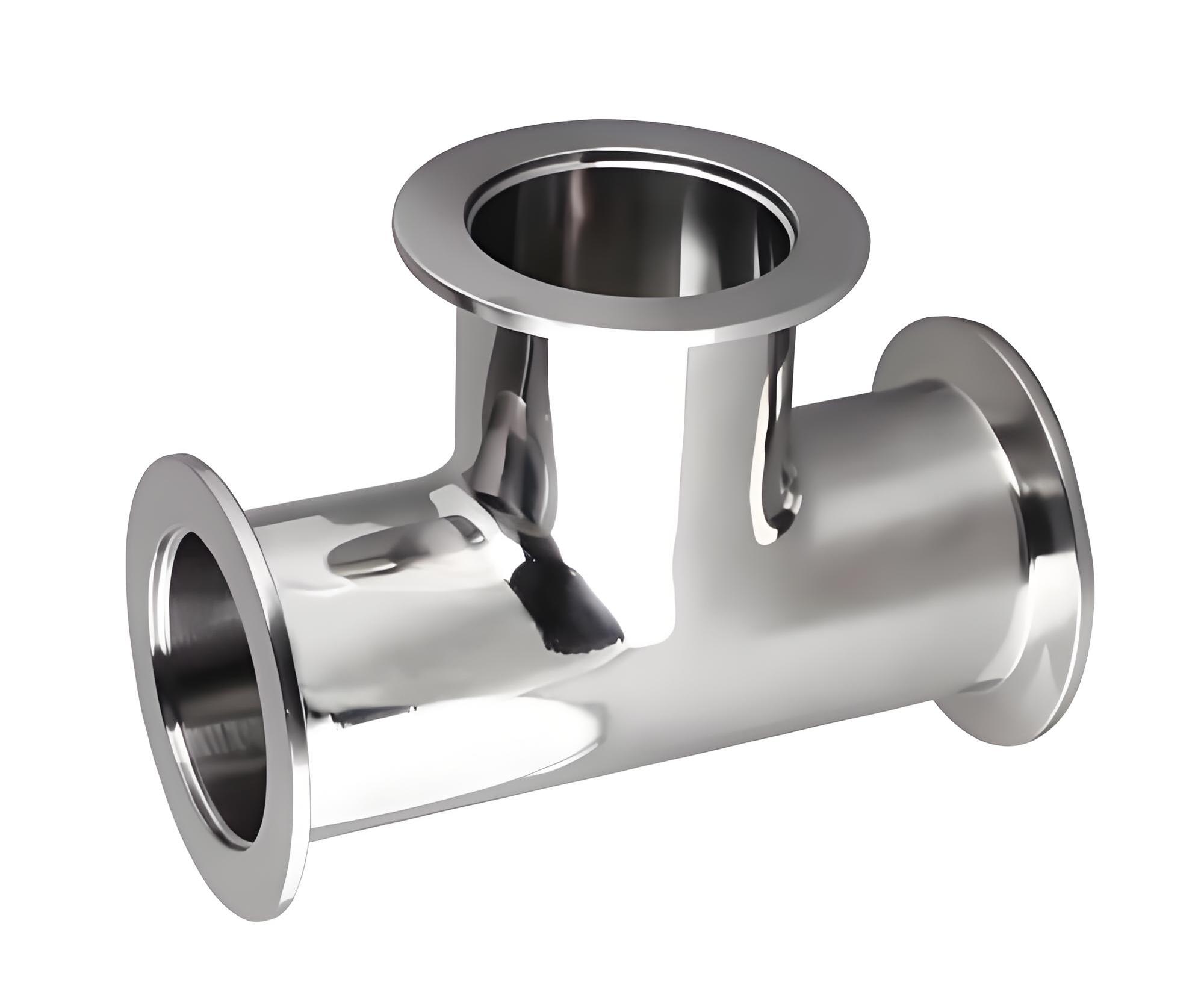
Sanitary tees mainly solve the problems of ordinary industrial pipe fittings in clean pipelines, such as easy material accumulation, dirt retention, bacterial growth, and incomplete cleaning. We provide equal-diameter, reducing, and Y-type oblique tee structures. Connection methods include quick-install clamps, butt welding, threads, and unions, with specifications covering DN10 to DN150. The products are integrally forged and formed from 304 food-grade or 316L pharmaceutical-grade stainless steel, with mirror polishing inside and outside, arc transitions in the flow channel, and no cleaning blind spots. Seals can be food-grade silicone or EPDM gaskets. The temperature resistance range is -20℃ to 180℃, and it can transport media such as pure water, medicinal liquids, dairy products, beverages, biological preparations, and daily chemical stock solutions. Before purchasing, please confirm the specific configuration according to the medium type, cleanliness level, disinfection method, and connection standard. You are welcome to contact us for assistance with selection.
Overview
Sanitary tees are used in clean fluid piping networks for food and beverage, dairy products, biopharmaceuticals, purified water purification, daily chemical and cosmetics, and fine bioengineering, undertaking the functions of flow splitting, flow merging, and branch flow diversion. The products are integrally forged and formed from 304 food-grade or 316L pharmaceutical-grade stainless steel, with precision mirror polishing on both inside and outside, smooth arc transitions in the flow channel, and no cleaning blind spots. The structures cover equal-diameter, reducing, and Y-type oblique tees; the connection methods include quick-install clamps, butt welding, threads, and unions; and the specifications cover DN10 to DN150. The products follow 3A, SMS, DIN, ISO, and GB clean piping standards, comply with FDA food-contact safety regulations, and can adapt to CIP clean-in-place and high-temperature steam SIP sterilization working conditions.
Key Features
The core advantages of sanitary tees lie in mirror-smooth aseptic surfaces with no dead corners, CIP clean-in-place capability, zero medium contamination, corrosion resistance, high-temperature sterilization resistance, and long-lasting cleanliness. The integral forging process ensures a dense metallographic structure with no pores, sand holes, or impurity precipitation. The inner and outer mirror polishing roughness is as low as Ra0.4–0.8μm, and the arc transitions in the flow channel eliminate material accumulation dead corners and material-hanging blind spots, reducing the risk of bacterial growth and secondary medium contamination. The material resists weak acid and weak alkali corrosion and repeated sterilization aging; the sealing is paired with food-grade silicone or EPDM sanitary gaskets, which are non-toxic and odorless. The temperature resistance range covers -20℃ to 180℃, adapting to the conveyance of media such as purified water, medicinal liquids, dairy products, beverages, biological preparations, and daily chemical stock solutions.
Applications
Food and beverage scenarios adapt to juice, alcoholic beverages, drinking water, and syrup processing and conveyance piping networks; dairy and pharmaceutical scenarios adapt to aseptic pipelines for milk, yogurt, medicinal liquids, and biological preparations, supporting fully automatic CIP cleaning and use in GMP workshops; purified water purification scenarios adapt to purified water, ultrapure water, and RO reverse osmosis water purification systems, with no metal precipitation; daily chemical and biological scenarios adapt to the conveyance of cosmetic stock solutions, washing and care fluids, and biological culture fluids; laboratory precision scenarios adapt to scientific research high-purity fluids and aseptic test pipelines. The quick-install clamp style is easy to disassemble and assemble, suitable for dust-free production lines with frequent sterilization and high-frequency cleaning; the welded style is integrally sealed with zero dead corners, adapting to high-cleanliness pharmaceutical and aseptic purified water main pipelines; the threaded union style adapts to the connection of small precision clean equipment and branch flow diversion modifications.
Specifications
The material of sanitary tees can be selected as 304 food-grade or 316L pharmaceutical-grade stainless steel; the specifications cover DN10 to DN150; and the structures include equal-diameter, reducing, and Y-type oblique tees. There are four connection methods: quick-install clamps, butt welding, threads, and unions. The conventional surface roughness is Ra0.4–0.8μm, and high-end pharmaceutical grade can be customized to Ra≤0.4μm. The temperature resistance range is -20℃ to 180℃. The sealing gaskets can be selected as food-grade silicone or EPDM sanitary gaskets. The products follow 3A, SMS, DIN, ISO, and GB clean piping standards and comply with FDA food-contact safety regulations. For specific models, interface standards, and special size requirements, please contact us for confirmation.
Purchase & Delivery
For DN10–DN80 conventional quick-install and welded standard in-stock specifications, the MOQ is as low as 10 pieces; for other diameters and customized specifications, please contact us to confirm the minimum order quantity. For conventional in-stock styles, clean re-inspection and aseptic cleaning are completed within 24 hours after order confirmation; the specific delivery cycle is confirmed according to the order quantity and customization requirements. Packaging uses dust-free anti-static bags for vacuum sealing; all ports are equipped with dust plugs and sealing protective caps; each piece is wrapped in pearl cotton to prevent mirror surface scratches; small and medium specifications are packed in aseptic thickened cartons with built-in desiccant; medium and large diameters are wrapped on the outer layer with waterproof stretch film and placed on solid wood pallets. English shipping marks, specification parameters, and batch LOGOs can be customized.
Service & Support
We provide full-process services for clean industry and foreign trade customers. The pre-sales technical team can assist in matching materials and polishing solutions according to medium type, cleanliness level, and sterilization method. Before leaving the factory, products undergo appearance fine inspection, full inspection of mirror surface finish, sampling inspection of aseptic cleaning, material verification, and pressure-resistant sealing tests. For quality defects in factory forging, polishing, or clean treatment, free returns and exchanges and free replacements are supported. After-sales support provides answers on aseptic pipeline installation, cleaning and sterilization, and clean operation and maintenance, with full-process logistics tracking to assist overseas customers with customs clearance. The product warranty period is 18 months, with 7×24-hour response.
FAQ
How to choose between 304 and 316L sanitary tees?
For ordinary food, purified water, and room-temperature clean working conditions, the 304 style can be selected, with higher cost-effectiveness. For medicinal liquids, weak acids and weak alkalis, high-temperature sterilization, and highly corrosive clean working conditions, it is recommended to select the 316L pharmaceutical-grade style, which has stronger corrosion resistance. If you are unsure whether the medium is suitable, you are welcome to contact us for confirmation.
Does the sanitary-grade tee support CIP clean-in-place?
The entire series adopts a mirror-polished dead-corner-free design, with no material-hanging or material-accumulation blind zones, fully compatible with fully automatic CIP cleaning and high-temperature steam sterilization, and meets the requirements for use in GMP aseptic workshops.
What is the surface finish standard?
The conventional food-grade roughness is Ra≤0.8μm, and the high-end pharmaceutical grade can be customized with ultra-high precision Ra≤0.4μm, with a higher aseptic grade. The specific surface finish requirement can be confirmed according to your working conditions.
How should the connection type be selected?
For scenarios with frequent disassembly and sanitization, the quick-install clamp type is recommended; for permanent aseptic main pipeline routes, the welded type is recommended; for connection to small precision clean equipment or branch-flow modification, the threaded or union type can be selected. We can assist in confirming according to your pipeline design.
Will it rust and contaminate the medium?
The product uses food-grade stainless steel and has undergone passivation treatment. Under normal clean working conditions, it will not rust or precipitate impurities. If conveying strongly corrosive media, we recommend contacting us to confirm the material and seal selection.