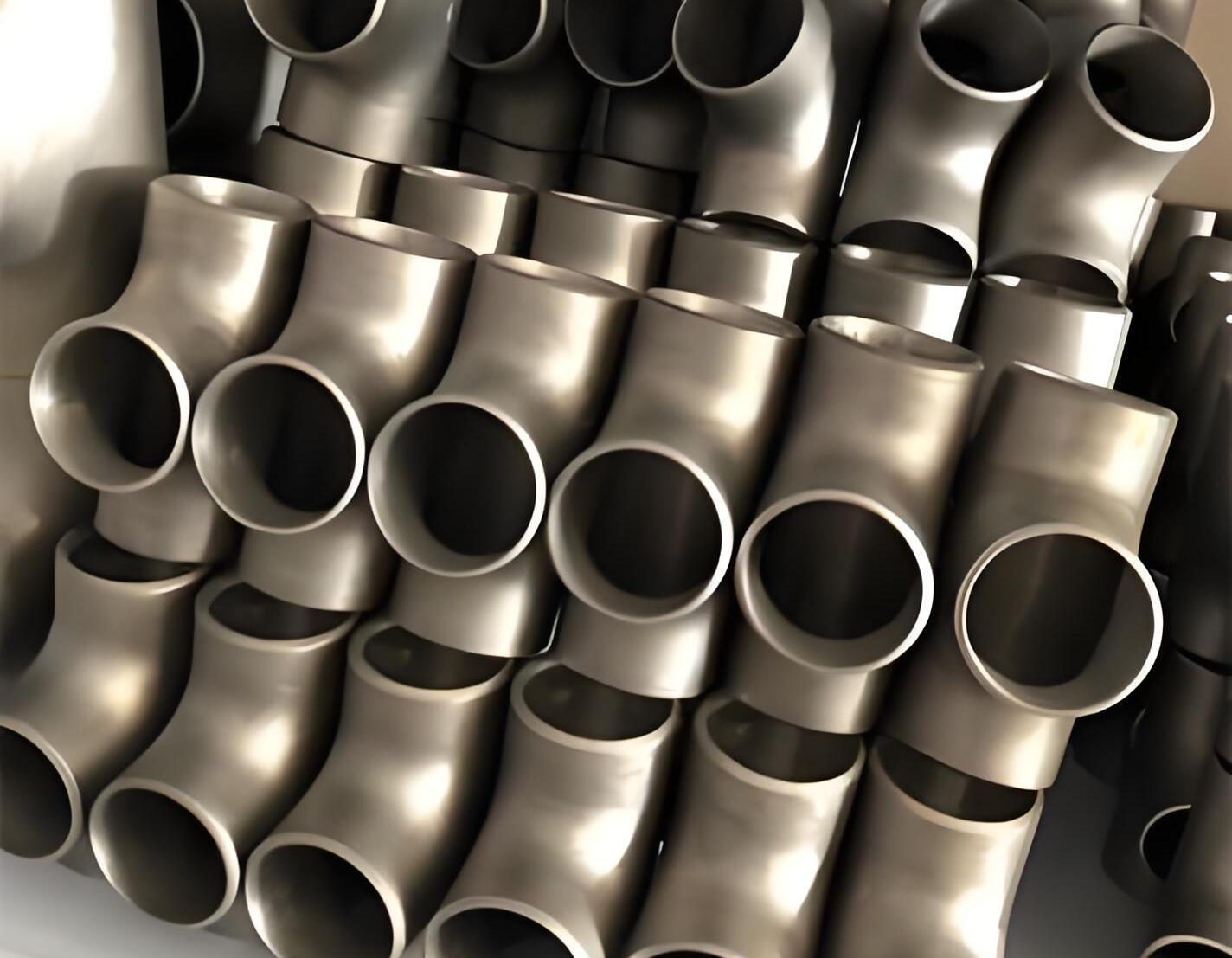
Alloy tees belong to chromium-molybdenum heat-resistant alloy steel special pipe fittings, and are mainly used in high-temperature steam, hydrogen-containing media, and high-pressure heavy-duty piping systems to achieve media diversion, merging, and branch direction changes. The products are manufactured according to standards such as ASME B16.9, ASME B16.11, GB/T12459, GB/T14383, ASTM A234, etc., with diameters covering DN15–DN3000. According to the process, they are divided into three major categories: seamless pressing, high-pressure forging, and rolled welding, corresponding respectively to small and medium-diameter conventional high-temperature and high-pressure applications, small-diameter ultra-high-pressure equipment piping, and main trunk pipeline networks with extra-large pipe diameters above DN600. Mainstream materials include 15CrMo, 12Cr1MoV, Cr5Mo, P11, P22, P91, and they can operate long-term in high-temperature and high-pressure environments of 450℃–620℃. We can customize non-standard sizes and special materials according to drawings, samples, or technical agreements. You are welcome to contact us to confirm specific configurations and quotations.
Overview
Alloy tees are chrome-molybdenum heat-resistant alloy steel pipe fittings, used for splitting, merging, and branch direction changes of media in high-temperature, high-pressure, hydrogen-containing, and heavy-duty pipeline systems. Compared with ordinary carbon steel and stainless steel tees, alloy tees improve high-temperature creep strength and hydrogen corrosion resistance by adding elements such as chromium, molybdenum, and vanadium, making them suitable for working conditions above 450°C where carbon steel pipe fittings are prone to softening and deformation. We offer three process routes: seamless pressing, high-pressure forging, and rolled welding, with diameters from DN15 to DN3000, and materials covering commonly used heat-resistant alloy steels such as 15CrMo, 12Cr1MoV, Cr5Mo, P11, P22, and P91. Products are manufactured according to standards such as ASME B16.9, GB/T12459, and ASTM A234, and can be customized according to project drawings or technical agreements.
Key Features
The core value of alloy tees lies in the adaptability of materials and processes to high-temperature and high-pressure working conditions. Chrome-molybdenum alloy steel can still maintain structural stability above 500°C, and is not prone to softening, bulging, or high-temperature creep failure. The seamless pressing process provides a smooth flow channel and low resistance loss, making it suitable for small and medium-diameter high-temperature main pipe networks; the integral die forging process has dense grains and no weld weak points, making it suitable for small-diameter ultra-high-pressure equipment pipelines; the rolled welding process breaks through mold limitations and can produce large-diameter non-standard pipe fittings above DN600. Before leaving the factory, they undergo heat treatment and tempering and non-destructive flaw detection testing, reducing the risk of deformation and leakage during high-temperature operation. We can recommend materials and processes according to working conditions. You are welcome to contact us to confirm the selection.
Applications
Alloy tees are mainly aimed at thermal power, cogeneration, petroleum refining and chemical, coal chemical, and high-temperature energy engineering. In thermal power plants, they are used for branch nodes of boiler steam pipe networks and high-temperature circulation pipelines; in refining and coal chemical plants, they are used for branch pipelines of high-temperature process lines, hydrogen-containing desulfurization pipe networks, and high-pressure reaction units; in old power plants and pipeline network renovation projects, they are used to replace ordinary pipe fittings that have already shown creep or deformation in high-temperature sections. Different materials correspond to different working conditions: 15CrMo and 12Cr1MoV are commonly used for conventional thermal power high-temperature and high-pressure pipelines, Cr5Mo and P11 are suitable for corrosive environments such as hydrogenation desulfurization, and P22 and P91 are used for ultra-high-temperature, ultra-high-pressure heavy-duty working conditions. For specific selection, please contact us to confirm.
Specifications
Alloy tees cover diameters from DN15–DN3000, and manufacturing standards include ASME B16.9, ASME B16.11, GB/T12459, GB/T14383, and ASTM A234. Commonly used materials are 15CrMo, 12Cr1MoV, Cr5Mo, P11, P22, and P91, with an applicable temperature range of approximately 450°C–620°C, depending on the material and working conditions. Processes are divided into three categories: seamless pressing, high-pressure forging, and rolled welding. Non-standard diameters, special wall thicknesses, irregular branch angles, and material customization are supported. Prices need to be confirmed according to specifications, materials, and quantities. You are welcome to contact us for a quotation.
Procurement & Delivery
Alloy tees are engineering-oriented procurement products. The minimum order quantity varies according to specifications and materials. The minimum order rules for conventional standard specifications of 15CrMo and 12Cr1MoV are relatively flexible; please contact us for details. DN15–DN300 conventional standard styles are kept in stock, and after order confirmation, non-destructive re-inspection and anti-rust treatment can be arranged quickly; non-standard customization and special materials require delivery times to be confirmed according to production scheduling. Packaging adopts shockproof, anti-rust, and anti-deformation solutions, with protective thread caps or protective sleeves added to the ends; small and medium specifications are packed in moisture-proof hard cartons, medium and large diameters are equipped with anti-collision protective rings, and extra-large diameters are coated with anti-rust coating and supported by solid wood bases. English shipping marks, customer LOGOs, and batch identification customization are supported.
Service & Support
We provide pre-sales selection support for alloy tee buyers, including material matching for high-temperature working conditions, pressure rating confirmation, and process route recommendations. Before leaving the factory, products undergo appearance, dimension, spectral material verification, and non-destructive flaw detection testing. The warranty period is 18 months, with 7×24-hour response. If there are factory manufacturing quality defects, free returns, exchanges, and replacements are supported. After-sales service provides technical answers regarding welding, heat treatment maintenance, and pipeline network operation and maintenance, and assists overseas customers in tracking logistics and customs clearance. You are welcome to contact us to confirm specific service content and project requirements.
FAQ
What is the difference between alloy tees and ordinary carbon steel tees?
Alloy tees have added alloying elements such as chromium, molybdenum, and vanadium, and have better creep resistance, hydrogen corrosion resistance, and thermal fatigue resistance under high-temperature, high-pressure, and hydrogen-containing working conditions above 450°C. Ordinary carbon steel tees are suitable for ordinary pipe networks at room temperature or medium temperature, and are prone to softening, deformation, and even pipe bursting at high temperatures. If the pipeline operating temperature exceeds 450°C or there is a hydrogen-containing medium, it is recommended to choose alloy tees. For specific selection, please contact us to confirm.
How to select common alloy materials?
For conventional thermal power high-temperature and high-pressure pipelines, 15CrMo or 12Cr1MoV can be selected; for hydrodesulfurization and corrosive high-temperature environments, Cr5Mo or P11 can be selected; for ultra-high-temperature, ultra-high-pressure, and heavy-load working conditions, P22 or P91 can be selected. Material selection needs to be combined with design temperature, design pressure, medium characteristics, and pipeline class. You are welcome to contact us to provide working condition parameters, and we will assist in confirming the suitable material.
How to choose the forming process for alloy tees?
For small and medium diameter conventional high-temperature and high-pressure working conditions, the seamless pressing process is usually selected, with smooth flow channels and low resistance loss; for small-diameter ultra-high-pressure equipment pipelines, the integral die forging process can be selected, with no weld weak points and good fatigue resistance; for main trunk pipe networks with extra-large pipe diameters above DN600, the steel plate rolled and welded process can be selected, breaking through mold specification limits. For specific process selection, please contact us for confirmation.
Can alloy tees be customized in non-standard sizes?
Yes. We support customization of non-standard pipe diameters within the range of DN15–DN3000, special thickened wall thicknesses, non-standard center distances, irregular branch angles, and eccentric flow-splitting structures, and can also produce according to customer drawings, samples, or technical agreements. Materials can be customized such as 15CrMo, 12Cr1MoV, Cr5Mo, P11, P22, P91, etc. You are welcome to provide dimensions and quantities, and we will assist in confirming the customization plan and quotation.
What are the packaging and delivery lead times for alloy tees?
Alloy tees use shockproof, rustproof, and deformation-proof packaging, with threaded protectors or protective sleeves added to the ends; small and medium specifications are packed in moisture-proof hard cardboard boxes, medium and large diameters are equipped with anti-collision protective rings, and extra-large diameters are coated with anti-rust coating and equipped with solid wood support bases. DN15–DN300 conventional standard styles are kept in stock, and after order confirmation, re-inspection and shipment can be arranged quickly; non-standard customizations and special materials require delivery time confirmation based on production scheduling. For specific delivery times, please contact us for confirmation.