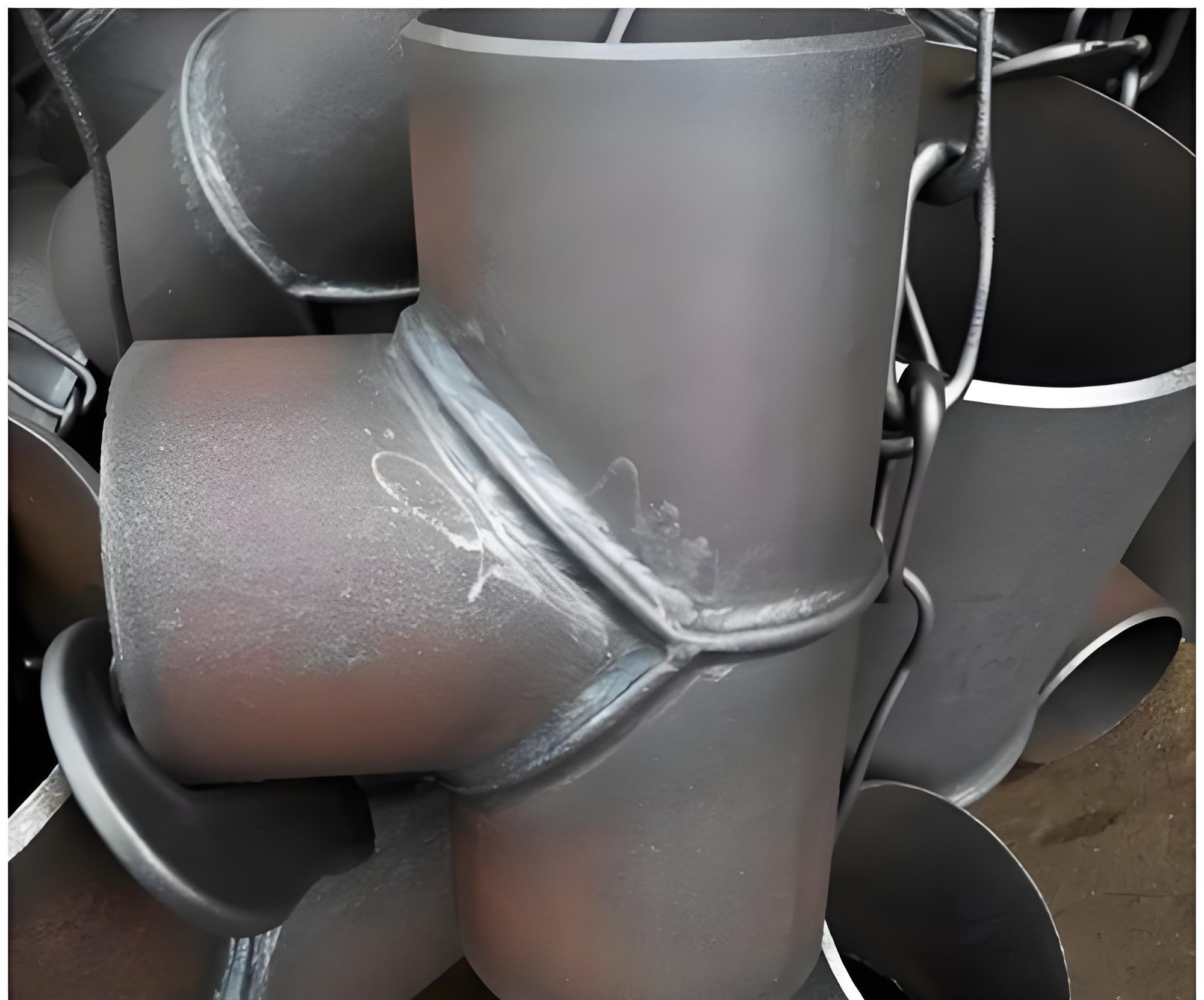
The reinforced tee has been structurally strengthened to address issues such as stress concentration at the branch root of ordinary tees, tearing under high pressure, and cracking due to thermal expansion and contraction. In the connection area between the main pipe and branch pipe, we add fish-belly, trapezoidal, triangular, or annular rib plates, so that fluid impact pressure and thermal stress are dispersed over a larger area. Products cover DN20–DN1200, materials include carbon steel, stainless steel, and alloy steel, structures include equal-diameter, reducing, and 45° lateral tees, and connection methods can be selected as butt welding, flange, socket welding, and threaded. Production refers to standards such as GB/T12459, GB50235, DL/T, and ASME B16.9. Before procurement, it is recommended to provide the medium, pressure rating, temperature range, and connection standard, and we will assist in confirming the reinforcement form and material.
Overview
Reinforced ribbed tees are industrial pipe fittings that add a rib plate reinforcement structure on the basis of ordinary tees. Under high-pressure, high-temperature alternating or vibration working conditions, ordinary tees are prone to stress concentration at the branch pipe root, which then leads to cracking, leakage, or deformation. We add fish-belly, trapezoidal, triangular, or annular rib plates in the connection area between the main pipe and branch pipe to disperse fluid impact pressure and thermal expansion and contraction stress over a larger range. Products cover DN20–DN1200, materials include carbon steel, stainless steel, and alloy steel, structures include equal-diameter, reducing, and 45° lateral tees, and connection methods can be butt welding, flange, socket welding, and threaded. Production refers to standards such as GB/T12459, GB50235, DL/T, and ASME B16.9.
Key Features
The core of the reinforced tee lies in its reinforcement structure. The rib plates and the fitting body are formed by integrated pressing, forging, or symmetrical welding, fitting tightly and able to disperse the concentrated stress at the branch root. Reinforcement forms include single rib, double rib, multi-rib, and full annular wrap, which can be selected according to pipeline pressure rating, impact frequency, and vibration conditions. Materials cover carbon steel, stainless steel, and alloy steel, suitable for water vapor, oil and gas, steam, and chemical media. Before leaving the factory, products undergo inspections for appearance, dimensions, hydrostatic pressure, and non-destructive testing, with an 18-month warranty.
Applications
Reinforced tees are mainly used at pipeline branch points with stress concentration, high-pressure impact, high-temperature cycling, continuous vibration, or foundation settlement. In electric power and thermal power scenarios, they are used for high-temperature and high-pressure main steam and feedwater circulation networks; in petroleum and petrochemical scenarios, they are used for process high-pressure oil and gas and chemical fluid pipelines; in heating and gas scenarios, they are used for high-temperature steam and high-pressure gas main networks; in heavy industry equipment scenarios, they are used for vibration connection pipelines; in infrastructure renovation scenarios, they are used for network reinforcement in areas of foundation settlement or terrain displacement. Old high-pressure pipeline networks with stress defect rectification and technical transformation projects can also use reinforced tees to replace ordinary tees.
Specifications
Specifications cover DN20–DN1200, and configurations include equal-diameter, reducing, and 45° lateral tees. Material options include carbon steel, stainless steel, and alloy steel; please contact us to confirm the specific grades. Reinforcement forms include single rib, double rib, multi-rib, and ring reinforcement, and connection methods can be butt welding, flange, socket welding, and threaded. Production references standards such as GB/T12459, GB50235, DL/T, and ASME B16.9. Prices require inquiry, and please contact us to confirm delivery times for standard specifications.
Procurement & Delivery
Reinforced branch tees are pipe fittings with a relatively high degree of customization. Before purchasing, it is recommended to provide the medium, pressure rating, temperature range, connection standard, reinforcement form, and quantity. We can produce according to drawings, mechanical parameters, or technical agreements, and support English shipping marks, LOGO, and batch customization. Standard single-rib and double-rib models in conventional small and medium diameters are in stock. After order confirmation, mechanical re-inspection and anti-rust packaging will be completed within 24–48 hours. Medium-to-large diameter and extra-large diameter products use anti-deformation, anti-scratch, moisture-proof, and anti-rust packaging. Full-container shipments use fumigation-free pallets and steel strapping for reinforcement. For specific delivery times and logistics solutions, please contact us to confirm.
Service & Support
We provide selection, installation, and operation and maintenance Q&A for reinforced tees. Before sales, we can assist in matching reinforcement structure solutions according to pipeline pressure, temperature, vibration level, and stress conditions. Before leaving the factory, products undergo fine appearance inspection, dimension re-measurement, hydrostatic pressure test, and non-destructive testing. Warranty is 18 months, with 7×24-hour response. If there are factory manufacturing defects, we support free returns and exchanges and replacements. For overseas customers, we can assist with customs clearance and logistics tracking. Please contact us to confirm specific service terms.
FAQ
What is the difference between a reinforced tee and an ordinary tee?
The reinforced tee adds a rib plate reinforcement structure in the connection area between the main pipe and the branch pipe to disperse the concentrated stress at the branch root. Ordinary tees under high pressure, high-temperature cycling, or vibration conditions are prone to cracking, leakage, or deformation at the branch root. Reinforced tees, through single-rib, double-rib, multi-rib, or annular reinforcement, disperse fluid impact pressure and thermal stress over a larger range, making them suitable for pipeline branch points with stress concentration, high-pressure impact, and continuous vibration.
How to choose the reinforcement form for different working conditions?
Conventional medium- and high-pressure water vapor and oil and gas pipeline networks can choose the single-rib version; high-frequency start-stop or continuous impact heavy-load pipelines can choose the double-rib or multi-rib version; ultra-high-pressure main trunk pipelines can choose the annular full-wrap version; high-temperature and high-pressure fatigue working conditions can choose the integrally forged version. Specific selection needs to be combined with the medium, pressure rating, temperature range, and vibration conditions; please contact us to confirm.
What materials and specifications are supported for reinforced rib tees?
Specifications cover DN20–DN1200, and materials include three major categories: carbon steel, stainless steel, and alloy steel. Structures include equal-diameter, reducing, and 45° lateral tees, and connection methods can be butt welding, flange, socket welding, and threaded. For specific grades, pressure ratings, and connection standards, please contact us to confirm.
What information needs to be provided before procurement?
It is recommended to provide the medium, pressure rating, temperature range, connection standard, reinforcement form, specification quantity, and delivery location. If there are drawings or technical agreements, they can be sent directly to us. We will assist in confirming the configuration and quotation based on this information.
What are the delivery time and warranty for reinforced rib tees?
Conventional small and medium diameter single-rib and double-rib standard versions are in stock, and after order confirmation, mechanical re-inspection and anti-rust packaging are completed within 24–48 hours. For medium and large diameter and customized versions, please contact us to confirm the delivery time. The product warranty is 18 months, with 7×24-hour response.