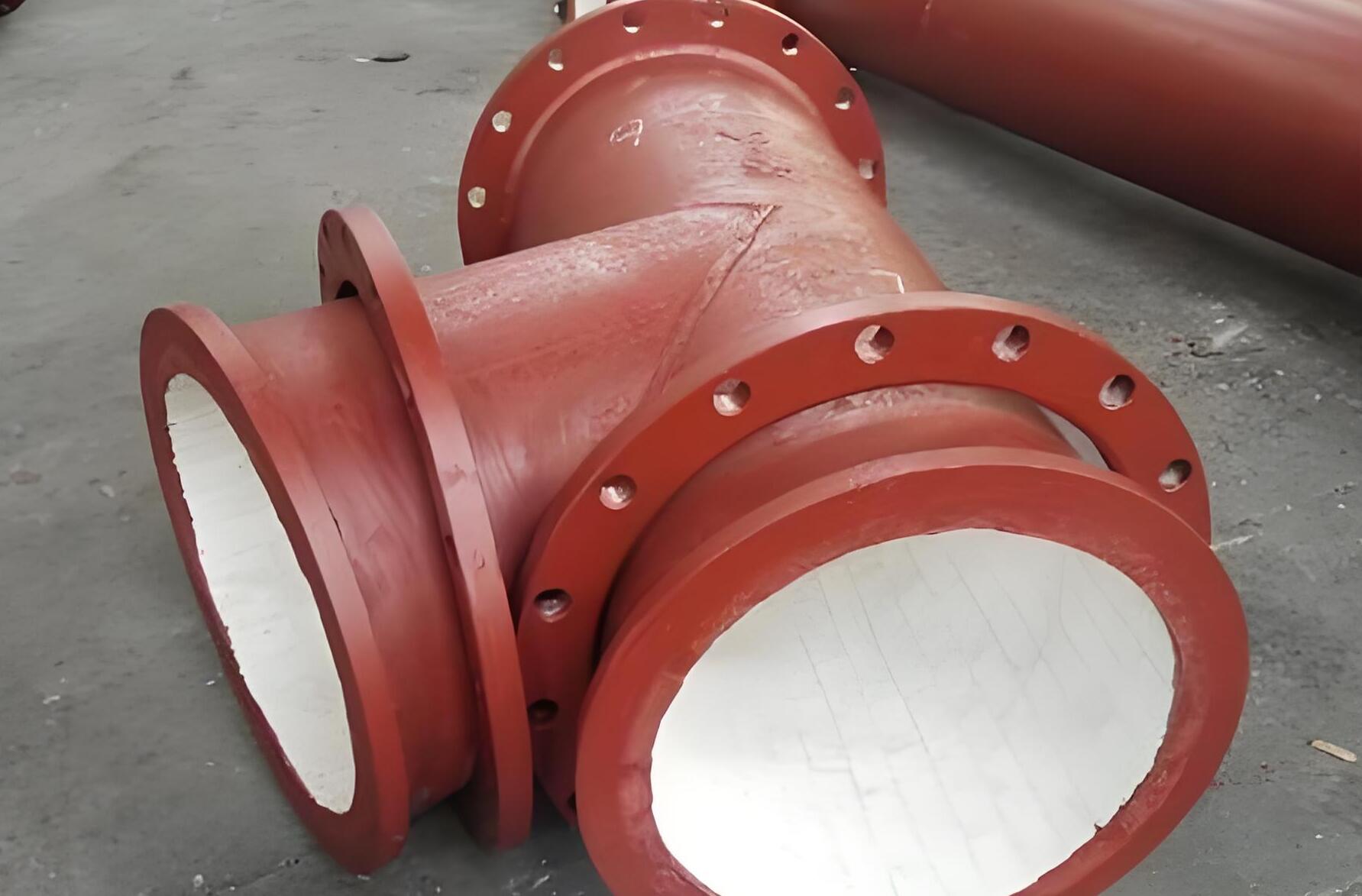
Wear-resistant tees are used for splitting, merging, and branch direction-changing conveyance in industrial pipelines with high scouring and strong wear. We manufacture them in accordance with GB/T12459, HG/T21635, and power industry wear-resistant pipeline standards. Nominal diameters cover DN50–DN1200, pressure ratings are compatible with PN10–PN40, and equal-diameter, reducing, and 45° oblique tee structures can be produced. Connection methods include butt welding, flanging, and socket welding. According to wear intensity, temperature, and corrosive environment, we provide four wear-resistant processes: the ceramic-lined type is suitable for normal-temperature dry strong wear, the bimetal overlay welding type is suitable for large-particle heavy-load impact, the rare earth alloy casting type is suitable for high-temperature ash conveying and desulfurization working conditions, and the rubber-lined type is suitable for wet wear environments such as ore slurry and mud slurry. Compared with ordinary carbon steel or stainless steel tees, wear-resistant tees can increase service life by 8–20 times under corresponding working conditions, reducing downtime maintenance and pipe replacement losses.
Overview
The wear-resistant tee is an anti-wear diverting and merging pipe fitting we have launched for high-scouring, strongly worn industrial pipeline networks, used in powder conveying, ore slurry and tailings, ash removal and ash conveying, desulfurization and denitrification, sand and gravel aggregate, pulverized coal conveying and other systems. Ordinary carbon steel or stainless steel tees are prone to thinning, perforation, and powder and material leakage under particle scouring conditions. The wear-resistant tee extends the service cycle of the pipe fitting under corresponding working conditions through wear-resistant structures such as ceramic lining, bimetal overlay welding, rare earth alloy casting, or rubber lining. The products are produced in accordance with GB/T12459, HG/T21635, and power industry wear-resistant pipeline standards, with specifications covering DN50–DN1200, suitable for low-pressure, medium-pressure, high-temperature, high-dust and other wear condition systems.
Key Features
We match the wear-resistant structure according to working conditions, rather than using one product to cover all scenarios. The ceramic lining type uses 95% alumina ceramic, hardness HV1000–1500, suitable for room-temperature high-strength particle scouring; the bimetal overlay welding type has a high-chromium alloy layer thickness of 3–6mm, hardness HRC55–65, with internal and external metallurgical bonding, suitable for large-particle heavy-material impact; the rare earth alloy casting type can withstand temperatures up to 350℃, suitable for high-temperature ash conveying and desulfurization conditions; the rubber lining type uses natural rubber lining, thickness 4–6mm, suitable for wet wear environments such as ore slurry and mud. The base body uniformly uses Q235B, 20#, and Q345B carbon steel, with stable structural strength and welding performance. The flow channel is smooth, with low resistance and no material accumulation, helping to reduce pipeline blockage and local wear.
Applications
Wear-resistant tees are mainly used for diverting, merging, and branch direction-changing conveyance in high-scouring, strongly worn pipeline systems for solid powders, granular materials, ash slag and dust, ore slurry and tailings, sand and gravel aggregate, desulfurization slurry, and similar media. In the power industry, they can be used for ash removal and ash conveying, pulverized coal conveying, furnace slag conveying, and waste heat dust pipeline networks in thermal power plants; in the mining and metallurgy industry, they can be used for ore dressing tailings, concentrate conveying, sand and gravel aggregate, and ore slurry circulation pipelines; in the building materials and chemical industry, they can be used for cement powder, lime powder, chemical particle conveying, and desulfurization and denitrification slurry pipelines; in the environmental protection and dust removal industry, they can be used for industrial dust removal, pneumatic ash conveying, and centralized dust conveying pipeline networks; in high-temperature conditions, they can be used for boiler high-temperature ash slag and hot dust conveying pipelines; in wet material conditions, they can be used for wet flue gas desulfurization, sewage slag slurry, and mud conveying.
Specifications
Wear-resistant tees have nominal diameters covering DN50–DN1200, and pressure ratings suitable for PN10–PN40. Structural forms include equal-diameter, reducing, and 45° angled tees, and connection methods support butt welding, flange, and socket. Wear-resistant processes are divided into four major categories: ceramic lining, bimetal overlay welding, rare earth alloy casting, and rubber lining. Ceramic lining uses 95% alumina ceramic, hardness HV1000–1500; bimetal overlay welding high-chromium alloy layer thickness is 3–6mm, hardness HRC55–65; rare earth alloy can withstand temperatures up to 350℃; natural rubber lining thickness is 4–6mm. The base body material is Q235B, 20#, and Q345B carbon steel. Specific diameters, pressure ratings, wear-resistant processes, and connection methods can be confirmed according to project working conditions. You are welcome to contact us to provide the conveyed material, temperature, wear intensity, and pipeline dimensions, and we will assist in matching the configuration.
Purchasing & Delivery
Wear-resistant tees are special pipe fittings for heavy industrial working conditions, with many model subdivisions and strong customization. For DN50–DN300 conventional ceramic and rubber-lined standard specifications, MOQ is as low as 1 piece, suitable for local renovation of worn pipeline networks and single-piece replacement for equipment; for batch centralized procurement and foreign trade heavy-industry distribution, you can contact us to confirm tiered minimum order rules. For DN50–DN300 conventional ceramic and rubber-lined standard stock styles, after order confirmation, wear-resistant re-inspection, rust-proof protection, and reinforced packaging are completed within 24–48 hours. Packaging adopts foreign-trade-grade solutions against impact, falling off, moisture, and rust. Flange sealing surfaces and welding bevels are covered with protective film and equipped with anti-collision protective rings. Ceramic lining and rubber-lined inner walls are fully sealed and protected throughout. For medium and large diameter pipe fittings, the exterior is wrapped with waterproof stretch film and rainproof woven cloth. For extra-large diameter products, solid wood load-bearing bases are added at the bottom. For full-container shipments, they are uniformly stacked on fumigation-free solid wood pallets and reinforced with steel straps. Custom English shipping marks, specification batches, and customer LOGOs are supported. For specific delivery times and logistics solutions, please contact us to confirm.
Service & Support
We provide pre-sales selection, in-sales tracking, and after-sales technical support for wear-resistant tee procurement customers. The pre-sales technical team can assist in matching ceramic lining, bimetal overlay welding, rare earth alloy, or rubber lining wear-resistant styles according to conveyed material, temperature, wear intensity, and pressure conditions. Before leaving the factory, products undergo fine appearance inspection, dimensional re-measurement, base body flaw detection, wear-resistant layer hardness testing, and adhesion spot checks. For quality defects in factory processes, wear-resistant processing, casting, and overlay welding, we support free returns and exchanges and free replacement shipments. After-sales support provides answers to questions on wear-resistant pipeline installation, operation and maintenance, and wear loss prediction, with full-process logistics tracking to assist overseas customers with rapid customs clearance. The product warranty period is 18 months, with 7×24-hour response. For specific service terms and warranty scope, please contact us to confirm.
FAQ
How should different wear-resistant tees be selected?
For dry powder dust removal and ash conveying scenarios, ceramic-lined wear-resistant tees can be selected; for sand and gravel coarse particle impact scenarios, bimetal overlay welding types can be selected; for high-temperature ash and slag scenarios, rare earth alloy types can be selected; for ore slurry wet desulfurization scenarios, rubber-lined wear-resistant types can be selected. If you are not sure which structure corresponds to your working conditions, welcome to contact us and provide the conveyed material, temperature, wear intensity, and pipeline size, and we will assist in confirming the configuration.
What advantages do wear-resistant tees have compared with ordinary tees?
Under corresponding working conditions, compared with ordinary carbon steel or stainless steel tees, wear-resistant tees can increase wear-resistant service life by 8–20 times, resist scouring, prevent blockage and leakage, reduce the frequency of repair and replacement, and help lower the operation and maintenance costs and downtime losses of heavy industrial pipeline networks. The specific degree of service life improvement is related to working conditions such as material, flow rate, and temperature; please contact us to confirm.
Will the wear-resistant layer fall off?
The ceramic lining uses a high-temperature bonding process, the bimetal overlay welding uses metallurgical bonding, and the rubber lining uses vulcanization molding. The wear-resistant layer has strong adhesion and is not easy to fall off, crack, or peel under normal working conditions. The actual use effect is related to the degree of matching with the working conditions. Welcome to contact us and provide working condition information, and we will assist in confirming the suitable wear-resistant process.
What is the largest specification that can be made?
The standard specifications of wear-resistant tees cover DN50–DN1200, and the conventional ceramic and rubber-lined standard in-stock styles include DN50–DN300. Non-standard pipe diameters beyond the standard range, special thickened wall thicknesses, non-standard branch angles, and special reducing ratios can be customized; please contact us to confirm the specific dimensions and quantity.
What information needs to be confirmed before procurement?
It is recommended to confirm the conveyed material, medium temperature, wear intensity, pressure rating, pipe diameter, connection method (butt welding, flange, or socket welding), and whether equal-diameter, reducing, or 45° lateral tees are required. After providing this information, we can assist in matching the wear-resistant process and specifications, and provide a quotation. Welcome to contact us.